Glenfiddich has just unveiled the latest expression of the Grand Series, Grande Couronne, hailed as the crowning glory of the Grand Series, and it’s teaming with one of Dubai’s best street artists to celebrate the occasion.
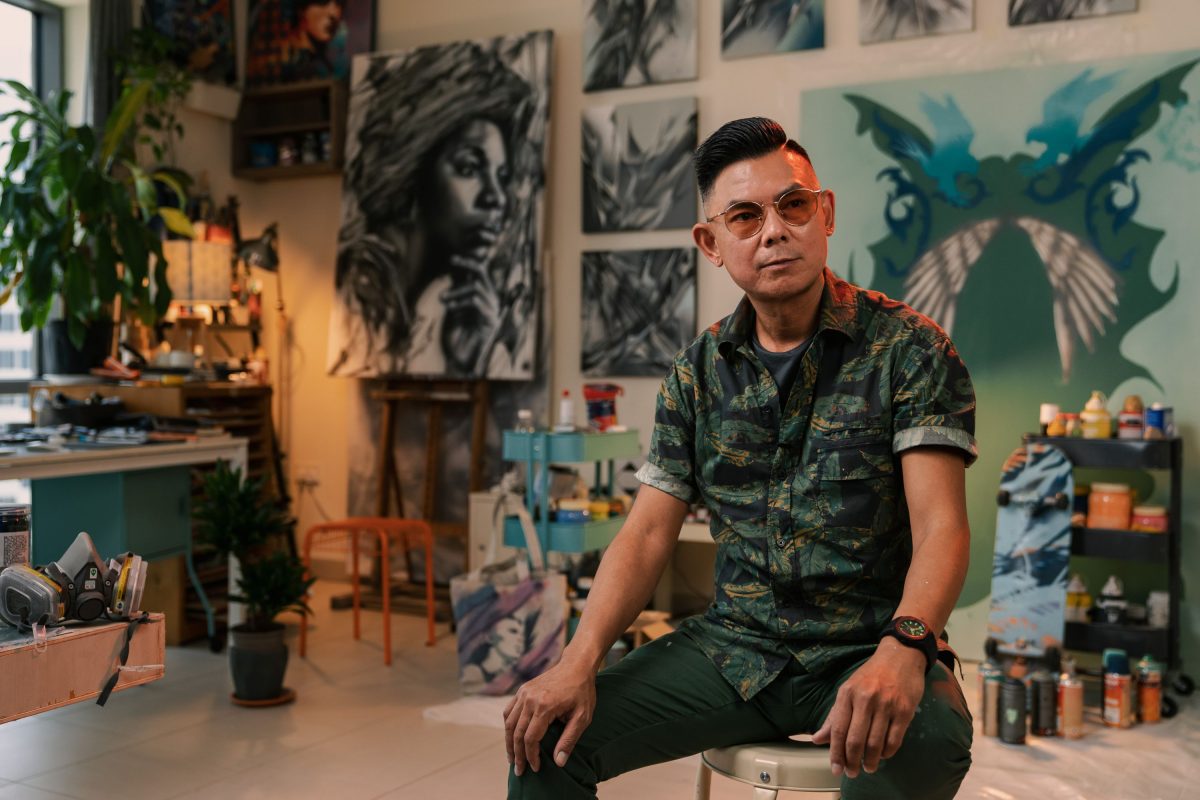
To celebrate the auspicious launch, Glenfiddich has collaborated with acclaimed New Zealand visual artist Gary Yong, also known as Enforce One. The UAE-based artist, known for his larger-than-life murals, was chosen by the brand to reimagine the lavish sleeve that adorns the Grande Couronne packaging, merging Scottish and French heritage with UAE traditions.
The collaboration is part of Glenfiddich’s new Mavericks DXB Program, in which select artists are invited to create a piece that expresses the opulence of Glenfiddich Grand Series. The program showcases the artists unique style that is representative of their country’s rich heritage and culture. Two confirmed artist partnerships will be revealed soon.
Brian Kinsman, Glenfiddich Malt Master commented, “In collaboration with Enforce One, we have elevated the limited edition experience and the design is as bold and innovative as the product itself. The artist and the product – they both share a passion for depth and distinction in creativity.”
Grand Couronne is the latest edition of the Grand Series completing the trio with Grand Cru and Gran Reserva already launched last year.
Esquire Middle East sat down with Gary Yong to talk about the collaboration.
Read our full interview below:


Gary, it’s such a pleasure to speak with you. Congratulations on this project. Glenfiddich has a great tradition, but they’ve always tried to do things that are different, things that are interesting, things that are breaking out of the box, and, following your work in Dubai, I think you’ve always had like this really unique voice to yourself, as well.
I wanted to talk a bit about your perspective, how you are approaching this, how it began. What was it specifically that attracted you to this project?
I have previously collaborated with Glenfiddich, but that was completely different from this. I think the challenge of being an artist from this region is about getting into the project in a pure, artistic way, and to be as creative as possible. It also gave me an opportunity to really turn to the nature of the geography here. That’s the most attractive thing for me going into the project.
I think it’s expected of your work that freedom is going to be really important. But before we talk about what you’re doing with this project, going back to the themes of Glenfiddich being driven by innovation, being driven by experimentation, how does that fit your ethos as an artist?
I think sometimes you don’t even think about it. I’m really lucky because my dad was a Chinese fine artist. I don’t even think about it, I would just always stumble across his tools, things that he was using back in the days. I was a child.
Going into this career, it’s almost spontaneous. I started drawing at school, entered a competition, got more interested in graffiti art, and studied graphic design at university. Each thing informed my journey as an artist. Sometimes I do stop and think about it, but a lot of the time you just keep going. It is about having that hunger to try new things, to never think that you’re good enough. In a way, to not be complacent, and just keep looking at the next thing and welcoming challenges or opportunities, and be ready for those opportunities.
I’ve even gotten into projects where I am completely nervous and don’t even know if I can deliver it. But then, that’s the beauty of having a career like this. You just push yourself. After a project, you feel like you’ve kind of gone through art school again. I’ve been really lucky living here in this region for the last eight years, as well as coming from New Zealand.
If we’re talking about the product itself and the filigree that’s on the product, there’s this amazing, gorgeous packaging that’s on the original for the Grand Couronne. The filigree was designed to mix the heritages and the traditions of France and Scotland.
You, yourself come from a mix of cultures. You’ve been living in different places in the world, you’re being informed by different cultures in the world. How do you feel that the mix of cultures inspires your work?
First of all, let’s talk about this opulent filigree design. Glenfiddich is inviting an artist like myself to go, ‘look, this is beautiful, what can you do with it?’
It’s everything that you talked about. I am from very diverse cultural backgrounds. I’m Chinese. I was an immigrant to New Zealand. When I went to New Zealand, I started studying some of the Maori culture, Maori carvings, and native designs. New Zealand is very multicultural.
To be honest, when I was reimagining this filigree design, I actually brought out all of those things–the Chinese culture, a little bit of that Maori symbols, as well as influences from the region. I designed it for the sleeve based on this knowledge without really overthinking it. It came really naturally to me. I just sat in front of the computer, looked at this beautiful original design, and I just started shaping it.
The final result is very much based on the original, but it’s also very much a visual style that I’ve been developing for a long time, and I keep bringing back out when the time is right. The time is right this time. Talking about general practice, I do always reach back to this pocket of Asian culture, and native-related visuals.
You don’t always get to pick what commercial projects come up. But sometimes a special project comes up, and you immediately know where to draw influences and inspiration from. When I get those kinds of projects, I’m definitely very excited to flex the visual style that I have.
Could you tell me more about the development of that style? What is it that speaks to you? How exactly does it manifest?
It’s constantly re-mixing things. There are no rules. I could be really interested in these old-school Japanese paintings, and the elements in this branch that I would take, and I would renew it and mix it with something contemporary.
I’m not just talking about artwork. I know musicians do the same thing. I know fashion designers do the same thing. But as a visual artist, I find this very interesting. It’s about having no boundaries. If I get a brief, I start with one idea and it just grows, and trust my instinct.
Going back to Glenfiddich, part of their ethos is this Maverick spirit. What does it mean to being a maverick mean to you? Would you categorize yourself as one?
I am a bit of a lone wolf. But I also know that to have individualism, you do need to be around people with different voices, people with different opinions, people that inspire you in a different way. I think I am a Maverick, and I do like that word. But at the same time, there’s only that much you can achieve.
For a really individual artist like myself, I have a pretty distinctive style, but I learned to use it when I need to. It’s liberating to know that I can let go and be with other people, work with other people. Because at the end of the day, if you’re going to have longevity, you have to learn a lot as an artist and you have to grow with influential people around you.
I think to be a true Maverick, you need to know when the time is to have a voice and be completely individual. We’ve all been through it. Even going through adolescence and dressing a certain way, I’ve had some crazy styles. I was influenced by the music scene. I’ve always had this individualism, but then as I’m getting older, I’m able to let that let my individualism come out in a different way, and continue to explore what that is. I don’t even think about it anymore. I guess I’m just busy trying to be me.
Once something is finally in front of people, they don’t necessarily have all context that I’m able to get in speaking to you. All they have is this piece of art in front of them. What do you hope that people take away from it without your full story?
I think people will see that that I’ve approached this project in a very free way. But at the same time, I’m very disciplined in every part of the project that I need to deliver. And for me, I don’t think there’s a lot of projects like that.
It also is paying homage to this region, and I hope people will notice that. It came really naturally to me, to be honest. Being someone from New Zealand, I’ve always been drawn to nature. I love our rainforest and our jungle, our bushes and ocean dunes and rivers and things like that naturally. So coming here, I’ve also had a huge love for the desert, and to the region’s falcons.
From the beginning, I kind of knew where to draw from, and then when I started putting them together, researching more into the meaning of the project, the whole theme about being resilient actually just formed quite late, but it all makes sense. It’s because of me having this kind of freedom, and just trusting my instinct to draw elements in, that I was able to create a cohesive theme, And visually, they all kind of match in a way. That’s something I am really appreciative of.

Esquire now has a newsletter – sign up to get it sent straight to your inbox.
Want up-to-the-minute entertainment news and features? Just hit 'Like' on our Esquire Facebook page and 'Follow' on our @esquiremiddleeast Instagram and Twitter account.