

There are perhaps few places on earth where allegiance is as fierce, stubborn, and impervious to compromise as the Autodromo Nazionale Monza. For generations, the Italian Grand Prix has operated less like a sporting fixture and more like a cathedral of red; a sacred ground where the tifosi pledge blood fidelity to Scuderia Ferrari and little else.
Yet at the most recent running of the race last month, something curious fractured that ancient script. As the weekend built to its dramatic climax, the roars of the partisan crowd began to ripple not solely for the Prancing Horse, but for the twenty-year-old Italian driver. The only problem here was he was not wearing the sacred scarlet red of Ferrari, but the silver and black of Mercedes. For decades, cheering against the Scuderia on home soil was unthinkable; suddenly, driven by national pride and an instinctive emotional spark, decades-old loyalties shifted in a second.

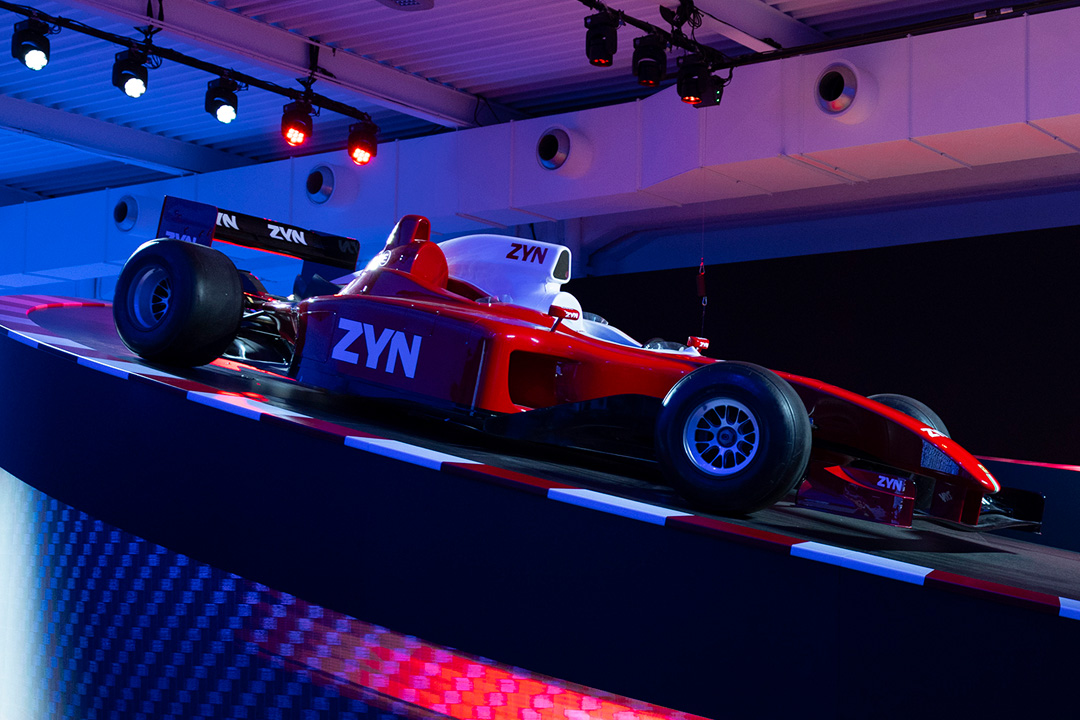
It was a telling visual backdrop for Philip Morris International (PMI) to unveil the latest phase of its presence in motorsport. The corporate bond between PMI and Ferrari dates back to 1973—a half-century-and-change partnership that is woven deeply into Formula One’s visual identity. But the narrative that has been sweeping across the paddock over the past near-decade has very much be an evolution of the past. In place of classic combustion-era branding sits ZYN, the modern oral nicotine pouch that is quickly becoming a cultural and commercial phenomenon in its own right.
“The PMI and Ferrari partnership has existed almost longer than I have been alive,” chuckles Stefano Volpetti, PMI’s Chief Global Growth Officer. “But this feels like a new chapter. Bringing ZYN—one of our flagship smoke-free products—to a new audience that is deeply passionate about sport and technology is a very important step for us.”


To understand why a nicotine pouch is adorning elite motorsport machinery requires stepping away from traditional commercial logic. According to Volpetti, the company’s objective is fundamentally misread if viewed as a simple sales exercise.
“We are not trying to sell products, we are trying to change habits,” Volpetti states flatly.
That distinction is the cornerstone of PMI’s corporate transformation. In 2014, the conglomerate announced a pledge to steer its core business toward a smoke-free future. Today, smoke-free products account for roughly 43% of PMI’s total revenue, with a stated target of reaching two-thirds by 2030. Having established IQOS as a leading smoke-free brand, ZYN represents its second major pillar, already counting around seven million adult users globally.
Yet converting a stubborn habit—especially one as ritualistic as lighting a cigarette—is rarely a matter of cold arithmetic.
“If you want to change habits, the emotional part plays an important role,” Volpetti explains. “Because if you only consider the rational part, a cigarette smoker would already be aware of the long list of rational reasons to want to change. So the trigger to change a habit has to be an emotional one.”
For Volpetti – an ardent non-smoker himself – that transformation is grounded in a specific philosophy of human behaviour. “Behaviour can change in a second,” he says. “Of course there are many moments required that build up to that decision, but the moment when you take that decision is a very valuable second.”
He draws a parallel from his personal life: “I have always done a lot of sport, and I have always had a healthy diet—but what I never really took seriously was my sleep and the quality of my sleep. So I bought some wearable tech that fed me the data and showed me the life improvement I could have if I just slept one hour more per night. The change has been remarkable on me, on my work, and on my family. But it all changed in the intention, and the decision to do something about it.”

Bridging that gap between intention and action is where the modern spectacle of Formula One enters the equation. The sport has evolved into a dynamic global platform, exploding in popularity across North America and Asia, driven by digital engagement, cutting-edge technology, and a younger, design-conscious audience.
Volpetti views the Ferrari partnership as serving a distinct triad of functions: “Creating awareness, creating access to a wider customer base, and creating an emotional trigger.”
With its minimalist circular cans, vibrant colour palettes, and spit-free, discreet design, ZYN feels native to this modern, tech-literate world. It looks and feels less like a legacy tobacco derivative and more like a sleek wellness accessory—an intentional aesthetic geared toward adults open to evolving their rituals.
“The habit change required to go from cigarettes to ZYN is a big jump, and one that the younger generation is more likely to make, because they are more open to experimentation,” Volpetti observes. “If you take a 55-year-old Japanese consumer or a 23-year-old German consumer, both of whom smoke cigarettes, if we provide them exactly the same choices, who do you think is more likely to switch? The Japanese man is more likely to think, ‘Well, I survived this far, why would I change?’”
While the appeal skews younger, Volpetti is quick to delineate between adult experimentation and underage exposure, an area under constant regulatory scrutiny: “We are also very diligent on youth access prevention, which is forbidden, not by law, but by our own practices.”
Instead, the focus remains firmly fixed on the roughly one billion adult cigarette smokers scattered across the globe. For harm-reduction advocates, shifting a 23-year-old away from combustible tobacco carries decades of cumulative public health benefits.
“We want to contribute positively to society,” Volpetti says. “When we declare that we want to go smoke-free, this means we’re focusing on switching existing smokers to alternatives. When we align ourselves with events like Formula One, which skews to younger adults, we believe there is a higher chance to switch those customers from smoking to smoke-free products—and therefore making a bigger impact from a life-health standpoint.”
Changing ingrained human behaviour on a global scale remains a steep hill to climb. Skepticism inevitably shadows any move by big tobacco, regardless of how clean the packaging appears. But the pace of change suggests something real is underway.
“There are approximately one billion smokers around the world; it is our role to give them alternatives,” Volpetti insists. “The more choice we give them, the more likely they are to switch to a smoke-free alternative. The more options you give people, the better the chance of it making a wider impact.”
As the engines cooled at Monza and the crowds eventually dispersed down the historic banking, the takeaway was clear: habits, even those anchored in decades of ritual and identity, are not entirely unmovable. It simply takes the right catalyst, an emotional trigger, and a single, deliberate second to choose a different path.