


“Go big or go home.”
This is the mantra that Huawei‘s army of engineers has been chanting over the past few months as they put together the Mate 10. The new smartphone is all-metal and all-glass, with not one but two Leica cameras, an eye-catching 18:9 screen and barely-there bezels. But it’s the tiny additional CPU that Huawei has snuck under the hood that makes it all the more special.
The Mate 10 has a separate artificial intelligence unit, that’s dedicated purely to machine learning, image recognition, and other neural networking jobs that make it more supercomputer than a smartphone. And it’s far more than a simple Siri clone…
Huawei’s AI assistant will make you a better photography, remind you of features you’re not using (but should be), as well as translate languages on the fly.
A delicious metal-and-glass sandwich
The Mate 10 effectively crams a 6-inch screen in to a 5-inch phone. It does so by having a skinny 18:9 aspect ratio screen (similar to the highly-lauded Note 8) and almost no bezels around the edge.
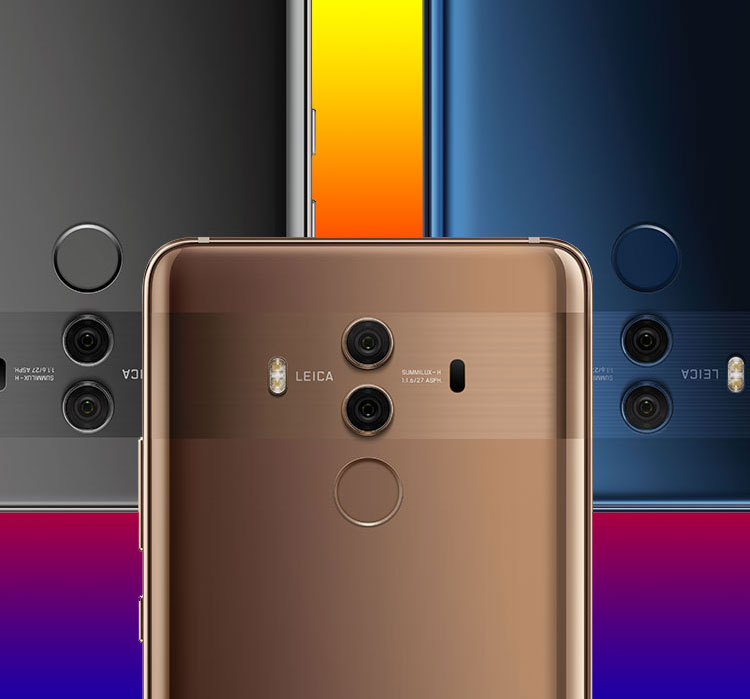
The entire back panel is made from glass, which is heat-bonded to an aluminium frame. Huawei went with curved glass so that it better fits in the palm of your hand. There are four colours, all with highly-descriptive names; midnight blue, mocha brown, titanium grey and rose gold.
The phone is IP67 water-and-dust resistant, meaning you can take it to the beach or the pool. This puts in on par with Samsung, which has waterproofed its smartphones for the past two years.
Unfortunately, that waterproofing comes at a cost. There’s no headphone jack, as Huawei ditched it in favour of USB-C or wireless headphones. While Apple, Google, Motorola and HTC have all done something similar, it’s still a tad annoying.

Screen like you mean it
The Mate 10 switches aspect ratios to 18:9, and rocks a 6-inch 2160×1080 OLED display. Huawei calls it a ‘Fullview’ display, as it has barely any bezels on either side of the screen. There’s a single main speaker down near the bottom (next to the USB-C port) which works in tandem with the earpiece speaker, supposedly providing you with the stereo side.
Resolution-wise, it’s a tad smaller than competition from LG’s V30 and the Galaxy S8+. But there’s still plenty of pixels to be had, so expect images and video to be chock-full of detail.

A smarter camera
Huawei already has great camera hardware, so it makes sense that the Mate 10 continues the tradition. Huawei has included the same 12-megapixel colour and 20-megapixel monochrome dual-sensor setup as the P10, and that’s no bad thing.
Only the 12-megapixel snapper has image stabilisation, but a 4-in-one hybrid zoom should make locking onto subjects a quick and easy affair. You also get contrast, depth, phase-detect and laser autofocus, that make taking snaps a doddle. Speed is the name of the game with the Huawei Mate 10, and everything is lightning fast.
That artificial intelligence unit also comes into play here, automatically recognizing subjects and boosting corresponding colours. Point it at some flowers, for example, and it’ll boost greens, yellows and reds to make the image really pop.

Robots under the hood
You’re not going to see or feel the AI in action while swiping through the Mate 10’s home screen and menus, but rest assured it’s there. Let’s say you’re using the phone at night; the artificial intelligence will recognize that – it knows the time and your location – and then automatically turn on low-light mode that should help you sleep better at night.
Huawei also partnered up with Microsoft, to create a dedicated version of the big M’s translator app. It uses the AI CPU’s neural processing brain for live language translation, with next to no delay.
All of this runs behind Huawei’s EMUI 8 operating system, which is a skinned version of Google’s Android (Oreo edition). It doesn’t look all that different to previous versions, with tweaked icons, a notification tray and modified settings screen.
As the screen is longer and thinner than previous models, the big addition to the OS is a floating navigation dock that will replace the physical home buttons at the bottom of the screen.
The Mate 10 also has a dedicated desktop mode, that’s similar to Samsung’s DEX. However, unlike the Samsung there’s no dock required – you just need a USB-C to HDMI cable and a Bluetooth keyboard. For now, only certain apps will work with the bigger screen, but that will change over time.
Powerful and fully-juiced
The Mate 10 is powered by a Kirin 970 CPU that uses multiple cores to handle multitasking like a champ. Huawei says the dedicated Mali G72 graphics chip is 20 percent quicker than last year’s version and twice as efficient.
Somehow, the boffs at Huawei have also managed to squeeze a giant 4000mAh batter under the hood, which should – says Huawei – be good for two days of use between charges. What we do know is the battery is significantly bigger than anything Apple, Google and Samsung offer right now.
And when it is time to charge it up, you’ll get up to 58 percent charge in just 30 minutes – using Huawei’s ‘Supercharge’ technology. Sadly, there’s no wireless charging option.

When can I put it in my pocket?
With solid battery life, camera quality, powerful hardware and smarter software, the Huawei Mate 10 Pro is a smartphone deserving of your attention. On paper, it more than outmuscles the Galaxy S8, LG V30, Pixel 2 XL, and iPhone 8 Plus.
While there are no exact launch dates or prices for the UAE launch, we’d expect it to be upwards of AED3,000. Expect it to be in shops within a month.
Get the Esquire Newsletter. Click here to sign up


