
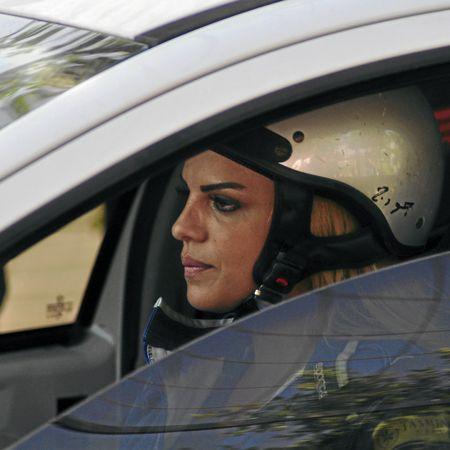

 As Marah Zahalka pulls up in the lane leading to the test circuit, her car is surrounded by male faces wanting a glimpse of the twenty-one-year-old before she hits the asphalt. Zahalka taught herself how to drive when she was twelve by watching her mother give driving lessons in her hometown of Jenin. The accountancy student has since spent most of her leisure time competing in the street races that happen across Palestine.
Organised motor sports began in 2005 when the Palestinian Motor Sport and Motorcycle Federation (PMSMF) held its first events in Ramallah and Jericho. It was recognised two years later by the global motoring organisation Fédération Internationale de l’Automobile. A five-event series of trials are now held annually on makeshift tracks in major cities across the West Bank for amateurs who compete in their own souped up cars of varying levels.
Marah Zahalka is one of seven women who formed a racing team within the Palestinian Union for Race Car Drivers, with support from the British Consulate. It’s mid November and she is competing in the season’s final street car race, taking place on a race track in the historic city of Jericho. As well as the local competitors, drivers include Jordanians and Palestinians from inside Israel.
As Zahalka waits for her turn, a re-modelled BMW from Hebron with a picture of Yasser Arafat and the Dome of the Rock on its windows is weaving through cones and drifting around turns. It leaves a trail of thick smoke and the sound of mini explosions coming from its retrofitted muffler. Spectators – mainly men – are cramped around the circuit seemingly not bothered by the noise, the smell and 30 C degrees heat. The game is on, adrenaline is pumping. Zahalka ties her helmet, sends cheering spectators around the car a smile and a thumb up and then steps on the gas.
“Why I love speed? To accelerate my life. Everyone has their own way to release pressure; when I get in the car and speed I feel free,” says Marah Zahalka a week before the race, at her home in Jenin with her family. She is the soft-spoken and, sitting on a couch wearing blue jeans, she looks like any average girl. “When she was small, Marah wouldn’t go to bed before driving her baby car,” her father Khaled recalls.
 But with the final race fast approaching, Zahalka has a problem. Her car, a 2000 cc Seat Cupra, is out of action. This time however, the damage was not inflicted by Zahalka but by her mechanic who took it for a drive and crashed it. The repair will cost 35,000 Israeli Shekel ($10,000), and the family is hoping the mechanic will admit the blame and cover the costs.
Racing has already proved to be a costly hobby for her family. There are no cash prizes, so in order to make a career out of racing rather than rely on handouts, she needs to find a sponsor like the other Speed Sisters Noor Daoud, who is sponsored by the Bank of Palestine, and Betty Saadeh who is backed by Peugeot Palestine. Luckily Zahalka can join international races. She has Palestinian travel documents, unlike most Palestinians, for whom obtaining visas to most countries is a tedious and unpredictable affair.
“I’m her sponsor,” says her father, who is a dentist, with a big grin. “I work all day and night to support her in racing.” Their support seems unconditional, as demonstrated by an ongoing house construction project that has been on hold for years. His hope for his daughter is to achieve her biggest dream: becoming a Formula 1 champion. Though that might be wishful thinking, Khaled wants her to pursue the opportunities that he, growing up in the Jenin refugee camp, was never able to do.
Marah Zahalka’s passion for cars has become a family affair involving her parents, uncle and her three brothers, one of whom is training to be a mechanic. But her involvement was not initially welcomed in the community. Khaled says that when she began racing in 2009, no one in Jenin supported her dream. The family would store spare parts for cars in the living room; guests called him crazy and criticised him for allowing his daughter to compete in a masculine sport. “That is none of your business,” her mother, named Arab, would answer. “What our daughter wants is what we support,” was her father’s standard reply.
The disapproval of society bothered Zahalka, but when she started winning races and gaining the attention of the media, things quickly changed. One day at his dental clinic, Khaled discovered that the son of his patient, a woman from Haifa, was watching one of his daughter’s race videos on YouTube. “I follow Marah all over, he told him and pointed at her picture on the wall. “Today ninety percent of Jenin supports her. Everyone knows who Marah is at her university,” Khaled says proudly.
“We have power now, and that’s important in our society,” says Zahalka. She says she feels obliged “to do everything right in an honest and truthful way,” as an example for girls from Jenin who want to follow in her footsteps. She is also considering opening a female-only coffee shop where they can play cards and smoke shisha, both of which are popular pastimes for men.
The sisterly solidarity of the female drivers exceeds borders. At the height of the Saudi Arabian women’s My Right to Dignity right to drive campaign (sparked by rhetoric from a Saudi Sheikh who claimed that allowing women to drive could “harm their ovaries”) the girls asked people to join the campaign by sending a photo of themselves and a message of support.
 “I drift. You know Fast and Furious style?” says Noor Daoud, explaining the over-steering technique that allows a driver to maintain control of the front of the car while the back wheels skid. That idea makes me slightly uncomfortable as she accelerates her beloved BMW that will take us the 100 kilometres from Ramallah to Jenin in the northern West Bank to visit Marah Zahalka and her family in barely one and a half hours. “Don’t worry, I drive normally when I have someone in the car,” she laughs, after sensing my worries.
“Hm hm,” Amber Fares interjects from the backseat. The Lebanese-Canadian filmmaker has been following the girls since 2010 for the making of her documentary The Speed Sisters and goes on to share a few of the nerve wrecking experiences she has had in Daoud’s car.
Fares’ movie tells the story of the four girls and how they entered a male-dominated Palestinian streetcar-racing scene, challenging social expectations, family dynamics, community politics and the restrictions of movement by the Israeli military occupation. The film, which Fares plans to launch in early 2015, has been supported by the Sundance Institute and BritDoc Foundation, and last November a teaser, featuring Daoud racing, ended up on Madonna’s Art For Freedom website.
Noor Daoud is one of those Speed Sisters and is also the only female drifter in the Middle East. She has risen to prominence as a result (and has seventy-thousand Facebook followers) after competing in many races abroad including Dubai, Croatia and Hungary. At her first drift race in Jordan in 2010, where she reached top ten among thirty male drivers, she was so overwhelmed by the scene and the thirty-thousand-strong audience who cheered for her, that she shed tears.
As Daoud lists the engine specs of her car, a 328i E36 BMW with 800 horsepower, I process these facts from the long curly-haired beauty wearing tight camouflage pants and a black slim-fit shirt that reveals a well trained body. “Wow,” I reply, but the truth is, I know very little about racing and don’t even have a driver’s license. I confess this fact and she laughs.
Israeli settlements, checkpoints and military zones fly by as we speed on roads prohibited to West Bankers but that Noor, with her Jerusalem ID, can drive. She tells me she was ten-years-old when she started driving her mother’s car. This was in Texas in the U.S. where she was born and where she has lived on and off since her parents’ divorce. At the age of six, she went with her mother to her hometown of Jerusalem where she later opened up an Italian clothing store with high class brands.
But it was during the First Intifada [uprising] and their house was surrounded by four checkpoints. Daoud quickly became familiar with the Palestinian reality of restricted movement, but she was lucky. The American passport and family money allowed her to attend high school in Switzerland where she excelled at various sports genres such as ice hockey, tennis and swimming. She also attended the IMG Academy in Florida, (where Serena Williams is an alumna) and the Wingate Sports University in Netanya, Israel. Today she uses her personal trainer certification to work at gyms in Ramallah.
But her highest passion has always been cars, and she tells me of her ambition to learn how to repair and remodel her cars, join more international races, and attend the Prodrift Academy Middle East in Dubai to improve her skills under the instruction of professional drift competitors
“All respect to my husband and to Marah Zahalka’s father,” says the mother of thirty-two-year-old Betty Saadeh, from Bethlehem, who was the fastest woman on the Palestinian circuit in 2011.
Like the Zahalka family, Betty and her parents and brothers are waiting for the Jericho race to begin and are picnicking in the shade. Her brother waves away a ring of guys hanging around the car wanting photos with the blonde Speed Sister in her blue racing outfit and orange painted nails.
 “Many girls now want to race in Bethlehem but their families refuse,” Betty’s mother continues. “You want to be with the men? ‘You will never get married,’ they say.” She shakes her head in disappointment. “They have opened the door for other women,” says Betty’s cousin, Dina, who is visiting from Las Vegas. When she left Bethlehem eighteen years ago, there was nothing like this happening.
Betty is the third racer in the family. Her father, whose family fled to Mexico in 1948, and where Betty was born, has won several rallies in the Mexican desert. Her brother George has won the last few races in Palestine. “I really respect them [the Speed Sisters], they achieve better results than a lot of the guys,” he says.
Although she has a Mexican passport, Betty’s driving stops short at the checkpoints. Her West Bank ID is written in her passport, so like most racers here, she can race in Palestine and abroad, but not in Israel.
Noor Daoud can race on the other side of the border, but her BMW is in Jordan and she is not allowed to bring it to Israel, so she won’t be driving in this race. Instead she takes a spin on one of the motorcycles of The Jerusalem Motorcycle Association who used the event to organise a bike trip for its members. Many of the men turn mute as they watch her take off on the sports bike, her curls waving in the wind.
Meanwhile, two women dressed in traditional Palestinian embroidered dresses, accessories and wide smiles, stride across the lawn to the tarmac. They are the mother and grandmother of Mona Ennab, a veteran Speed Sister and the first one to compete with Palestinian male drivers.
Through making the film, Amber Fares says she realised the extent to which racing in Palestine is a family affair. “They definitely wouldn’t be able to make it without the support of their families,” she says. “Given the high costs of racing, the girls either have to come from families of relative means or have parents dedicated to saving up to cover the costs.” Fares also initially assumed that men would be restricting the aspirations of the girls, and was surprised to see how much the girls were supported by the male members of their families and how much respect they receive from their male peers.
Indeed the faces of Marah Zahalka’s family are glowing with pride when she receives two trophies for ranking number ten out of forty-five fastest drivers (with 1:19 sec; the first is Jad Nabbas from Jordan with 1:11) and for being the female winner of the season.
“She should follow her dreams,” says her father. As long as we are in good health and keep working, I won’t stop supporting her in becoming a champion.”
By Janne Louise Andersen