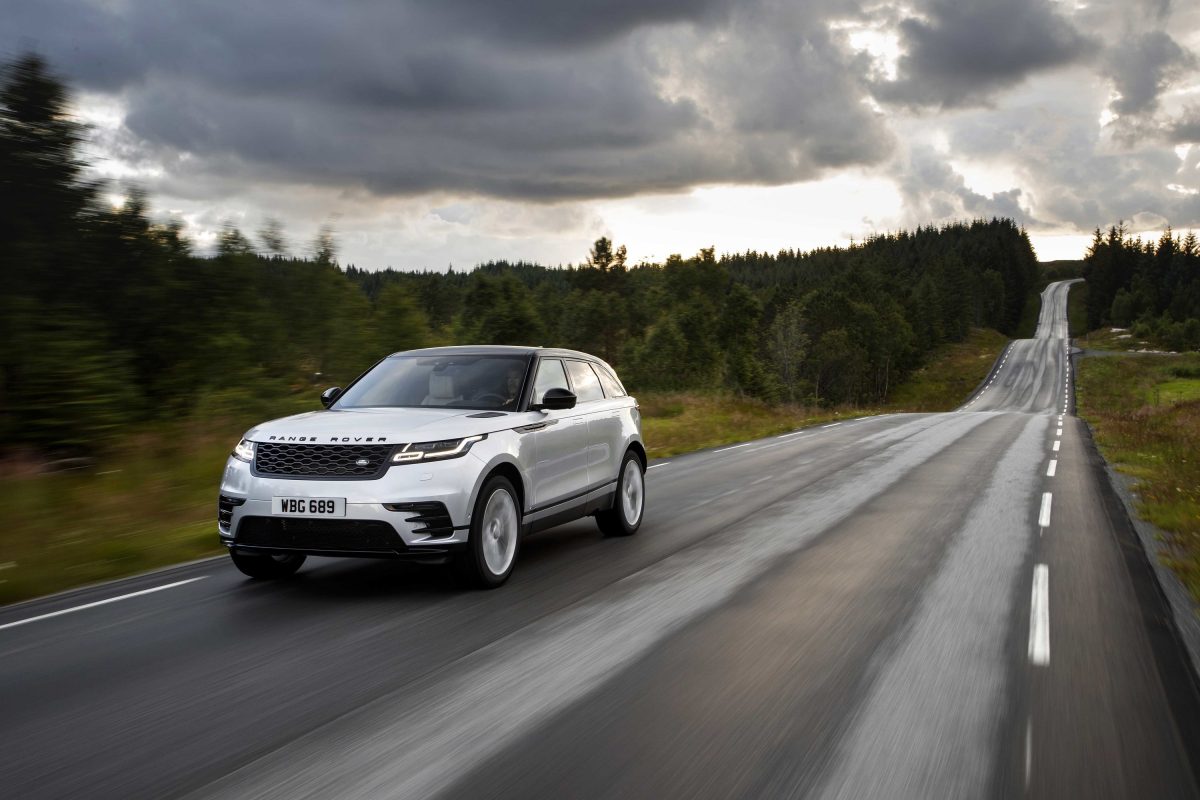

Although many have tried, few have succeeded in producing a big and bulky SUV with genuine style. Over the years we’ve used terms like ‘well-proportioned’, ‘slick’, ‘menacing’ and ‘bold’; but never have we described an SUV as, well, beautiful. Until the Range Rover Velar.
Deciding that there was a need for a middle-sized Range Rover in the, er, range, the Velar is the fourth member of the family slotting above the smaller Evoque and below the Range Rover Sport.
Looking to exploit this seemingly empty space, Land Rover chief design officer Gerry McGovern has produced a car that is polished, tactile and desirable. It looks pretty and feels at home in the era of the technophile. Immediate evidence of this is the retractable door handles that rise out of the body when you unlock and sink back in when either locked or it exceeds 5mph. Sure, it’s function is mainly cosmetic but it is one that you will probably never tire of showing off to others.
While it does have the same genetic make-up of its siblings, its smooth, pared-back and slimmed-down style takes priority over absolute space or off-road ruggedness. The exterior design looks like it was carved out of wind with the grille, lamps and bumper all meticulously flush. It’s rare to see such a design-led and emotional approach to a practical product executed so effectively. It also looks really good resting on a big set of wheels.
But good-looks aside, the Velar is also built to be the most dynamic model in the range, borrowing elements of the others, but careful not to encroach. It feels very Range Rover-y to drive: smooth and calm with light steering, and—despite evidence to the contrary—
it doesn’t feel as quick as it claims to be.
Available with a choice of six different engines (three petrol, three diesel) and a big price range of AED210,000 to AED435,000, the top-of-the-range 3.0 V6 petrol model is no slouch, doing 0-100kph in 5.3 secs.
Size-wise, it is more spacious than the Evoque and less beefy than the heavy-duty Sport or Full-Size, and while it doesn’t have the high-up seating position that many Range Rover fans like, it does have decent ground clearance to keep you out of trouble when you’re off road. Although, we can’t help but feel that perhaps the closest many potential Velar owners will come to actual off-roading, might be the gravel path leading up to their multi-car garage.
The cabin is even more of a revelation, thanks to an all-new glass cockpit system for the displays and controls. It looks ultra-modern and the Windsor leather perforated seats are utter luxury and come with in-seat massage and cooling options. But the hero of the interior is the rather lovely digital control system. Headed up by two 10-inch screens (and full-digital dash)—the fact that there are very few analogue knobs and buttons show that it is clearly designed for the glued-to-smartphone generation.
Speaking of tech, the Velar’s infotainment, driving modes and HVAC systems are all operated from the very user friendly interface. It also includes Land Rover’s clever off-road technology named ‘Terrain Response’ which despite lacking the low-ratio transfer box of the Sport, the system electronically distributes the power between the vehicle’s wheels to make maximum use of the available grip. It also has All-Terrain Progress Control, which is essentially cruise control for off-road, allowing the driver to concentrate on navigating tricky landscape rather than worrying about the pedals.
When the hugely popular original Range Rover was introduced in 1970, it was comfortable and practical, just as at home in town
as in the countryside.
It seems that in 2019, according to the marque, the Velar is the modern day version of that.