

Despite the outright denial of the current threat of climate change by some – here’s looking at you President Trump – most countries are making serious inroads into battling the harmful effects of human pollution.
According to the Organisation for Economic Co-operation and Development (OECD), “The United Kingdom has invested $22.5 billion on environmental protection in 2010.” Other initiatives include Switzerland’s Green Cross campaign, the European Union’s Emissions Trading Scheme and Climate Change Programme, the introduction of a Carbon tax in Australia… and that’s just to name a few.
On a micro level, whether you re-use a paper bag, drive less, plant a tree, eat less meat or even switch off a light bulb, it all counts.
In recent years, issues of global warming and air pollution have been a burden on auto industries for a while now, and therefore solutions are in the works. Large-scale research has gone into the potential use of solar and electric power as alternatives.

Tesla’s charismatic CEO, Elon Musk, believes that “50 percent-plus of new cars will be electric in 10 years”. Other industries have started to follow the Tesla initiated movement, the most recent of which is Chevrolet. The goal of electric vehicles is to cancel out the ill-effects caused by the emission of fossil fuels, as well as providing efficiency while keeping the costs low for consumers.
Drivers can charge their cars at home. With no additional costs of petrol or oil, you save your cash and your planet at the same time.
From the use of satellites in transmitting TV signals, and in powering navigation systems, we’ve seen technology running in space.
But could space technology also help in electric vehicles?
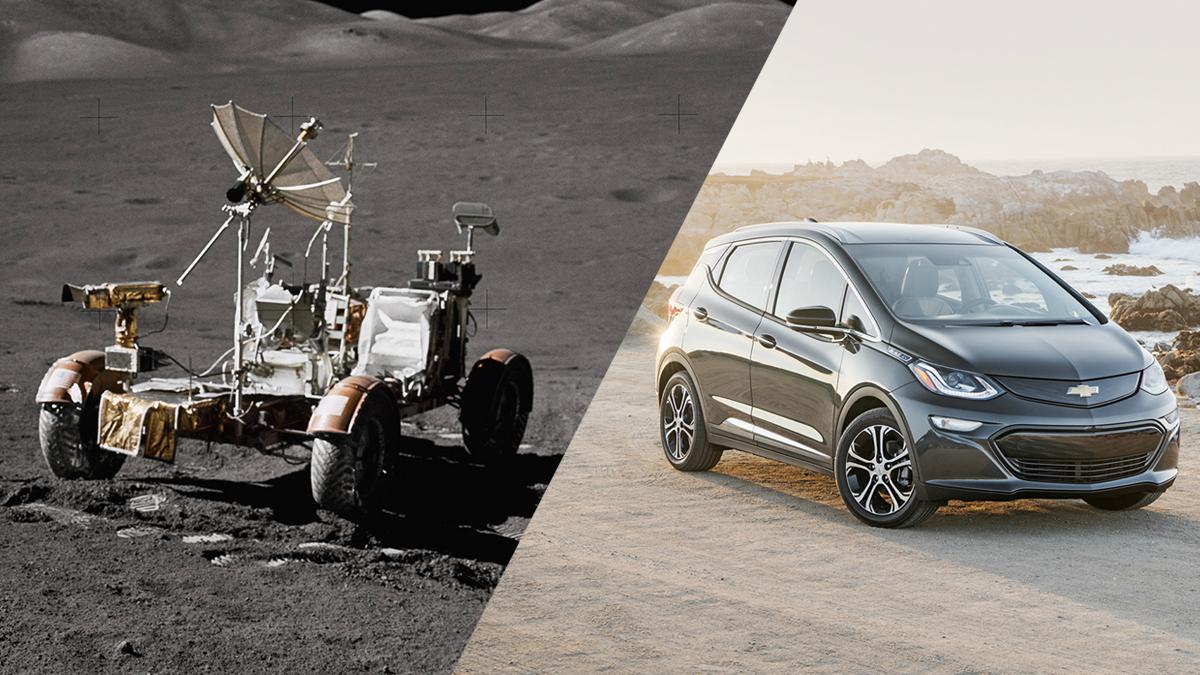
GM writes, “The same innovative spirit that drove the company to engineer an electric vehicle for the moon lives on in the Bolt EV. Except today’s EV drivers don’t have to wear space suits.”
For the anniversary of the July 1971 moon landing, Chevrolet releases the latest Bolt EV; Tesla and Nissan Leaf’s most recent competitor.
One main problem that most earlier releases have had was the short battery life.
Technology used once on Lunar Rover space ships has now been implemented on the latest addition to Chevrolet. With a mission of creating the most splendid experience to their consumers, Chevrolet was successful in creating the first long-range, affordable electric car.
GM had its hands in the development, design, and testing of the first ever Lunar Rover. The fact that it was an EV helped them big time.
Experiences gain in the 1971 creation and with the help of partner companies, the automaker was able to successfully create a brand-new electric motor drive system, suspension, and mesh wire wheels, along with a special drive controller to work with lunar gloves.
Comparing the Bolt to Tesla and the Nissan leaf, the Bolt has introduced a DC Fast Charging CCS port that enables much faster charge rates, providing a full charge to compatible electric cars in fewer than 30 minutes. In addition to a maximum of 383 km (238 miles) range in the Chevrolet Bolt compared to the 170 miles of competitors; the new Bolt could become Chevrolet’s new money maker.
Will we really see the world go green any time soon? And if we do, will space technology be a driver of that change?