
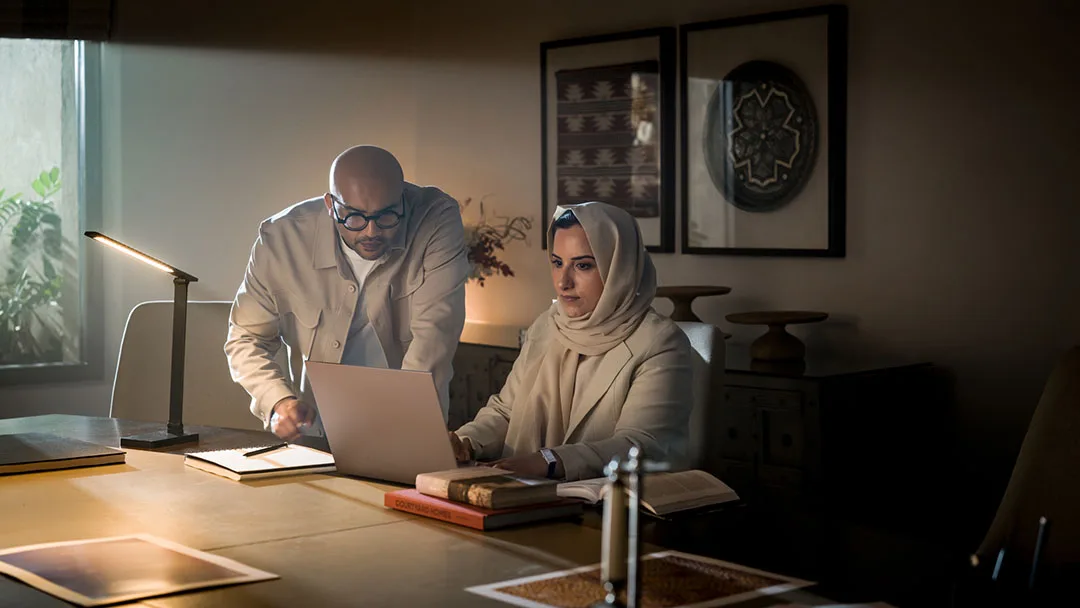

Balancing the past with the future is a constant challenge in design. The tricky balance is often how to honour tradition while embracing the new. As we celebrate the 200th anniversary of photography in 2026, this question has shifted to the digital world. With the rise of Artificial Intelligence, we are now forced to reconsider what it truly means to create an image.
“What does photography become when the line between captured and generated begins to blur?” asks Emirati photographer Hussain AlMoosawi. This question sits at the heart of Bridge in Time, a new artistic collaboration commissioned by Jaeger-LeCoultre.
Launching during the Holy Month of Ramadan, the project sees the Swiss watchmaker bring together the tangible heritage of the Middle East and the limitless possibilities of digital art.
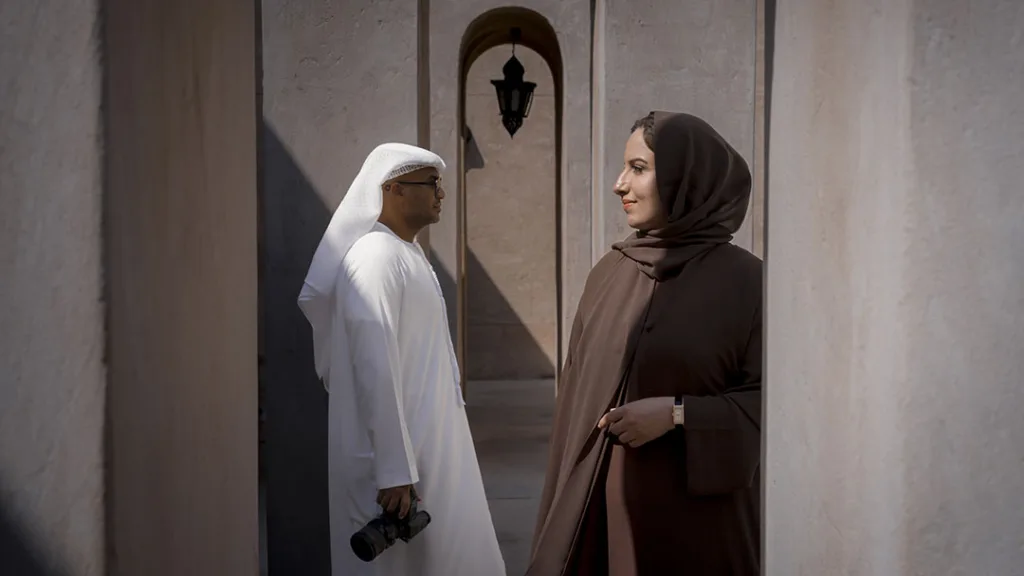
The project brings together two unique talents from the region: AlMoosawi, a photographer who documents the UAE’s changing cities, and Mona Algwaiz, a Saudi digital artist who blends history with technology. Together, they have built a series of artworks that feel like real spaces rather than just pictures. They describe it as a “dialogue across time,” where the past isn’t just history—it is the starting point for the future.
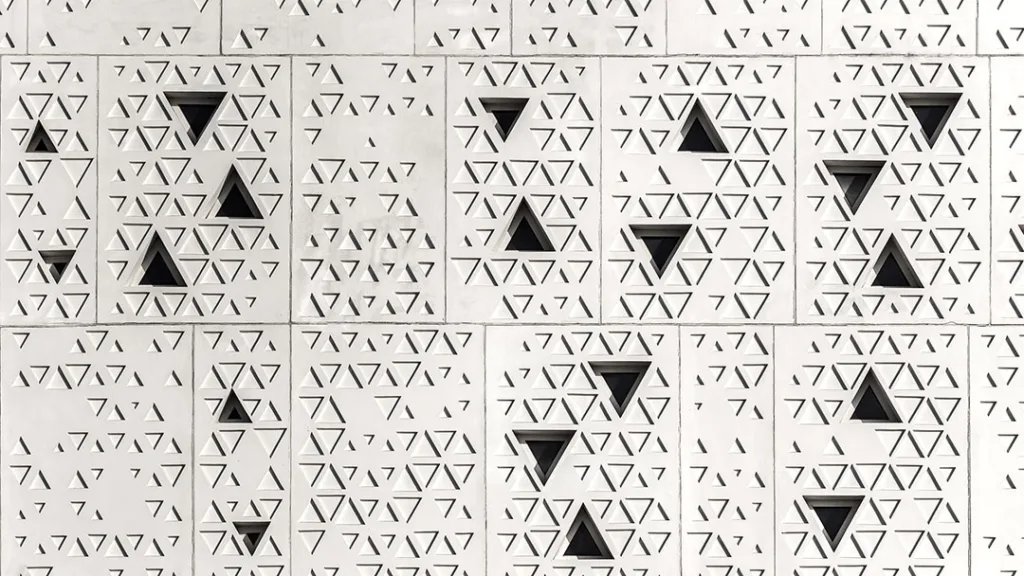
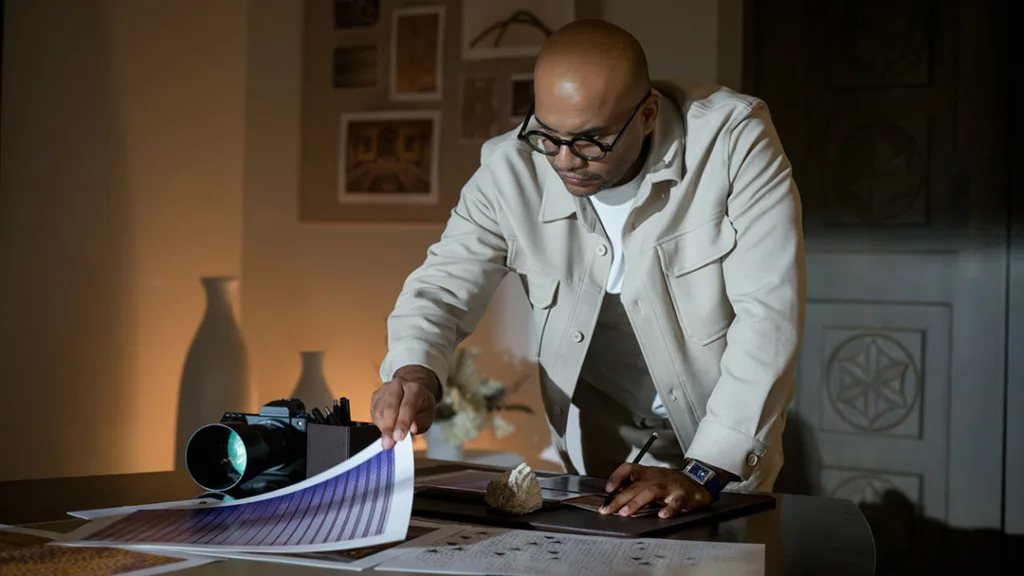
For AlMoosawi, the work starts with the real world. With over 20 years of experience, he acts as the project’s anchor, grounding the art in reality. His camera captures the true look of the region, focusing on traditional details like arches and patterns that define the local architecture.
“I began with Dubai, not as a skyline, but as a memory,” he reflects, describing a process that is less about panoramic spectacle and more about intimacy. “I followed the light across arches, patterns and lines echoing the culture of the Arab world”.
AlMoosawi, however, views the architectural identity of the region through a nuanced lens – one that is less about rigid preservation and more about fluidity. “We don’t have loads of ‘classic’ architectural styles that are specific to the Gulf region – we are not North Africa, for example – so most of what we already see in place like Dubai are already reinterpretations of those styles,” AlMoosawi explains. “I find that quite liberating as a photographer because the subject isn’t static, it is actually documenting a journey that has already begun.”
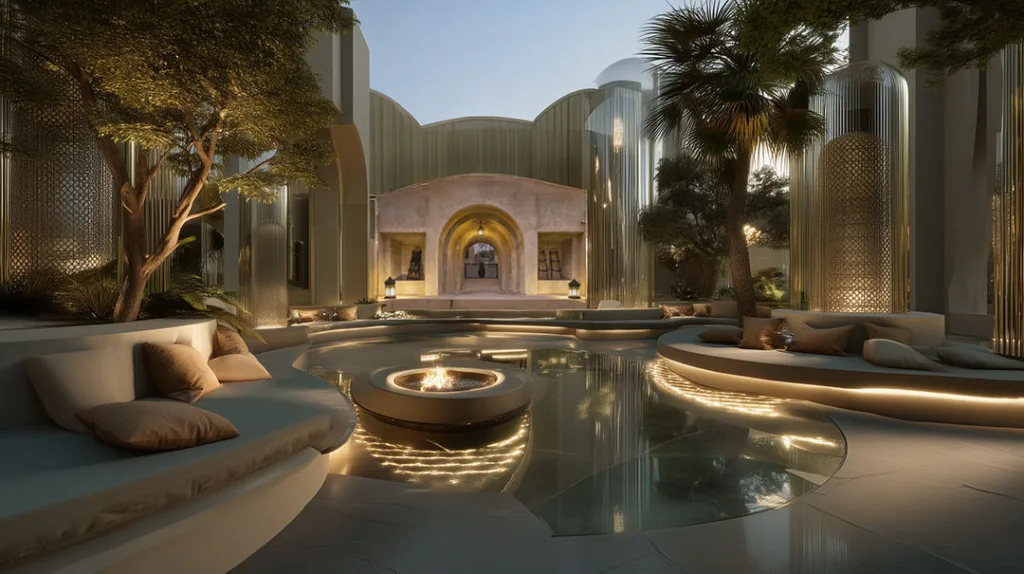
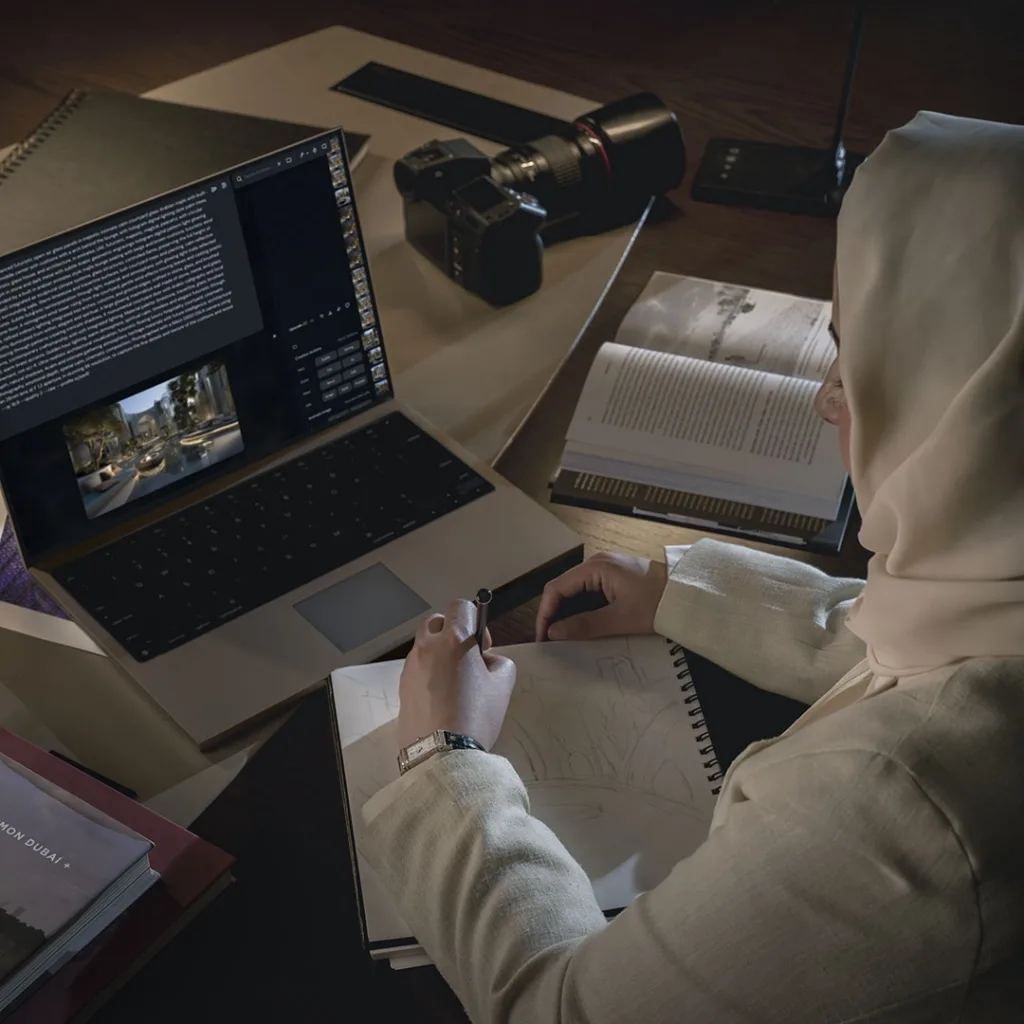
If AlMoosawi documents the structural bones of what has already happened, then Mona Algwaiz provides the speculative elevation. Once the fragments of reality are captured, Algwaiz employs AI-assisted practices to expand the frame. She does not simply alter the photographs; she projects AlMoosawi’s archival motifs into vast, futuristic environments.
This collaborative dynamic required a surrender of control that is rare in photography. “My work focuses on documentation, research and making sense of space. As an artist, I try to make sense of what we see,” AlMoosawi notes. “What I enjoyed about this project was that my work was less about showing the world from my viewpoint, but rather it being used as a point of departure for Mona to create something from.”
“People can be quite sensitive to altering things that are ‘classic’, but, for me, I find it very interesting to offer a new viewpoint of traditional architecture or heritage,” says Algwaiz. “What would something classic look like in a more futuristic setting, or can we imagine watching it evolve.”
The result is what the artists term “immersive picturing”—a fascinating evolution of the medium where the image ceases to be a flat surface to be viewed and becomes a volumetric space to be entered. “I loved how blending traditional architecture with the futuristic is very related to the concept of the bridge of time,” says Algwaiz. “The core remains real, rooted in heritage, and then the future grows around it”.
The collection manifests as five distinct “worlds,” each anchored by a historic or symbolic architectural element. There is The Courtyard, inspired by Bab Al Shams, representing the communal focus of hospitality; The Threshold, drawing from the Expo Portal to mark intention and transition; and The Bridge, a nod to the Infinity Bridge, symbolizing the transmission of knowledge between generations. Perhaps most evocative is The Coral Wall, which reimagines the UAE’s historic use of coral stone not as a static fossil, but as a living, regenerating form, and The Mosque of Light, which anchors time through spirituality and unity.
For Jaeger-LeCoultre, the collaboration is an extension of their own philosophy—one where “classic” is not a static designation. As Chief Marketing Officer Matthieu Le Voyer notes, “True classics were disruptive in their time. It is only history that later anoints them as the standard”.
To bring this concept to the public, Bridge in Time will be presented as a public art installation at Dubai’s Nad Al Sheba Square.
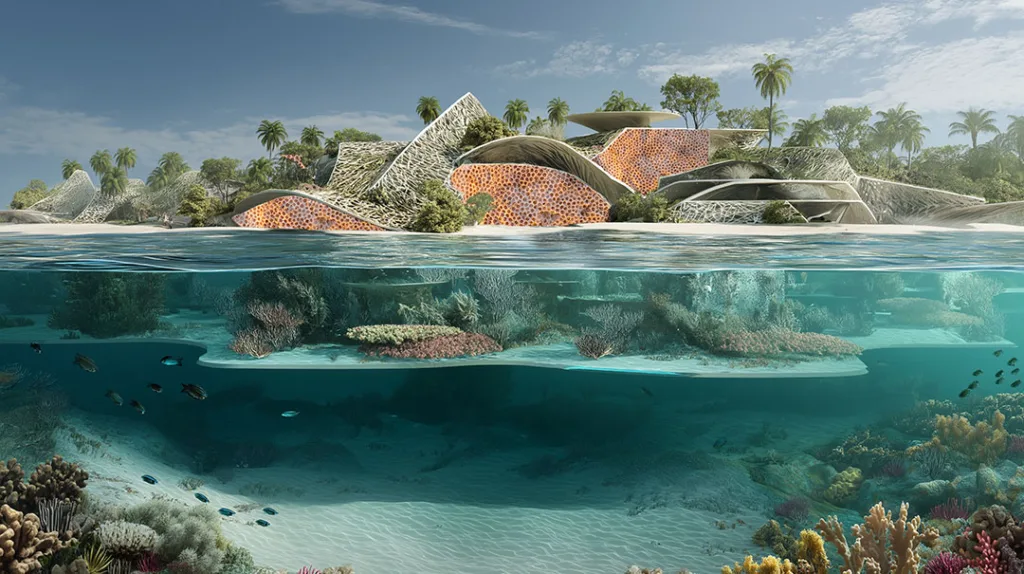
Conceived as a curated journey, the installation invites visitors to traverse these five hybrid worlds. Running from March 5th until Eid Al-Fitr, and open daily from Iftar onwards, the exhibition juxtaposes these large-scale digital works with a selection of Jaeger-LeCoultre’s Reverso timepieces.
In a square known for its cultural energy, the installation offers a moment of pause. It is a reminder that whether through the mechanical beat of an escapement, the shutter of a camera, or the algorithmic dreams of artificial intelligence, we are all engaged in the same human pursuit: the attempt to capture time, and in doing so, to understand our place within it.