
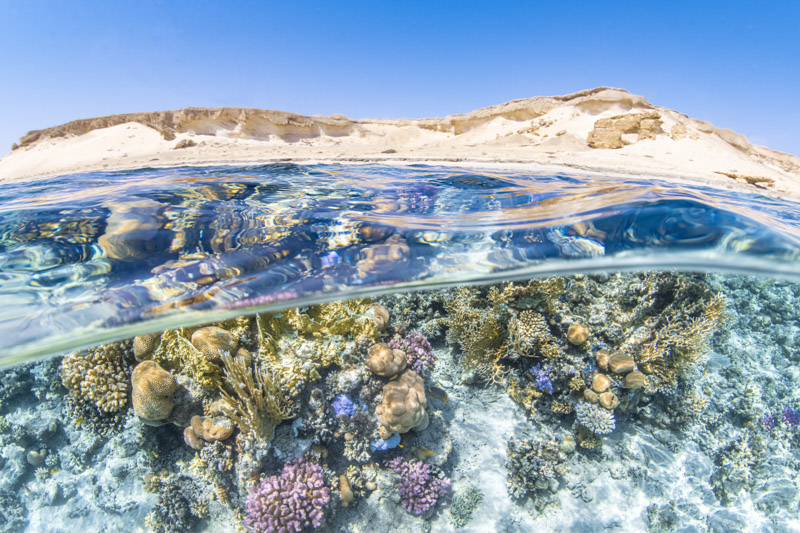

West of Al Ula, 4 km off the Red Sea coast of Saudi Arabia, lies a place simply called ‘The Island’.
It’s a part of a 4,000 sq/km area called AMAALA, which is currently being developed into a sustainable wellness paradise marked with zero-carbon footprint–one of the huge projects that marks the future of what the Kingdom is set to become.
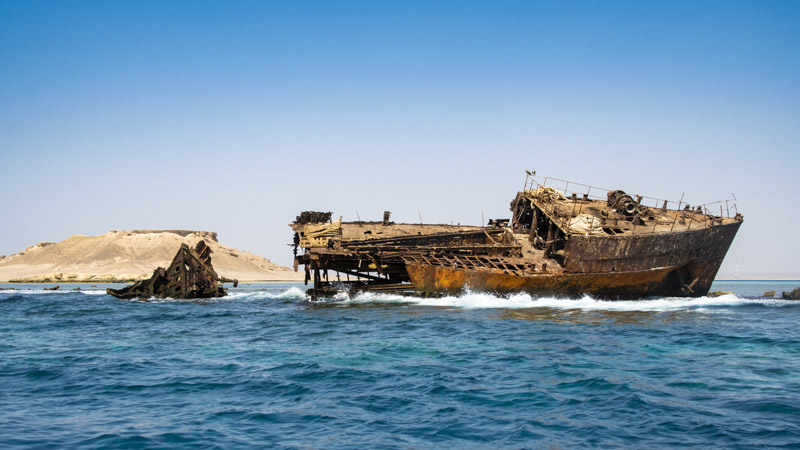
The Island, however, is unlike anything else you’ve seen from Saudi Arabia, a treasure trove of coral reefs, marine life, untouched flora and fauna, and even a shipwreck with a mysterious backstory–all waiting to be discovered.
To learn more about the area which will be open for visits soon, we turned to Warren Baverstock, Senior Marine Life Director, at The Red Sea Development Company & AMAALA, who took us on a 24-hour journey around The Island, to experience the quiet majestic drama of an untouched land and seascape that holds an abundance of nature’s most precious treasures.
Read Baverstock’s account below.
Setting off early in the morning I had a clear mission in mind: to introduce three perfect diving sites to a delegation from the Saudi Dive Federation (SDF) who were accompanying me that day. The beauty of The Island is always breathtaking, and it was particularly striking that morning. The orange glow of the sunrise was reflected on the surface of the sea, and as the sun began to inch its way above the horizon, the morning had an atmospheric auburn hue. After checking in with the coast guard, it is just you and whoever else you are with, as we were going to be exploring untouched territory, the coast guard would be the only other people we would see.
The first thing I was eager to show the SDF team, was the diversity of the incredible coral reef that could be found on the southern side of The Island. It’s a very special and unique profile to dive, with the rich, dense corals on the gentle reef which slopes down to a dramatic 30 meters. The condition of the coral reef is incredible, and this beautiful habitat is home to large shoals of fish, tiny critters and reef sharks. Due to my packed schedule for the day, I limit our dive plan to only three dives as I was due to meet scientists later that evening to help out with the turtle tagging initiative.
After the first dive, our surface interval was spent at The Island’s Eastern Bay. It was here in this beautiful and tranquil spot that I had a magical encounter with Eagle Rays. It was a rare and a wonderful moment to come across where the three large fish, with their distinct spotted backs were cruising along in the shallows of the bay which could have been for hunting or mating purposes. Crouched down in less than half a meter of water, it was an extremely rare treat to encounter these majestic creatures up close and watch them swim by without being disturbed by my presence. Having close encounters with special animals like these is a truly privileged experience.
Shipwrecked at a Vantage
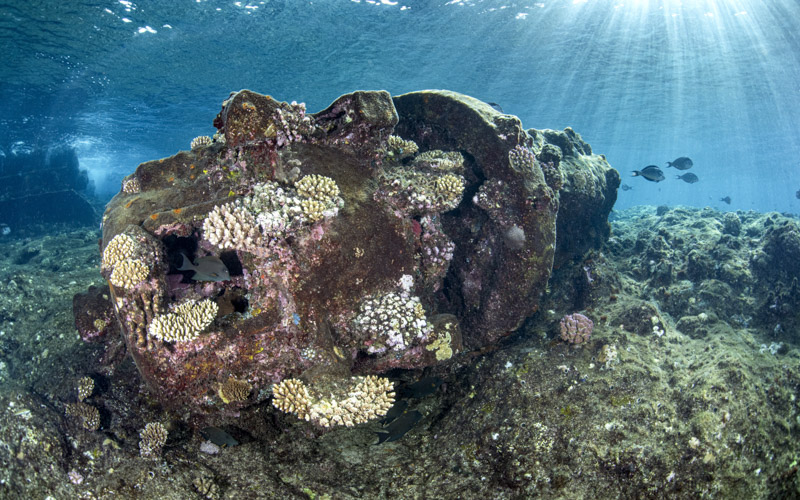
For the next dive, we moored off the southern tip of The Island. There, on the southernmost point, is a shipwreck that sank around 1969. It was washed ashore and is now a haven for a wide array of fish and marine birds including nesting Ospreys. This wreck has served as a huge advantage to the local wildlife. The Osprey use the part of the shipwreck that juts out of the water as a vantage point, so they are high up and can easily survey the sea and surrounding area.
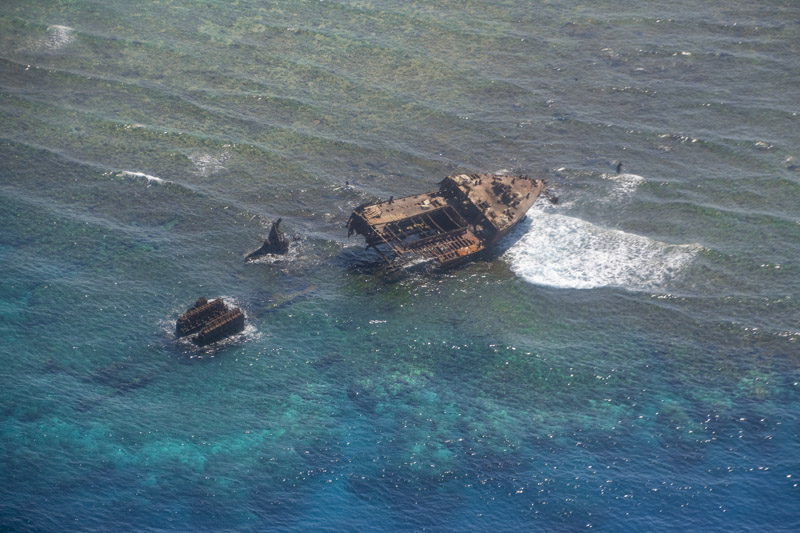
They swoop in, catch fish and bring them back to the vessel to dine on their prey. Herons are also plentiful on the wreck grazing on the small fry that use this artificial reef as a nursery. When your boat pulls up at this dive site, you are surrounded by crystal clear water, gazing into the water you can see all the way to the bottom with the different shoals of fish swimming around. Again, it’s a perfect dive profile and whilst down at 25 meters on a sandy bottom peering up to the surface and the sun cascading down over the healthy reef you cannot help but be overwhelmed at the beauty of this special place, what more could you want?
Warren vs The Humphead Wrasse
At the third site during our last dive, something incredible happened. I encountered five Humphead Wrasse – so called because of the huge bulge on their foreheads. They are gigantic coral reef fish that can live for over 30 years and can grow to 180cm long. The Humphead Wrasse frequent coral reefs looking for their favorite foods, all of which have hard shells like mollusks, crustaceans and starfish.
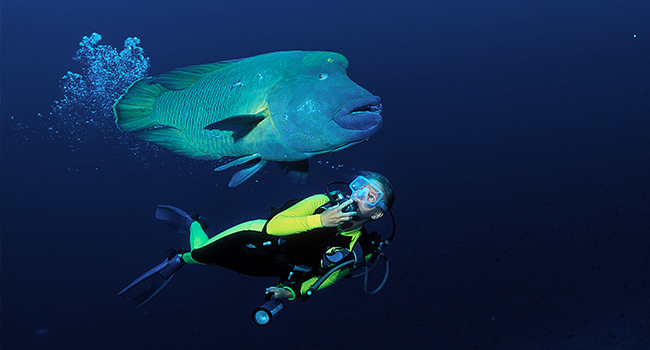
It was a pleasant surprise to encounter these fish as they are very rare. While I was photographing a coral reef along with a beautiful shoal of anthias, I slowly became aware of a large Humphead Wrasse off to my right. They are particularly sketchy at the best of times, and as soon as you show them any attention, off they go. I thought to myself, “I am not going to be distracted by you, you can wait. I am just going to ignore you,” hoping all the while that it would stay. I had already prepared for my shot and was focused on my subject; a large pinnacle of coral surrounded by fish. I took the photograph, and when I turned to my right, I saw some very weird behavior from the Humphead.

It was skittish but at the same time being quite territorial. Then I noticed something move to my left, turning around I saw a large female plus three juveniles – all females. Only the male Humphead has a hump on his forehead but if for whatever reason that male disappears, the largest female of the group turns into a male, which is an incredible feat of nature. To see one Humphead Wrasse at a dive site is very special but to see five is just incredible. It absolutely made my morning and I left the dive site feeling very lucky to have had such an amazing encounter.
Darkness creeps in and the show of a lifetime begins
In the evening, I met up with a group of scientists from the King Abdullah University of Science and Technology (KAUST); one of our key environmental partners. Their mission that night was to tag the nesting green turtles that frequent The Island. The temperature was beautiful with a lovely fresh breeze when we set out to patrol the southern beaches. We quickly began seeing turtle tracks identifying where a turtle had travelled up the beach, decided that the spot they had come across was not a suitable place to nest, so had turned around and made their way back to the water. They normally stay in the water for about an hour and then come out in another location. As we were walking along the southern part of the beaches, we saw several large tracks leading out of the water, indicating the presence of female green turtles who potentially could be around 70-80kgs in weight. We combed the beach looking for the turtles that had ventured out in the darkness to start laying their eggs.

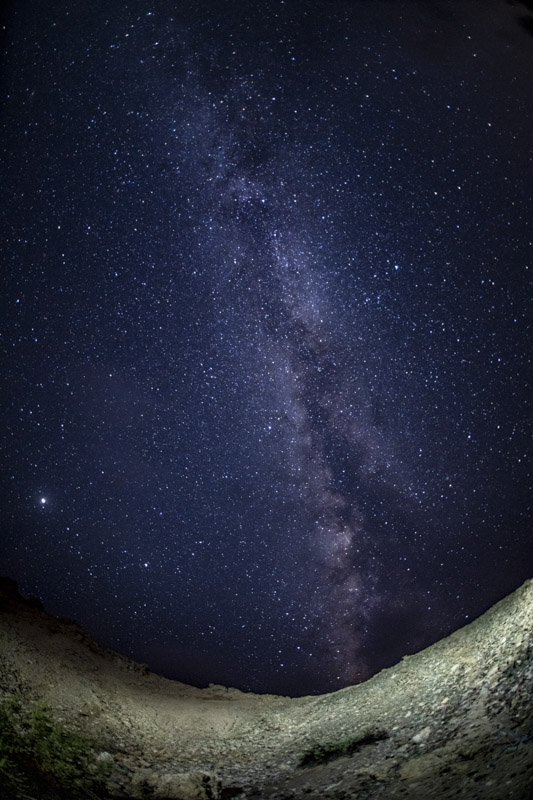
As it gets darker The Island takes on a totally different feeling. The wind dies down completely, and it is so quiet you can hear the gentle lapping of the waves against the beach and the call of birds. As you look up into the sky, there is zero light pollution and you are exposed to a magnificent, uninterrupted view of The Milky Way. As the night progresses, there is a rotating view of a whole showcase of stars which simultaneously illuminates The Island while you are looking for the sea turtles.
Eventually we came across a nesting female as she was travelling up the beach. Even though she decided she wasn’t going to nest at that point, we made the decision to attach a satellite tag to her, which is a process not short of challenges! For a short period of time we hold the sea turtle to prevent her returning to the water.

We prepare her shell by sanding it down so that it can house the satellite transmitter which we fix to the shell. After we had fixed the tag, we allowed her to continue her journey back to the sea, and 48 hours later she returned to the same spot and proceeded to lay her eggs. The perfect end to a perfect trip!
Saudi Arabia’s natural state
I have a deep love for this place, and I am grateful to be working for a company that is conscious about making the right choices when it comes to development. Coastal developments, by their very nature, have historically negatively impacted ecosystems and created stress on marine environments. AMAALA is hugely different in terms of its overarching regenerative approach.
Our coastal developments will have the opposite of a detrimental effect and go further than simply maintaining the status quo. We are utilizing our projects as a means to actually improve the environment, as we aim to contribute a 30 percent net conservation benefit by 2040 in our project areas.
Our projects are a seed of life that will make the biodiversity of our Red Sea destinations thrive. The net positive expansion of Saudi Arabia‘s green and blue habitats will encourage biodiversity to flourish and is an essential contribution to the global fight against the climate and ecological crises. We will leave an invaluable legacy for current and future generations to come.