

In his new book, Brendan Whittington-Jones chronicles the incredible story of one of the most inspiring animal rescue stories of all time. Here is an exclusive excerpt from The Accidental Invasion of Baghdad Zoo:
Lawrence and I stood in the shade of a tree outside the hotel gates discussing the contrived absurdity of our surrounds and the zoo initiative. The early morning heat was quickly gaining in oppressive intensity. I inspected the clusters of bullet holes ripped through the nearby lamp posts. Soldiers, wrapped up in bulky body armour, sat awkwardly on chairs behind the razor wire at the gates, staring out towards the road. The sticky residue of a removed corpse still stained the concrete pavement slabs next to us in a profile that was undoubtedly human. Apart from that, there was an unexpected serenity in the stillness. Then the deafening half roar, half whine, of the 1500 horsepower gas turbine Abrams tank engines firing up in the adjacent tree-lined parking lot reverberated through our bodies. The ground rumbled as if it had indigestion. The tracks of the 60-ton beasts rattled and clanked as they manoeuvred their massive, squat, angular, armour-plated hulls out the hotel entrance checkpoint, past us hitchhikers and on their way to patrol the city streets. The helmeted young battle veteran standing in the turret raised a thumb in greeting. As the clatter faded, the orange and white Chevrolet Caprice with the word “ZOO” emblazoned in black tape on the hood drove up to us.
Stephan Bognar, a field agent for the NGO WildAid, stepped out the passenger side, immaculately dressed in combat trousers, a white t-shirt and black baseball cap. His tri-athlete physique and groomed features stood out from the less urbane surrounds. His welcome was overwhelmingly charming, and his vibrant character immediately apparent. In time he would be my reference into the world of the everlasting expatriate; caught in that compelling space of conservation ambition and philanthropic aid in remote areas, reflectively thinking of normal life back home. A Canadian, he was based in Cambodia working on rural development projects. While on assignment in Israel he was issued with new instructions to get to Baghdad Zoo. He seemed infinitely resourceful as he described the ease of travelling to neighbouring Jordan and then securing a taxi to Baghdad – as one does during a war. He had moved by road under the shield of the imposingly built, broad-bellied, boldly moustachioed, street-savvy taxi driver Mohammed Ali. Ali, by a twist of circumstances and the arrival of a polite Canadian with U.S. Dollars, quickly became embedded as Baghdad Zoo’s fixer, our bodyguard, lion tamer, personal deal negotiator, and white-knuckle urban rally driver extraordinaire. Arriving a few weeks after Lawrence and William, Stephan’s injection of fresh energy and desperately needed funds was a vital reprieve for the zoo’s troubled recovery that coincided with Hilde’s CFTW meat delivery. Until that point, Lawrence had been using up his small pot of personal funds to bargain food for the animals, lure back any hesitant workers and acquire the most basic equipment for the zoo.
Stephan, despite his surprisingly glamorous appearance, worked tirelessly. His ability to put in the heavy, sweat-soaked labour or wield chunks of a bloody carcass for the lions and still look immaculate, led us to believe he was covered in Teflon. No filth stuck to him. However, charm and dashing looks did not always fight in his favour, particularly when his boldness and frustration overcame good sense on the day he was denied access to the Green Zone. He reportedly suggested the checkpoint soldier shove his military radio up his arse. Through some delicate behind-the-scenes negotiating from Lawrence with his Al-Rasheed contacts, Stephan avoided incarceration in the hotel tennis court, as was the plan of the infuriated Captain Burris. Stephan’s flamboyant, energetic personality combined with a stubbornness of principle and unquestionable courage. These character traits powered a desire to broach any conversational topics, no matter how apparently bizarre or sexually creative. Add in the repercussions of extreme heat and a remarkably fragile digestive system, and there were few dull moments when he was nearby.
Since Al-Zawra Park was within the perimeter of the Green Zone, it was possible to cross the road in front of the hotel, wave politely to soldiers while weaving between checkpoint barricades and traffic cones, and enter the park. We headed past an assortment of old military aircraft mounted alongside the park road, over small concrete canals fed from the Tigris River, between coils of razor wire and past an abandoned pink and cream restaurant being used as sleeping quarters by an engineering unit. The somewhat incompatible plinth-mounted white statue of an elegantly dressed, but heavily set couple seated on a bench had been given a decorative update of old rounded Iraqi soldier helmets. Oddly enough, it made them look like Laurel and Hardy sitting in front of an Armoured Personnel Carrier. The anti-aircraft guns, burnt-out Iraqi military vehicles, Surface-to-Air Missile launchers, ripped and twisted irrigation pipes and cracked walls folded over piles of battered bricks still showed the brutal reality of recent months. “You see that building over there?” said Lawrence. “The crumpled one. Apparently, there was a massive cache of weapons and ammo for the Fedayeen militia in it. AK’s, RPGs, 9mms and loads more. The U.S. Army engineers were trying to blow it up and came under heavy fire. They only partially destroyed it so apparently there’s still a pile of the stuff in there under the rubble”.
The zoo entrance took me by surprise. I expected a ramshackle hovel. It was quite elegant and grand for an establishment that was by all accounts quite the opposite. The enormous flat-topped arch with a white brick façade stood imposingly over two intricate green steel gates, each with a golden, lion head emblem. It was remarkable, principally because it was totally unexpected. The A4 paper with the no entry sign stuck on the gate for the attention of any would-be looters was more like what I had expected. It implied politely in English that Ali babas should turn around and piss off rather than try to steal more critters and fittings from the zoo. It seemed appropriate, if unrealistically optimistic. A column of dusty, olive green patterned Humvees was neatly parked nose-to-tail along the side of the central road leading under the arch into the zoo grounds.
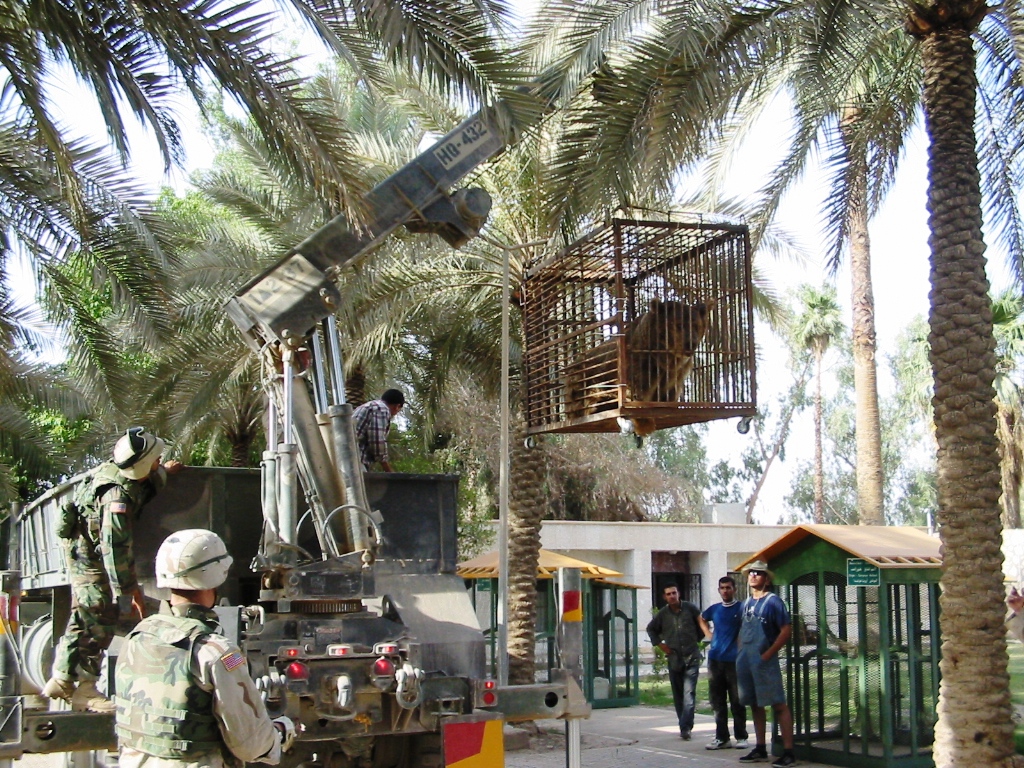
William Sumner greeted us warmly as he sweated away beneath the heavily adorned camouflage webbing and body armour. Naturally, as seemed befitting of genuine cultural immersion, he too wore a luxuriant, neatly cropped moustache. Its refined style reflected mastery of the scissor and comb trim, a subtle reflection on the 354th Civil Affairs Brigade Captain’s attention to detail; or so I thought. With a smoke grenade dangling from his chest, strategically placed pens, a Sterling sub-machine gun slung under his arm and refined manners, he impressed as every bit the polished fixer Lawrence had described him as. Talk of the next rescue quickly ensued between William, Stephan and Lawrence as I was anxious to get around the zoo to see what all the fuss was about.
It was a few minutes earlier that the somewhat theatrical Hilde arrived to say her goodbyes. Her first entry at the zoo had been as remarkable as any of the other foreigners, but her volatile force of personality had unexpectedly created some disrupting social politics. Her arrival with critically needed meat supplies for the zoo had been a crucial intervention at a desperate time, and the CFTW sponsorship of the precious dart gun was to prove invaluable in the ensuing months. I had only heard snippets of tales recounting that she also brought an intense animal welfare commitment flavoured with an abrasive, distinctly emotional character and a remarkable affinity for television cameras.
She was leaving Iraq that morning and quickly choked up with tears while talking to Lawrence, Stephan and William in her curiously high-pitched and distinctive, clipped German-English accent. Her short experience had clearly been emotional. I shuffled around awkwardly, not knowing how to handle the unexpectedly demonstrative introduction. It was an intensity of passion that caught me off guard as I was still grappling with remembering people’s names. She certainly cornered my attention as she moved into my personal space, handed me a pair of small scissors and sobbed out the unforgettable, richly accented “and you Brendan, pleaze don’t forget to trim the wolfz earz” before wiping the dribbling tears off her cheek. “Sorry. Um, did you say to trim the wolf’s ears?” I asked slightly baffled at what I perceived as a madcap request in the context. Was that meant to be a privileged responsibility? I looked at Lawrence, raised an eyebrow and turned to nod slowly at Hilde. “Riiight, yes, ok, I’ll be sure to do that,” I said hoping a television camera would miraculously appear and break her potent concentration. Standing there with the delicate scissors was not the Screaming-Eagle grand entrance to the zoo restoration I had envisaged, but hairstylist to a wolf still seemed a workable compromise. Fortunately, cameras did appear, and both Hilde and Stephan headed off smartly, jostling for position to describe the zoo’s tenuous state to whoever would listen. Introductions to the zoo director, Dr Abbas, and Lawrence’s reliable ally, Dr Hussam, followed.

Lawrence, as a boost to Dr Hussam’s morale and for my context, explained Dr Hussam’s initial heroics in returning to the zoo with unshakable determination to reverse its dreadful state. Both he and Dr Abbas welcomed me warmly with handshakes and broad smiles. Again the facial grooming was compelling to me. I could not help but notice. Both sported such wonderfully ample moustaches that I was quickly starting to wonder if all these cultural attachments would spark nationalistic grooming envy between American soldiers and Iraqis. Then came Akram, Sa’ad, Ahmed (the gunslinger moustache), Jaboory, Kadhim – and the entirely unfamiliar names started swimming in my memory as an unpronounceable soup. I figured I could decipher and learn names later as long as I remained polite. Given the apparently dire state of the zoo, there was still enough joviality and curiosity that made one want to help without reservation. A white Volkswagen Passat slipped in amongst the Humvees almost unnoticed. A petite, young Iraqi lady in tight, flared-jeans, a collared shirt, gold jewellery and rose-tinted shades climbed out and walked quietly past us towards the office entrance. “That’s Farah. She’s a vet, speaks good English and I reckon we can start up an animal welfare society with her. I think you’ll like her” Lawrence chirped up with a barely disguised grin.
Discussions about sourcing food for the animals and the evacuation of animals from the vile Luna Park zoo the following day continued inside the minimalist office. Luna Park was an atrocious facility across the city. A rescue mission coordinated the previous week had already relocated some of its starving animals to Baghdad Zoo. In the office, wires hung out from cavities in the bare wall and ceiling where a lightbulb and its companion, the switch, used to exist. In the corner stood a surgical table and autoclave donated days earlier by another animal welfare NGO. A representative had arrived, donated the table and left almost immediately. It seemed a bit implausible that those would be the two most desperately needed items in the circumstances, but I was new and bordering on idealistic. As exciting and appalling as Luna Park sounded to me I needed to see Baghdad Zoo so I could understand what I was getting myself into. As I left the room, Lawrence advised I stick to the paths. “They found some unexploded bombs of some sort lying around the zoo a few days ago. Cleared them, but there could be more in the debris and grass”. Finally!

The cages were reminiscent of old Victorian menageries I had seen in books, except in this case most were empty of animals. Rows of bar-fronted structures stood among dusty, mature palm and eucalyptus trees. Dull, repetitive clattering sounded nearby as a small revitalised pump started to suck water from the murky, weedy Tigris-fed canals that weaved through the zoo grounds. The old, moustached (of course) trolley minder had carted the zoo’s one car battery across to the next pump to get that cycle started. Water dribbled and spat out of the sprinklers onto the parched soil and a few clumps of sparse, dusty grass. This splutter alone was a sign of enormous progress given that many of the metal irrigation pipes had been crushed by armoured vehicles and that the original pumps and batteries had been stolen. Sporadically uprooted trees tilted over and shattered branches hung limply from mottled eucalyptus trunks or littered the paths and surroundings. Behind green bars a defeated-looking brown bear lay curled on a bare, stone-tile floor clawing gently at a seeping sore on her chest. Saeida was thirty-two, apparently blind, malnourished and frail. She had no access to an outside enclosure, and her tragic state represented all that was around her. She would not have been able to see the destruction but would have heard and felt the explosions, intimidating clanking of armoured vehicles, helicopters and overhead roars of jet aircraft. Parched and starving, she would have blindly padded around searching for the non-existent food and water once the facilities were abandoned. It was her fourth experience of war while locked behind bars at Baghdad Zoo.
A few cells on, past the empty cage with the “Beagle – Germany” sign hanging at a rakish angle, another self-interested bear loitered lethargically like a schoolboy bully outside a liquor store. It was, I assumed, the one rumoured to have killed a few looters a week or two earlier when they broke into the holding area. He still, at very least, had access to an outside exercise area. Quite honestly, and perhaps perversely, the small section I had seen appeared in an entirely better state than I had expected. Sure there was grime and filth engrained in the canary-yellow paint, and the animals looked restless or depressed, lethargic and a touch emaciated, but it was healthier than what I had been hearing about in previous weeks. Clearly, an enormous effort and much improvisation had already gone into halting the crisis and levering it from the brink of soiled despair. There was water in the drinking troughs, the faeces and piss that had accumulated over weeks had been scraped loose and washed away. There were remnants of food served the previous evening. They were mostly simple tasks, but the complex circumstances meant every basic step felt like a disproportionately immense achievement. The incarcerated animals were on a slow journey to physical recovery because of the unrelenting foreigners and returning Iraqis.
The aquarium building was uniformly segmented inside by columns covered with marble tiles. Every glass tank had been pulled off their respective platforms to the ground and smashed. The senseless destruction had quickly become depressing to see. Polystyrene tank bases lay among the glass shards, and tank remains, spread in a mess across the floor. The ceiling light fittings were stripped to bare wires.
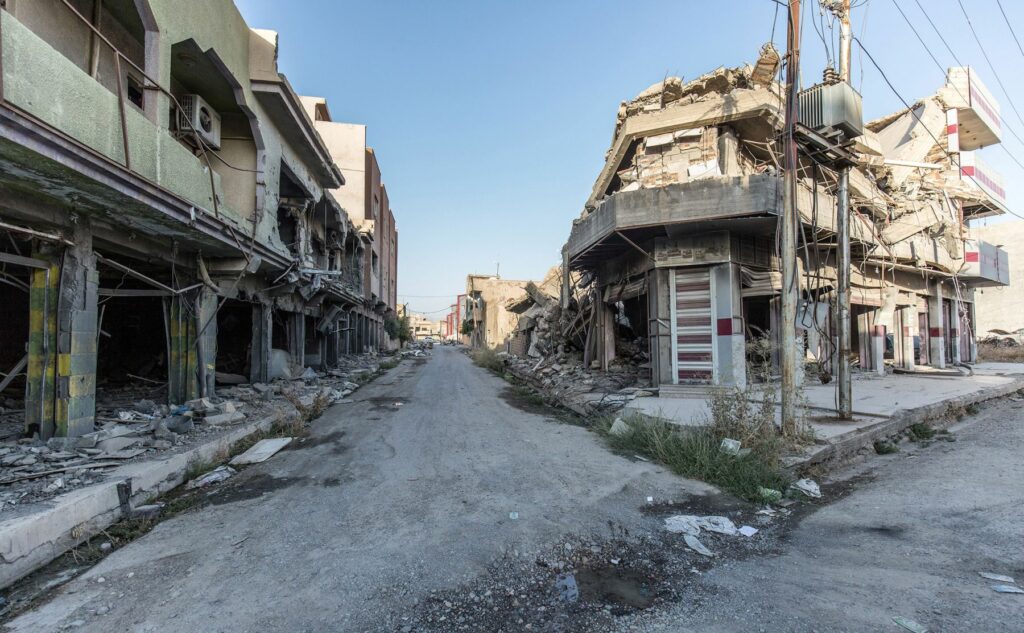
Three dishevelled ostriches, formerly from the palace complex about a kilometre away, strutted aloofly around a paddock. The road alongside the paddock showed shrapnel scars and a shallow crater where a mortar round had killed the donkey. Lawrence had earlier described the transportation of the ostriches with great gusto. It was because there were insufficient vehicles available that the only option left had been to herd the running birds from the palace menagerie, through a checkpoint of startled troops and off to the zoo. The muddy, matted-hair camel across the road, rescued a few days earlier from the Luna Park zoo, gutturally gurgled as he ambled to meet us at the barrier fence. Photos of the rescue had shown him in a state of physical collapse, lying curled like a withered pretzel. Now with access to water, fairly regular food supply and memories of a ride across the city in the back of a Humvee, he was showing his sunny personality as he drooled liberally and mumbled appreciation for his lumpy head and neck being scratched.
Over the bridge, a sizeable white-stone building housed a collection of lions. As we entered the building, Jaffer, allegedly a former Iraqi republican guard turned zookeeper, and a pint-sized spitting image of Sly Stallone, sat on the floor caressing the heads of two young lions. Pets of Saddam’s depraved son, Uday, they had been rescued from the abandoned palace days earlier by Lawrence, Dr Hussam and some zoo staff. Jaffer had taken a shining to the lions. In compartments behind bars were more adult and sub-adult lions. They lounged in their washed cubicles next to chunks of donkey bone that heaved with the flies Lawrence had cursed so often. A cream crossbreed dog lay quietly on the cool tiles in the corner of the building’s entrance. It was unexpected and as with so much else in this setting, absurd. War zones undoubtedly forge some odd alliances, and this case was no different as Lawrence later explained. When entering the lion enclosure at the palace, they had found that dog and a German Shepherd amongst the lions. It was assumed the dogs had been left in the pen as living larders when the palace was abandoned. Through some twist of nature’s traditional role-playing, the felines had in fact bonded with their canine captives to the point of being inseparable. While the German Shepherd had been quickly adopted out, the woolly individual had refused to leave his feline companions and was now a fixture at the lion exhibit. Two cheetahs, also starving pets rescued from the derelict death trap the abandoned palace had become, lay restlessly in an adjacent cell. While the lions had access to a reasonably large paddock about four times the size of a basketball court, the cheetahs saw negligible natural light and had no outdoor space.
“Hello! I am Salman. Lion, Tigers, Beers. Thirrrty two yirrss. Good! Very good!” He seemed to materialise in a rush of surprising eccentric animation like a dysfunctional leprechaun caught on a day off. The bronzed 5-foot-tall figure with balding grey hair, a dirty beige t-shirt, even grimier trousers and sandals patted his chest as he beamed a grin. A cigarette drooped from the corner of his mouth. “I am Salman! Thirrrty two yirrss” he burst out again now waving his hands in circular cleaning motions like a disciple of Mr Miyagi from the Karate Kid. The cigarette wobbled up and down but never left his mouth. He stood staring at me. There was a disjointed pause as I registered Salman in my head. I shook his hands before he proceeded to walk down the row of the lion holding enclosures, playfully slapping the paws that lions rested out between the bars, exclaiming proudly “Good! Very good!”

Past the building a rhesus macaque that appeared to have aged rather poorly sat mournfully on the floor of her cage watching the world go by. Looking just shy of 109 years old (rumour was that she smoked about a pack of cigarettes a day which may have contributed to her haggard appearance) she stared blankly back. I stared. She stared. Suddenly she pursed her lips, pressed herself against the bars aggressively and her face transformed into a demented demonic expression as she held my gaze. I could see why she was the only monkey not stolen from the zoo. A few cages along another pair of macaques sat recuperating after their rescue from the conditions of Luna Park, hoping their placid looks would lure unsuspecting staff and visitors close enough that they could snatch dangling loot like digital cameras or food. On that account they had been highly skilled, swiping a soldier’s camera before she could even get a fright.
Around the corner behind two sets of heavy bars was a stunning Bengal tiger. The vibrant colours of his auburn and black coat draped over a sleek, muscular frame showed a magnificent beast in his prime and entirely out of context given his surrounds. He lay in the shade on the bare soil of his hopelessly inadequate outdoor exercise area. A few cleaned donkey bones lay scattered around. The white-tiled plunge pool was empty. An oily, horizontal stripe plastered the walls and bars marking the territory definitively. His copper eyes stared with apparent indifference. Malooh was, without doubt, the most visually striking of the animals in the zoo. There was a palpable injustice that such a fierce creature, the physical and mythical embodiment of raw, wild power and wilderness was confined in that enclosure.
The Accidental Invasion of Baghdad Zoo is available now.