
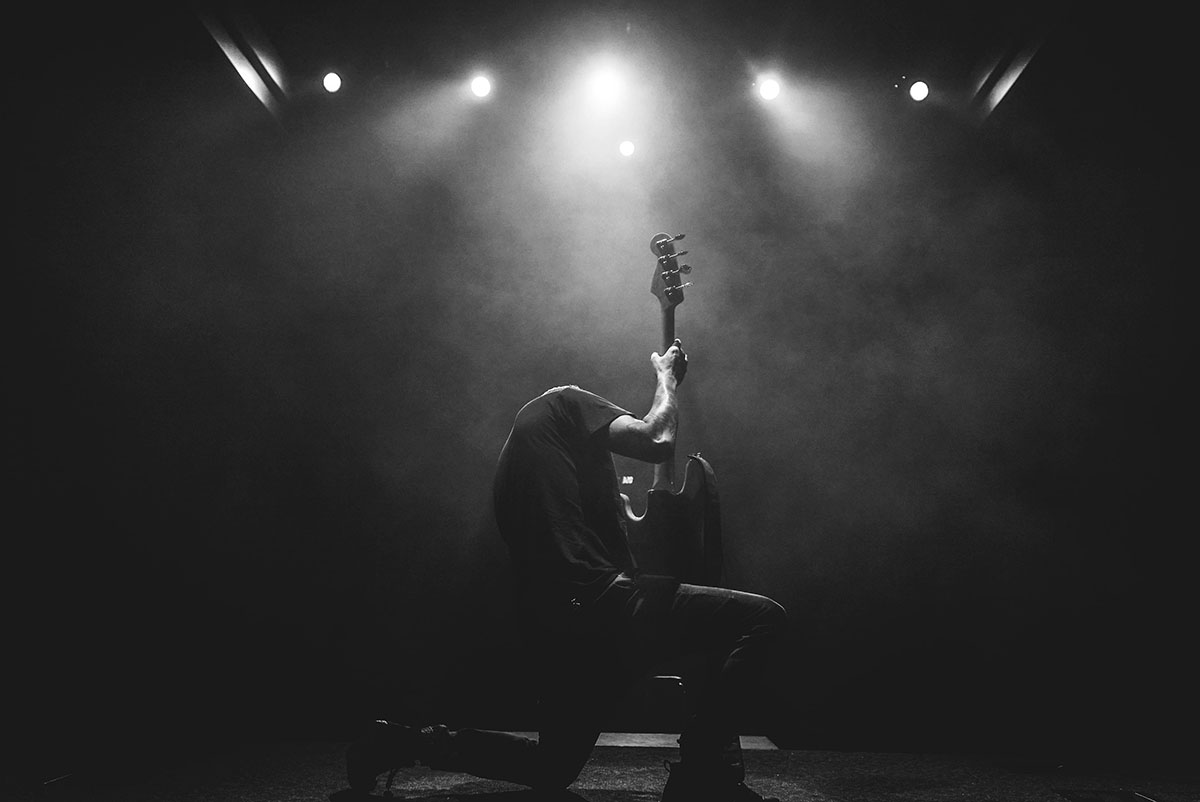
In broad terms, the acceptance of modern Western music has been steadily growing in popularity across The Kingdom in line with the openness championed by His Royal Highness Crown Prince Mohammed bin Salman bin Abdulaziz’s Vision 2023.
As expected, the biggest winners riding the crest of this transformational culture wave have been in the mainstream, where musical genres resonate with huge audiences across the world and streamwaves. Pop, Rap, House, Electronic are custom-built for commercial success and popularity, and the local acceptance of wider sources of music (and regular concerts held in The Kingdom) has led to the organic development of large fan bases for those genres.
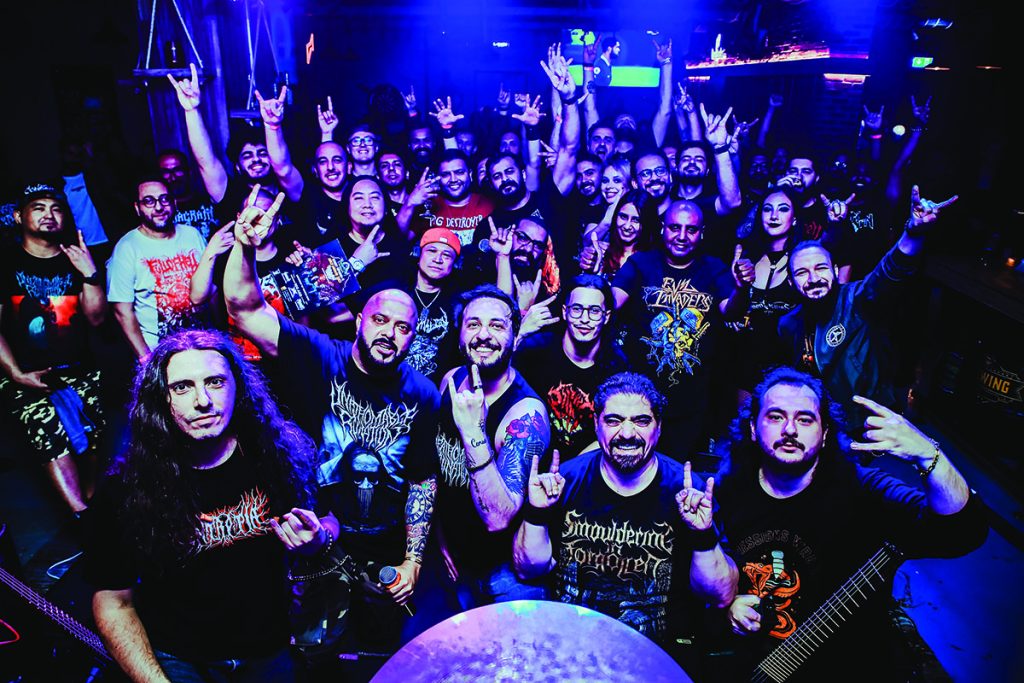
But music is a vast culture that brings with it a sense of identity both as a community and as individuals—for those who prefer thier music away from the mainstream, fringe music cultures such as Rock’n’Roll and Metal have long thrived in the margins, with passionate and dedicated supporters, bonding over their mutual interests of the aggressive sounds of electric guitar and drums. I am one of those supporters.
Whenever I think of metal music, I think back to my days at university in Sharjah, UAE. It was there I first met Meshari Sangora. He was also a student like me and we became friends with our common interest in rock, blues, and (occasionally) more commercially popular metal bands like Metallica. I would often go round to his apartment, not far from our campus, and watch him jamming on his electric guitar—a passion that he had only recently rediscovered after abandoning it for some time towards the end of high-school. Sat in his room, watching him thrash out some chords on his Fender guitar, it was clear to see that the creativity within him had been revitalized. As I always preferred less heavy stuff, I would often as him to learn (and play) rock and blues classics. One day he started playing ‘Goat’ by Polyphia—it was a song I hadn’t heard before, and its melody triggered something in me. That song was my introduction to Metal, and it prompted me to explore other branches of the genre. Almost every week, he would jam and play music, continuing my music education.
The history of metal music in Saudi Arabia dates back to the late 1990s when its first emerged and continued to grow during the 2000s, until today. During that era, the first metal or ‘hard rock’ bands emerged but didn’t generally receive a warm welcome, especially since they came from the Western world, thus strange and socially taboo.
However, for fans of the genre, every city in The Kingdom was known for its metal bands.
In Riyadh, bands such as Dune, Crimson, Native Notes, and Hemic had loyal local followings, while in Jeddah the most popular metal bands were Wasted Land, Immortal Pain, and Skeleton Crowd.
In the Eastern Region if you knew the right people, you could go and see Wrywreath, Creative Waste and Sound of Ruby. A lot of these bands played and lived through a much more difficult era—with some gigs subject to the occasional police raid—are still active today.
In the West, the history of metal music dates back to the early 1970s, but the term ‘heavy metal’ dates back earlier in its non-literal meaning, as we find it in literature and song lyrics since the 1960s. Names such as Iron Maiden, Black Sabbath, Cream, and Jimi Hendrix are the ones who developed the accelerated ‘metal’ tone with drums and electric guitar of controlled distorted sound.
Gaining huge popularity in the 1980s, this was the decade that formed much of the characteristics of what the current independent metal scene is based on—fast rhythms, harsh aggressive guitar sounds and critical or sarcastic lyrics.
Conservative society’s concerns with music genres like Metal are not are not born out of nowhere. It is a type of music that comes with plenty of negative stereotyping, even if it is often hugely exaggerated.
In Saudi the vast majority of people, particularily those from more conservative social environments, may not understand the characteristics that may drive a person to listen to and admire the type of music, that seems to have dark, sinister roots. But ultimately, it is one of taste rather than a belief system. Metal in Saudi, since its advent in the early 1980s until today, has always been of limited popularity—confined to a modest audience, but one that allows for a tight growing social bond between likeminded people who feel left out of mainstream culture. It’s raging noise and heavy guitars are often views as a sign of rebellion, but looking a little deeper many fans will reveal that it is an outlet for either internal angst or method of dealing with social phobias or internal anxeities. It can have a calming effect on both the musician and the audience, a way of self-expression in the a form that not everyone would understand.
“For many people the initial impulse to listen to metal music can be attributed to a rebellious spirit, or the desire to explore and be exposed to something that is either socially frowned upon,” writer Muhammad Farid al-Harari explains to Esquire, “Sometimes it is just someone who needs to unload an untapped aggressiveness held within.”
Musically, Metal is a complex genre. Divided into various niches that differ musically from each other, taking different forms mixed with other musical types. If you listen to it, you may think that it is hard rock, rap, or blues, while maintaining the tempo of the accelerated music that characterizes its nature.
“Metal is more akin to an abstract art form. All the usual parts of traditional songwriting are
there, but not necessarily in the way that people are used to hearing them,” says al-Harari.
“The lyrics in many Death Metal songs can be really hard to understand, but if you are a fan of the genre, you grow accustomed to them, unlike songs with more cleaner, more traditional, melodies and lyrics. Metal, as a genre, tries to explore beyond standard forms of musical presentation, like, for example in the song “War” by Idels, where instruments wrestle with each other demonstrating the destruction of the social or economic system— well, at least, that’s how I interpret it!”
In addition, metal music may create and enhance the environment that you need to reach your goals daily, that is, it is a stimulating fuel, if you want to accomplish something or maintain a state of enthusiasm and emotional energy, as for him, the music I hear personally when I encourage myself to accomplish a task.
Back when I met Meshari Sangora in Sharjah, he was DJ-ing at the university radio station, but he never expected that he would make a career as musician in a Metal band—especially a Saudi one. The idea that an art form with a limited audience in the Arab world would develop to a point where a Saudi guy could do it as a profession, well that was the stuff of fantasy. While things are still at a budding level, things are happening in The Kingdom when it comes to the Arts and new opportunities are not only flooding the mainstream but spilling over into more niche subcultures.
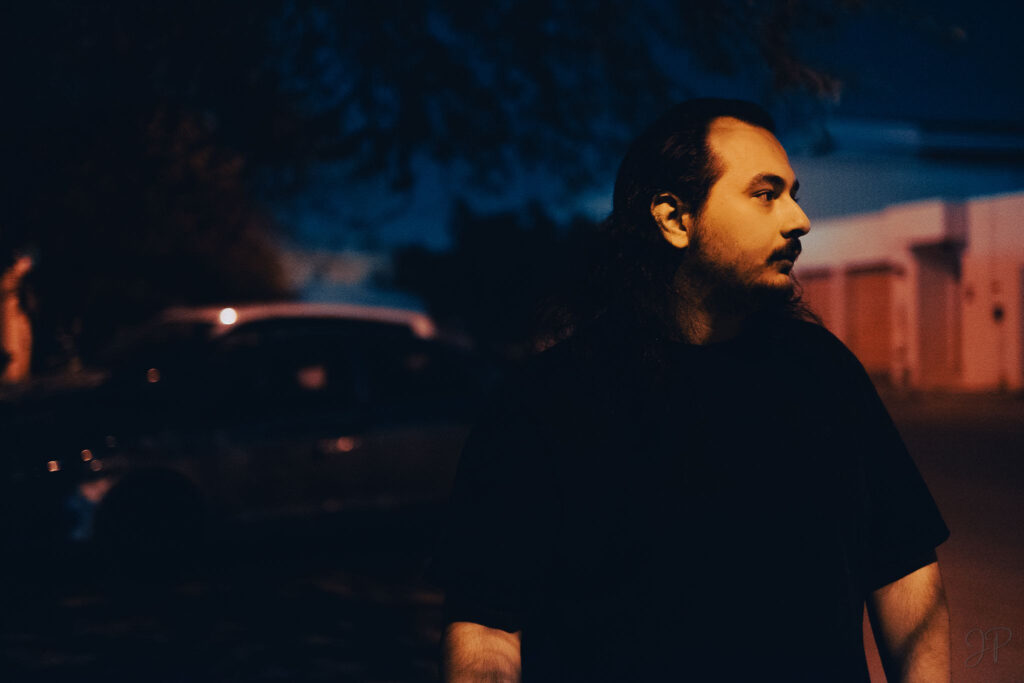
Since those days Sangora has spent years working tirelessly on hs craft, dedicating hundreds of hours on his songwriting and trying to fine-tune his specific sound. His one-man, progressive-metal band, DUSK, has released dozens of songs, signed to an independent record label (Wormholedeath Records) and performed in concerts across the Gulf and even in Saudi Arabia.
Among regional metal fans, DUSK has a reputation for its aggressively driving guitar rhythms, an instrument that Sangora has been playing since he was young. “I first bought an electric guitar when I was 11, I didn’t know anyone else at that time who played the same instrument,” says Sangora. “It with my hobby, but it felt quite isolating not knowing that there were people like me. This was before social media made it easy to go beyond the walls of your room, but it was the isolation that made me learn how to play, and rely on myself.”
Having released his first full-length album, Spectrums, earlier this year, things are looking up for DUSK—but there is a still a long way to go before the dream of becoming a full-time professional is realised. “When I graduated and returned to Riyadh, I found a regular job and started to commit to it, but my passion for wanting to make music did not subside,” he says. “I used to come home during my lunch break to work on my music, but it was very difficult to do both, so I decided one day to quit my job and focus on following my dream.”
The lack of funding and financial stability is often a huge hurdle for most young artists, with many having to either work side jobs to support their dreams or having to pick between them.
“My path was not paved with rose petals,” says Sangora. “I wasn’t making enough money from making music and playing concerts, in fact, often I would be spending money just to cover my basic needs and travel expenses.”
What proved to be a career life saver for Sangora using his regional music experience to embed himself into the industry—entering the world of concert promotion, and also creating a brand that specialized in providing specific parts for electric guitars. Using his understanding of what it takes to be in a band and helping others navigate the pitfalls of a small-but-growing local music scene, means that Sangora doesn’t have to choose between work and his dream, in fact, he is helping forge a path for others to follow their dreams too.
For metal fans like Muhammad Farid al-Harari, and musicians like Sangora, the situation today in Saudi Arabia is different from what it used to be.
Not only is there a wider, social media-helped network of likeminded niche music fans, but the country has also seen a growth in the building of creative spaces across The Kingdom that are able to host small concerts. In Jeddah there is The Music Space, while the live music venue, Syrup, has become a popular place in Riyadh. This step has provided opportunities that weren’t available just a few years ago, opportunities that allow independent musicians the space and public audience they need to development in terms of performance and publicity.
In addition to all of the existing changes, the interaction between the artist and the audience began to expand thanks to social media, which now plays the most important role in promoting this type of music commercially. This makes me optimistic when I anticipate the future of metal music in The Kingdom, but there’s a long way still to go before this abstract of musical art will full be accepted within wider Saudi society.