

It is 5:30 AM, and Adab Café swings open its striking blue doors while the city outside is still only half awake. Riyadh’s early mornings are a rare meeting place between the determined early riser and the disoriented night owl. The sky is smeared in the softest shade of early grey, the kind of color that doesn’t yet know if it will become blue or stay quietly overcast with clouds or dust. Inside, warm light spills over an intricate patchwork floor of Andalusian-style tiles. The space is hushed but not silent; there’s the light shuffle of chairs, the mechanical exhale of the espresso machine, and somewhere, faintly, Fairuz’s “Kifak Inta” plays from a speaker, like a whispered secret to start the day.
Lining the back wall, a gallery of black-and-white portraits quietly observes the room. These are not generic design accents but the faces of Arab and Saudi writers, philosophers, and thinkers—Ghazi Al-Gosaibi, Taha Hussein, and dozens more. Below them, old suitcases and antique radios rest like intellectual relics. The seating area is a blend of mustard-yellow sofas and faded wooden coffee tables repurposed from barrels. It feels more like a reading salon than a café—a space where thought is brewed alongside coffee.
A barista in a navy apron and pristine white shirt weighs out beans with surgical precision. Each movement is both craft and choreography. I sit near the window, sipping a pour-over so floral it tastes almost imagined. It strikes me then that this scene would have been unthinkable in Riyadh a decade ago—not because of the coffee, but because of the space: unhurried, unsegregated, utterly intentional.

In Saudi Arabia today, the most radical shift is not what we drink but how, where, and with whom we drink it. The modern café has become a microcosm of the country’s transformation: a quiet, curated arena where culture, commerce, and conversation meet. Not long ago, public life was dictated by separation, speed, and starkness. Today, in places like Adab, we see something else—a slow bloom of softness, stillness, and style.
And all of it, curiously, is beginning with coffee.
Gahwa: The Original Brew of Belonging
Before the V60s and AeroPresses, before even the espresso machine arrived in Riyadh, there was Gahwa. Brewed in long-necked dallahs and served in small finjan cups, Gahwa was and remains the first and most enduring gesture of Saudi hospitality. It is both invitation and insistence: sit, stay, be seen.

The preparation of Gahwa is a ritual of intimacy and performance. The right blend of lightly roasted beans, cardamom, and sometimes clove or saffron, poured slowly and with deference into the cup of a guest. It is a language, an etiquette, a way of structuring time.
Where Western coffee rituals often imply solitude or haste, Gahwa is about presence. You drink it not to rush out the door, but to stay awhile. It is perhaps Saudi Arabia’s first “third place,” long before the term existed—a cultural practice that blurred the line between home and community.
The Lost Second Wave: Corporate Cafés, No Culture
Coffee has been a staple beverage across human civilizations for centuries. Legend traces its origins to Ethiopia, around the 9th century, where a goat herder named Kaldi supposedly noticed his goats becoming energetic after eating coffee cherries. Within the Arabian Peninsula, coffee took root early. By the 15th century, it was being cultivated and traded in Yemen, where Sufi monks used it to stay awake during prayer. From there, it spread to Mecca, Cairo, Istanbul, and then to Europe by the 17th century. While its origins remain disputed, one fact is undisputed: coffee was central to Arab social life long before European café culture even emerged.
Nonetheless, the Arab world—and Saudi in particular—lagged behind in the more recent coffee movement, commonly captured in the three waves of modern coffee culture. During the first wave (1800s–1970s), coffee was treated as a mass-produced commodity (Folgers, Maxwell House), while Saudi Arabia focused on nation-building and institution development. Coffee remained present but peripheral to the Kingdom’s traditional beverage culture.
During the second wave (1970s–early 2000s), where coffee was reimagined as an experience—Starbucks, caramel syrups, cozy branding—Saudi Arabia again stayed at the fringes. We had the chains, yes, but not the culture. Cafés became air-conditioned bubbles in malls, more functional than flavorful. The furniture was corporate, the playlists global, and the coffee more sugar than substance. It was a revolution of convenience, not of culture. These cafés were tolerated, but they never rooted themselves in the local imagination.
Saudi Ahead in the Third Wave
Then came the third wave—and this time, Saudi did not follow. It leapt ahead.
The specialty coffee scene in Saudi Arabia didn’t just import global standards; it created its own. Local pioneers like Camel Step, Brew92, and Elixir Bunn took the language of craft coffee and gave it an unmistakable Saudi accent: careful sourcing, elegant design, and a deep respect for the communal act of drinking.
Baristas began training internationally. Beans were no longer just from Brazil, but chosen for altitude, process, and story. Cafés became design-forward, with brutalist lines and hand-laid tiles echoing both Riyadh’s modernity and Najdi roots.
From the urban trade hubs of Jeddah and Dammam to the ancient oasis city of AlUla and the capital’s fast-paced heart, Saudi cafés now rival Melbourne and Copenhagen not in mimicry, but in originality. This isn’t a belated imitation of global taste. It is a new epicenter of it.
The third wave was embraced by roasting aficionados, small business owners seeking distinction, and growing homegrown brands with national ambition. But perhaps most importantly, it was embraced by Saudi consumers. Saudis savor their coffee. The shops are full at dawn with professionals, busy in the evening with friends, and buzzing on Fridays after prayers.
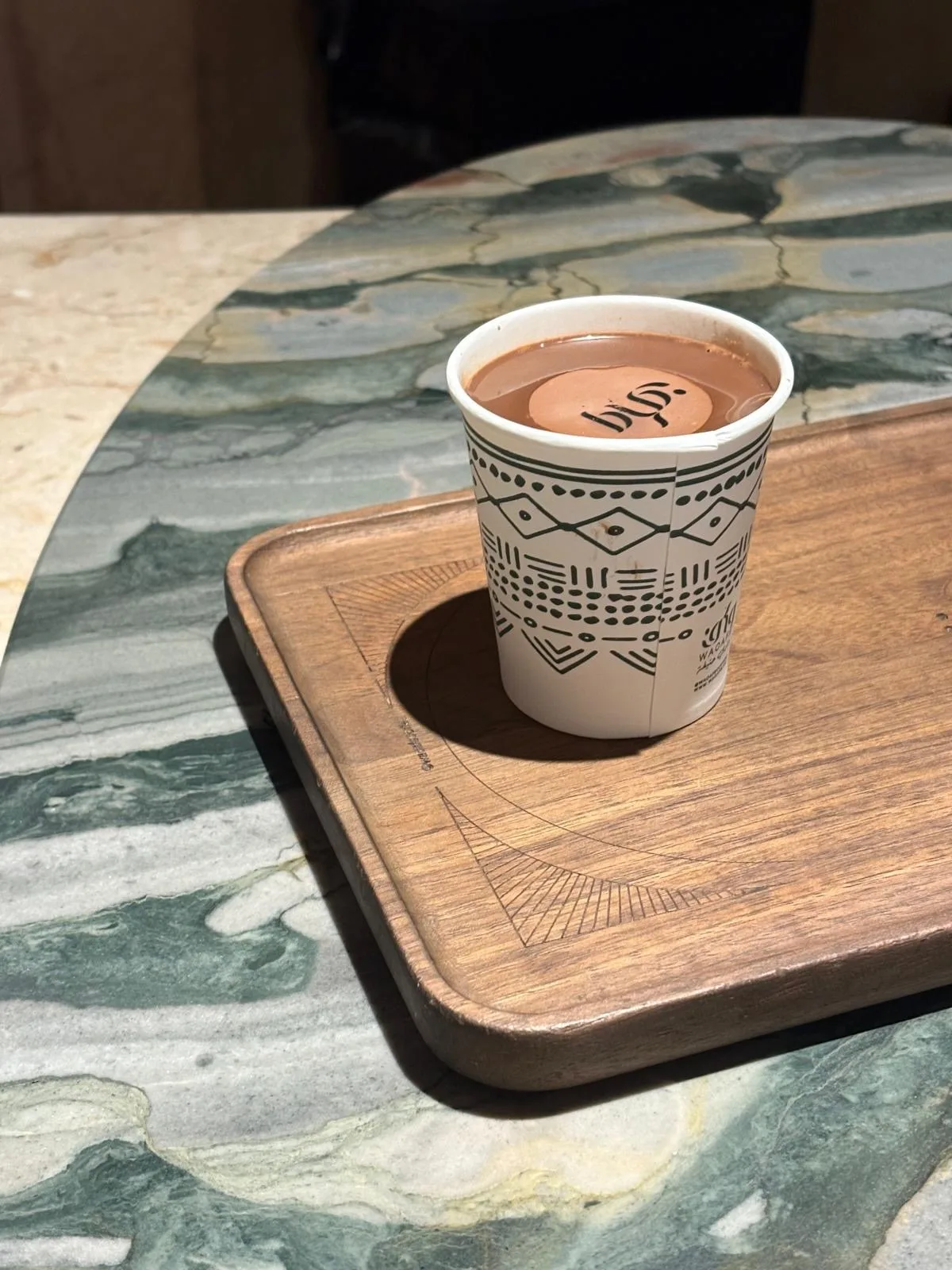
On a recent Friday in Khobar, my father took me and my three brothers for coffee after Jum’ah prayer. We stopped at WACAFE, a local chain known for its Hasawi cookies. Expecting quiet, I was wrong. The two-floor café was packed. After picking up three oat cappuccinos and one lava-hot cup for my father, I returned to our table and looked around: to our right, joyful retirees; to our left, a group of impeccably dressed young women taking selfies; in front of us, a young family sharing a pastry.
At any given shop, you’ll find the suited city-dweller, the post-gym regular, and the thobe-clad man in pristine sneakers. Women in fashion-forward abayas order iced V60s. One barista told me the top pick was Colombia beans—but “Saudi beans are rising fast.” These spaces are no longer just shops. They’re stages.
Even Adab, with its thoughtful interior and curated ambiance, wasn’t quite as packed as some of the bigger, more established Saudi names. It had a steady trickle of customers, yes—but in today’s fiercely competitive landscape, foot traffic can depend as much on brand loyalty and TikTok visibility as on bean quality. With the at-home brewing scene booming and retail cafés multiplying, standing out is harder than ever.
The Café as the New Majlis
Today, in Saudi Arabia, the café has replaced the majlis in both function and form. It is where friends gather, business pitches happen, arguments get settled, couples meet for the first time, and students work silently side by side. It is a space that gently bends the rules of public and private life.
Where the majlis was fixed by tradition and gender roles, the café is fluid. Here, you can be visibly ambitious, stylish, introverted, or romantic. The café allows for plurality.
And more importantly, it offers a kind of anonymity—a precious thing in a culture that once watched itself closely.
Business Is Brewing: The New Saudi Hustle
Beneath the scent of espresso and citrusy beans lies something else: an entrepreneurial revolution. Cafés in Saudi Arabia are no longer hobbies or side ventures. They are battlegrounds for serious, stylish business.
Camel Step has scaled with discipline, opening concept stores and integrating local design. What began as a niche roastery has grown into a national powerhouse—arguably the Kingdom’s first specialty coffee brand with international potential. With locations spanning the country, each branch is meticulously designed, but none quite like its shop in Hail. There, the space becomes a statement—part architectural gem, part local homage—where sand-toned minimalism meets community gathering. Camel Step has managed what few others have: to be both a brand and a symbol, consistent yet site-specific, commercial but artisanal.
Jazeen, meanwhile, represents the state’s bet on turning coffee into cultural capital. Backed by the Public Investment Fund, Jazeen isn’t just selling beans—it’s crafting an origin story. Focused on promoting beans from the Jazan region, the brand is combining agriculture, storytelling, and export ambition. More than once, I’ve brought their gift boxes—complete with custom mugs, house-roasted beans, and Arabic-English tasting guides—to friends abroad. Months later, they still ask if I can bring more. Jazeen is achieving what few government-adjacent ventures manage: creating something people genuinely love.

Perhaps no other example better represents the sudden uptake and acceleration of third-wave coffee in Saudi Arabia than Yousuf Al Bassam’s entrepreneurial journey. What began in 2009 as a business idea during his freshman year at KFUPM has since grown into a fully integrated coffee enterprise spanning sourcing, roasting, and retail.
Yousuf’s journey started not from a passion for coffee, but for entrepreneurship; a desire to build a successful, yet meaningful business that survives the test of time. “Since I was in eighth grade, I was trying, learning, and often failing at businesses,” he recalled. In 2009, while his peers sought overseas study, Yousuf chose to stay in the Kingdom with the primary goal of focusing on building a business in Saudi—envisioning a gap in local coffee shops. Back then, “specialty coffee” didn’t exist in Saudi, and neither did infrastructure to support it. He traveled to the U.S. to learn roasting, spent months registering his first company, and came home to a market that wasn’t ready.
“I’d ask customers where they got their beans from, and they’d say, ‘the moon’—that’s how disconnected the sourcing knowledge was,” he told me, laughing. Facing high costs, low awareness, and abandoned B2B deals, his early years were marked by hustle, pivots, and painful decisions to keep the business afloat and breakeven. A turning point came in 2015 when he helped bring Café Imports, a major U.S. green coffee supplier, into Saudi Arabia. He didn’t just import beans—he educated the market.
By 2015–2016, as specialty cafés bloomed in Riyadh and Jeddah & Khobar, his strategy shifted fully back to third wave as the market had finally caught up with what he had already established. His business was now booming, with one of his shipments selling out fully while still in transit at sea. They also began organizing annual origin trips to places like Brazil and Costa Rica to teach clients the stories behind their beans. “We’re not just selling coffee. We’re giving you content, quality, and a connection,” he explained.
Post-COVID, the market surged, but also segmented. Neighborhood cafés now dominate, and home brewing exploded. Through The Coffee Group (Marabih), Yousuf’s companies—like Kafa and Bunista—now export across the Gulf, with a sharp focus on sourcing, education, and story-driven quality.
As Yousuf put it, “Exposure gives you knowledge, and in the last few years Saudis have been over-exposed to origins all over the world.” That exposure created a deeply segmented, increasingly refined local palate.
Young founders are launching micro-roasteries, mobile brewers, coffee & tools platforms, and barista schools. Unlike previous generations, these entrepreneurs are driven by product and purpose, not just profit. It’s the taste that sells, not the wasta. This is where Saudi’s economic shift becomes visible: coffee as ecosystem, not just commodity.
Taste as Identity, Design as Soft Power
A new kind of Saudi identity is being brewed with every cup. These spaces are not just cafés; they are stages of style, taste, and intentionality. The palette is muted, the branding minimal, the furniture often handcrafted.
Design matters—because it signals values: restraint, quality, presence. In a region often caricatured by excess, the new Saudi café speaks in a quieter language: one of refinement and intentionality.
Even masculinity is being reshaped here. Young Saudi men, once taught to express confidence through volume, are now expressing it through detail: how a shot is pulled, how a tamper is held, how a table is wiped.
A Final Cup: Stillness in a City That Moves
Back at Adab, the sun has started its ascent. The café is slowly filling with the city’s early risers: an architect reviewing sketches, a pair of students murmuring over a shared laptop, a woman with a stack of notebooks and a jasmine-colored abaya.
The barista pours another cup with the same care he did at dawn. Nothing is rushed, though everything is moving.
It is in this moment—between sips, between silence—that the real Saudi transformation feels most legible. Not in the megaprojects or global headlines, but in the simple, steady presence of a country learning how to sit with itself. And brew.