


While comedy continues to dominate Saudi streams, Fayez Bin Jurays is taking a calculated risk to swim against the tide. Having just wrapped a gruelling action-drama, Al Dhariyah, the actor is determined to push boundaries, embrace complexity, and prove that not all paths to stardom are the same.
It’s the day before Saudi National Day, and Riyadh is buzzing. Saudi green flags line the highway from King Khalid International Airport to the location where I’m meeting Bin Jurays. The air hums with pride for the 95th National Day, celebrated under the theme “Our pride is in our nature.”
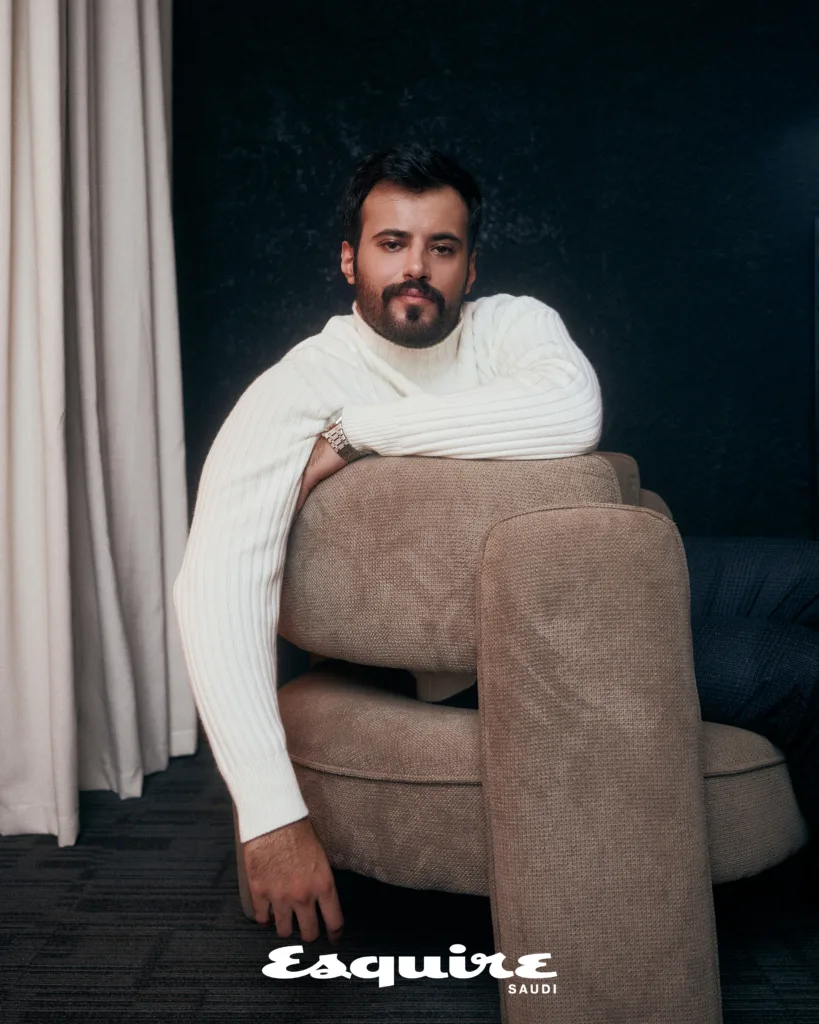
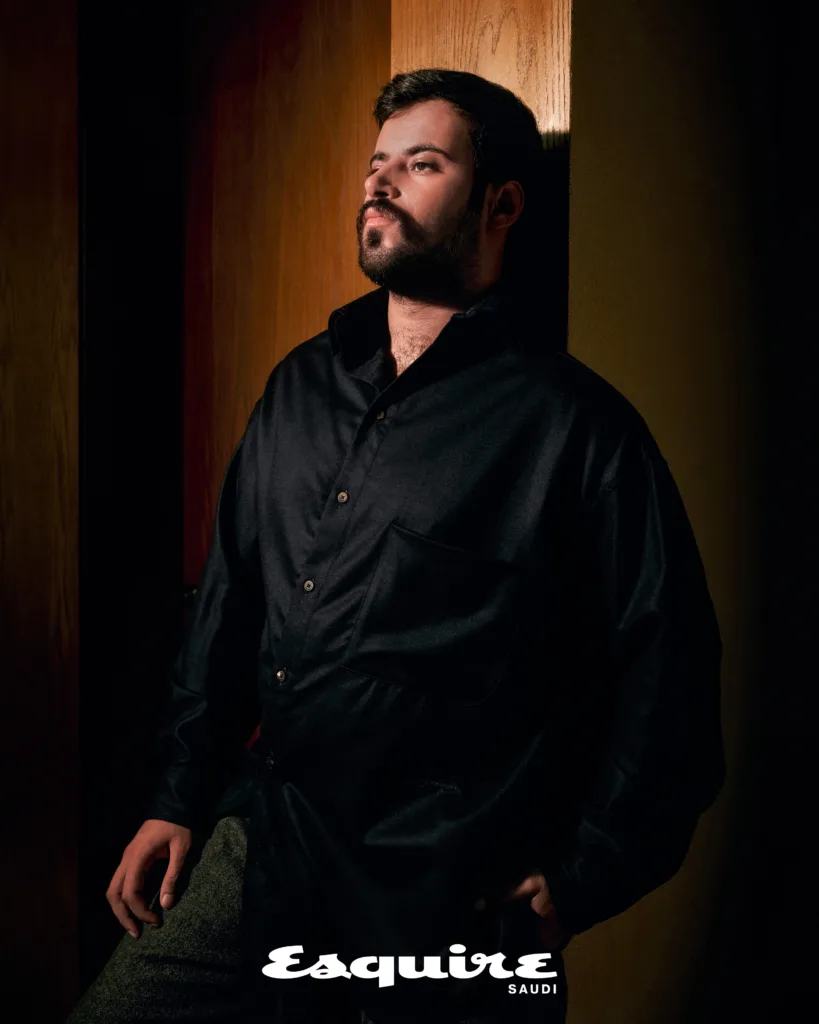
We’re shooting in a villa on Riyadh’s northern side, a modern home with a pool that feels both contemporary and traditional. Bin Jurays arrives dressed in all black: effortless, composed.
I greet him and walk him to wardrobe. “Brother, it’s forty-two degrees, and you want me to wear all these coats? Can I leave this for London?” he jokes, instantly breaking the ice.
Tomorrow, he’s flying to London, not just for a short escape but to shed the weight of the heavy role he has just wrapped. “I always plan a trip after a heavy role, so it helps me bid farewell to the character and leave it behind.”

A few days before our Esquire Saudi shoot, he finished filming Al Dhariyah, an eight-episode action drama set to premiere on Shahid in November. He plays Youssef, the son of a legendary smuggler, torn between his father’s legacy and his own conscience, as a fierce battle unfolds between greed, loyalty, and truth.
The series is a tale of legacy, internal conflict, and moral collapse in a place where not even mountains can protect. Jurays is betting big on the project, not only for its shorter format, as regional audiences are used to expansive 30-episode Ramadan dramas or Turkish-style 90-episode sagas, but also for its genre. “Action dramas have been rare in the Kingdom, where comedy has long been the easier sell,” he explains.
“What I liked about this role is its complexity,” says Jurays. “There’s a fine line between evil and good. Youssef is head of a gang, but he’s also empathetic. He cares for people. He’s respected. That duality makes him human.”
The role lingered on him long after filming. On set, he immersed himself so deeply that he began adopting new habits: slower speech, altered mannerisms, subtle yet chilling shifts in body language. “I created his voice, his movements. Even the way he carried his hands became different,” he says. The transformation was so consuming that he booked his London trip simply to shed the residue. “I need to leave the character there, and come back to myself.”
Physically, the role tested him too. A hamstring tear during one scene left him in physiotherapy, but he pushed through. The director adjusted the pace of the action, yet the stunts kept coming. “It’s a heavy series, with depth. And I believe people will be thrilled to see Saudi action on this level,” Jurays says.
At one point, during a break between shooting, he takes out his phone and shows me a master scene from the newly-wrapped series. It’s a gritty and intense scene, but what is more striking is that the character is nothing like Jurays, the actor, we’ve been working.

He has the ability to flip the switch and transform. That same level of versatility played out during our shoot. I asked him to balance on the edge of a window ledge, cross toward the deep end of the pool in a coat and formal shoes. He didn’t hesitate. He’s game. That’s Jurays: a movie star who loves action, blending passion with a willingness to go all the way for the perfect shot.
Fayez Bin Jurays’ path to this point was far from scripted. Born in Riyadh and raised in the small village of Al-Amriya, he began as a footballer for Al-Shabab Club until an injury ended his career. He traveled to the U.S. for language studies at the New York Language Institute, intending to pursue a business degree. Fate intervened when he was asked to act in a theatre production.
“The school director asked me to join a theatre class in exchange for him passing the course,” Jurays recalls. He resisted at first. But after one class, something shifted. “That night, I couldn’t sleep. I just wanted to wake up and go back. It was the first time I felt passion for something other than football.”
A fellow Saudi student then asked the life-changing question: why not study acting? “I was oblivious,” Jurays admits. “I asked, ‘Acting can be studied?’” Soon after, he transferred to the New York Film Academy in Los Angeles, leaving behind business, friends, and plans. “From that moment, I realised acting is life. Acting is therapy, it lets you release every emotion, negative and positive.”
But pursuing acting meant confronting more than self-doubt. In his village, actors weren’t seen as artists, they were seen as clowns. Jurays kept his studies a secret, letting his family believe he was still pursuing business.
The truth emerged publicly: in a TV commercial airing during Ramadan, prime-time equivalent to a Super Bowl slot. Overnight, his phone exploded with messages. His mother’s was blunt: If that’s you in the commercial, don’t bother coming back.
“I told her, ‘In acting, for the first time, I feel I am good at something. I’m winning at something.’” Slowly, acceptance came, with one condition: make us proud. That became his mantra.
When he returned to Saudi, offers didn’t flood in. He worked as a delivery driver to stay independent, telling himself every rejection was preparation. “Everyone will get an opportunity, but you must be ready for it. If it comes and you’re not ready, you’ll regret it. So I studied, I took online masterclasses, I kept working on myself.”
His preparation paid off in 2021 when he landed his breakthrough role as Omar in director Colin Teague’s series Rashash, based on the true story of Rashash Al-Otaibi, the notorious Saudi bandit of the 1970s and 1980s. The role earned him the Favourite New Face Award at the 2022 Joy Awards.
Fayez Bin Jurays approached the audition with unorthodox precision. He read the full script like a textbook, studied until he fully inhabited the character. “While the character was obvious, I did the opposite, added another layer to show my versatility.”
The series was a massive success. “Omar was the role that propelled me to stardom. It was the role that made me believe this is my path,” he says.
More roles followed: Dakat Al-Abid (2023), Beit Al-Ankaboot (2024). Each time, Jurays gravitated toward layered, conflicted characters. “I’m attracted to complicated roles, psychopaths, serial killers, people life has been unfair to. Characters with scars. Playing them is like shedding layers of skin.”
Today Jurays is part of a generation of Saudi actors reshaping the industry. Just a decade ago, the idea of a thriving entertainment sector in Saudi was unimaginable. Today, with cinemas open, theatres expanding, and Vision 2030 fuelling cultural growth, opportunities are multiplying.
Still, comedy dominates. “Comedy is an easy sell,” he admits. “But I want producers to trust drama, action, thrillers. These stories matter too. They’re harder, more expensive, but people want to see them.” He believes trust in Saudi cinema is growing, and more projects will follow.
Off camera, Fayez Bin Jurays is strikingly different. Warm, quick to laugh, he admits he struggles with social media. “On Snapchat, I’ll post scenery, restaurants, maybe a view. But not my face, not my personal life. I find it hard. On screen, I can perform in front of millions. On a phone screen? No.”
Part of that choice is deliberate. “As an actor, your value is your emotions and expressions. If you put everything on social media, people get used to you. They’re less impressed on screen. I’d rather keep the mystery.”
For Jurays, acting is telling the truth. “You need to believe every single word before you say it. If you believe it, you say it truthfully. I believe in the ‘TTT’ theory, ‘Tell The Truth’. Many actors overthink the script, that’s why their performance can feel rehearsed. For me, acting is reacting to the person in front of you.”
As the sun sets in Riyadh, his calm persona softens even further, though his excitement about the new role still sparks through. His final message is an advice to aspiring Saudi actors: work hard, study the craft, take online courses and invest in their skills.
Al Dhariyah premieres on Shahid on October 31st