
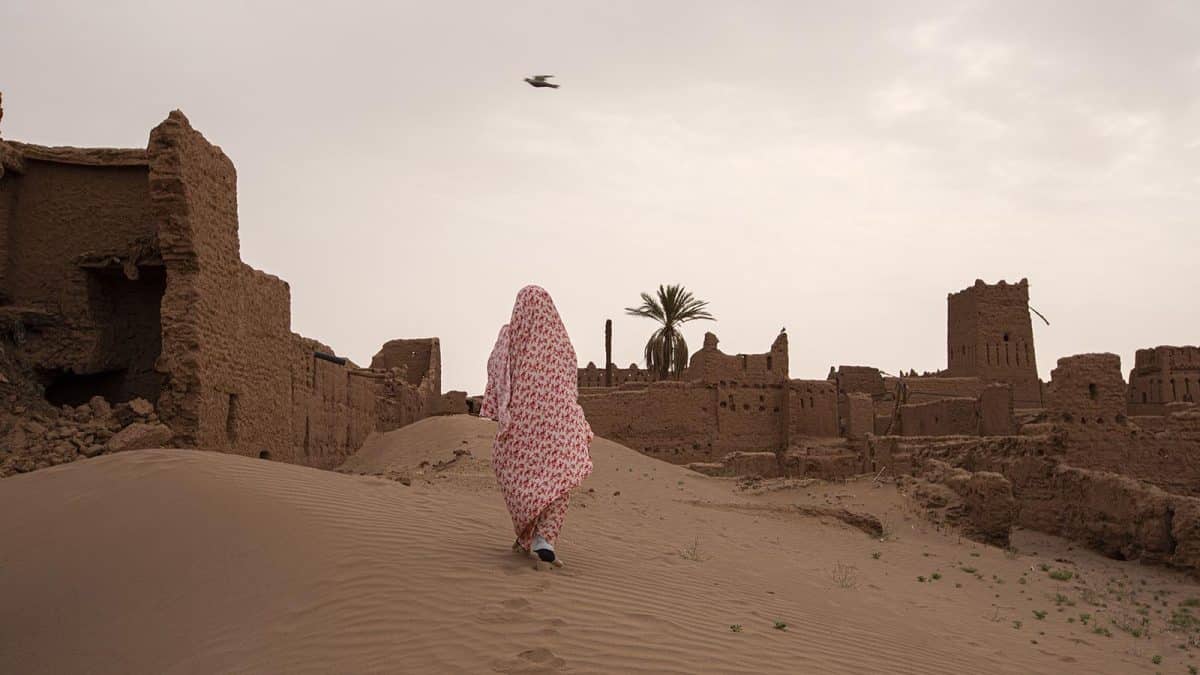
In the past decades, desert oases have disappeared at an alarming rate due to rising temperatures, droughts and depopulation. Morocco alone has lost two-thirds of them in the past century. In a series of photos, photographer Matilde Gattoni explores how a group of visionary activists, scientists and farmers are attempting to tackle it.
The world’s oases are at the forefront of an existential battle against climate change: in the past decades, rising temperatures and human activities have caused a deadly combination of droughts and desertification that have dramatically affected this unique ecosystem and way of life.
The trend is particularly acute in North Africa, one of the world’s driest regions where temperatures could rise up to 5°C by 2060. Morocco alone has lost two thirds of its oases in just one century, and the number of palm trees in the country has fallen from 15 millions to just over six millions. Local activists are trying to block the advance of the Sahara by rediscovering their people’s millenary teachings and traditions, promoting organic farming and cultural initiatives to restore the environment and stem youth migration.
Abdelkarim Bouarif, a 29-year-old agronomist from the oasis of Skoura, wants to promote an innovative mix of palm trees cultivation and sustainable tourism. “We have to go back to what our ancestors did”, he explains convincingly. “It’s the palm tree that bought life to this place. Without it, there would be no oasis”. Bouarif encourages local peasants to reintroduce traditional farming techniques, such as crop rotation and the use of local seeds and natural fertilisers.
As massive emigration from the oasis cuts the transmission of knowledge from one generation to the other, putting at risk the know-how painstakingly accumulated over centuries, his mission becomes of utmost importance. Bouarif applies the same sustainable practices to his family kasbah, which was converted into a boutique guesthouse a few years ago. “We source all the vegetables we need from our parcels and from the local market, so that we can sustain local peasants”, he explains. “And we use the discarded pool water to irrigate our fields”. Bouarif loves to take visitors for a walk in the palm groves, and explain how an oasis functions. By doing so, he also hopes to raise awareness on the plight of the oases in Morocco.
Halim Sbai, a 53-year-old environmental activist from M’hamid el Ghizlane, is trying to salvage his oasis’ rich history, which is still passed orally from one generation to the other through songs and centuries-old poems. Every weekend, dozens of children and adolescents from M’hamid gather at Sbai’s music school to sing and learn about them. Like many other men, Sbai had the chance to leave M’hamid and seek a better life elsewhere. He decided to stay and fight for the future of their beloved oasis by instilling that same love for this land into their youth. “We work on our immaterial heritage. It’s the first step to take”, explains Sbai. “Otherwise the youngsters will never even know what an oasis is”. Despite the challenges, Sbai is still hopeful about the future. “It’s going to be a long-term effort, but I love to see the smile on my people’s faces”, he explains. “In order to save the oases, you first have to take care of the human beings living there. They are the foot soldiers in this battle against desertification, and the Sahara is a quick enemy”.
Hope

A farmer clears the soil in order to let water flow in an irrigation canal in Zaouia el Hana. Oases share water among parcels and households on a rotation basis, sourcing it from groundwater tables, mountains, rivers, lakes or springs through an intricate array of ancient underground canals called khettaras, that take advantage of incline and prevent evaporation. Droughts have always been part of oasis life, but their previous cyclical patterns allowed communities to endure them by stocking food and carefully managing water resources. Now climate change is disrupting that natural pattern by increasing temperatures and making droughts longer.
Activists

A tourist guide from Jorf offers tours to a series of ancient khettaras. Many youngsters living in the oases try to earn a living with tourism, one of the few viable economic activities left in the region. Countless farmers have turned into self-taught guides for visitors eager to experience the nearby desert, but the sector is not big enough to sustain the whole region. Moreover, the proliferation of hotels is further straining water resources. Local activists are cautious about the perspective of tourism development in such a fragile ecosystem.
Playground
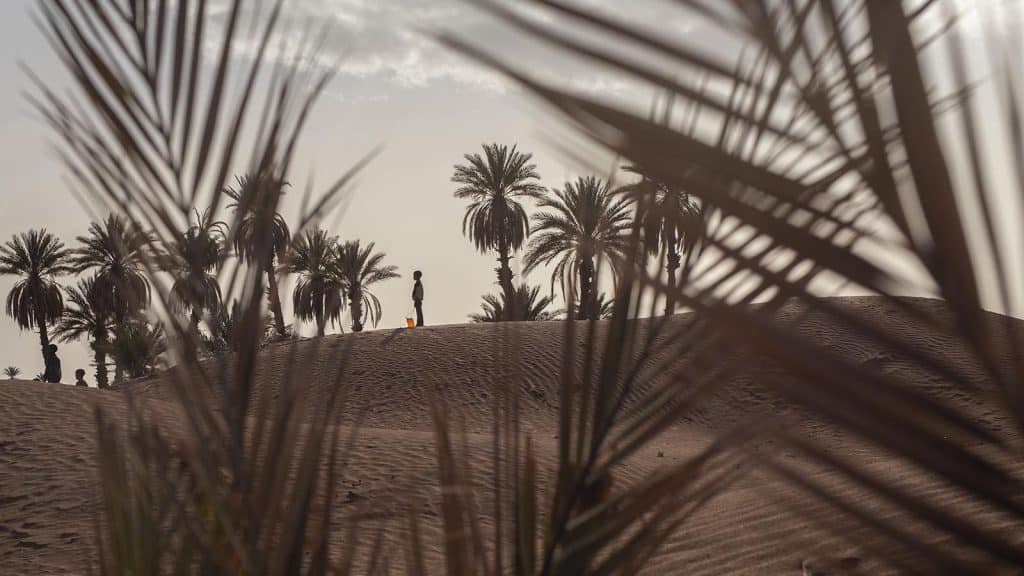
A little boy stands on top of a sand dune in M’hamid el Ghizlane. M’hamid, the furthest of the Draa valley oases before the Sahara and once a symbol of the area’s flourishing date trade, nowadays looks like an apocalyptic movie set. Home to just 8,000 people, in the past decades the oasis’s surface has shrunk by two thirds, and what remains is literally being swallowed by the desert. The drought has degraded the palm groves to a point where taking care of them has become almost impossible.
Survivor
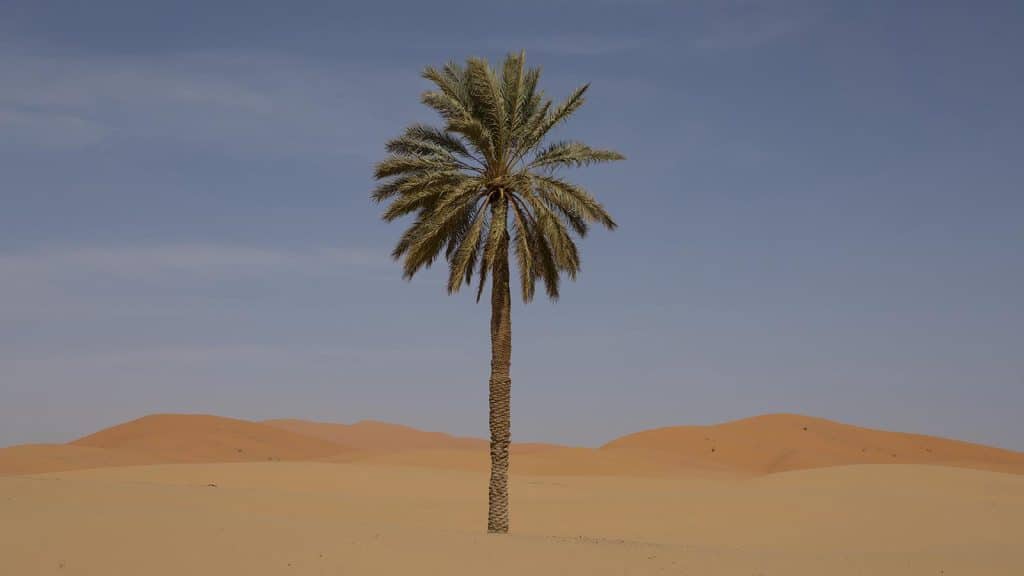
A palm tree stands amid the sand dunes in Merzouga. Oases are based on an unique agricultural system centred on palm trees, which provide dates— the oases’ main produce—and shade from sun rays, retaining the humidity necessary to grow orchards, vegetables and forage crops beneath them. This variety of cultures used to make oases extremely resilient and adaptable to weather changes. “Pomegranates, apples, apricots, peaches, olives, beans, wheat, barley… Everything can grow in a healthy oasis”, explains Abdelkarim Bouarif, an agronomist from the oasis of Skoura. “It’s an ode to biodiversity. All plants live in synergy, with the palm tree as the orchestra leader”.
Tea

A woman from Ksar Bounou pours tea in a glass. Moroccan oasis cover 15 percent of the country’s surface and host roughly two million people. Most of them lie along a wide desert basin south of the Atlas mountains, along the caravan routes that used to connect the Sahara with the Mediterranean coasts. Their inhabitants are the proud descendants of the nomad tribes that colonised these areas in the past centuries, and are viscerally attached to this land.
Life Goes On
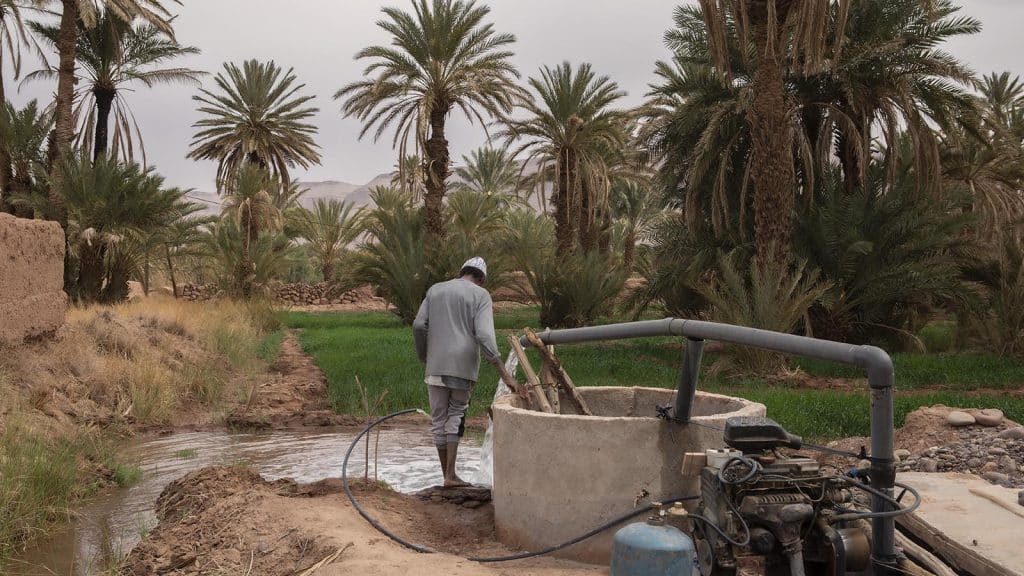
A farmer pumps water from a well in order to water his field in the village of Zouia de Sidi Elmokhtar Ben Ali. In the past, water resources in the oases used to be strictly regulated, with farmers being allotted a specific quantity of water, or irrigation time, on a rotation basis, according to the size of their land. But nowadays the availability of water pumps have prompted some families to dig private wells to irrigate their parcels, further exhausting the groundwater and chipping away at the principle of collective water usage, one of the main social pillars of any oasis.
Rain Chant

On a cold winter morning, a group of elders from M’hamid meet on the outskirts of the oasis, right where the desert begins. Dressed in traditional white robes, they start to clap and sing to the rhythm of a drummer, intoning a propitiatory chant to put an end to the drought and bring life back to the oasis. Until the beginning of the ’90s M’hamid used to have four seasons. Rains were regular in winter, and in autumn the place was abuzz with seasonal labourers and nomads coming from the desert for the harvesting season. Truckloads full of dates were departing daily for big cities like Marrakech or Casablanca. Once the season was over, families would celebrate with a flurry of weddings and common meals. “Now, the only thing we can do is pray for this drought to end”, explains one of the elders.
Oasis

A 54-years-old date trader with a contagious laugh, Mohamed Laaziz is from Tamegroute, a town of 21,000 and one of the many oases dotting the Draa river valley in southern Morocco. When he was a kid, his family fields were ripe with all sorts of fruit trees and vegetables, and palm dates—the oasis’s main livelihood —were plentiful. “During harvest season every family would collect more than a tonne of dates”, he remembers, as a broad smile lightens up his face. Nowadays, that same river is dry, and filled with bushes. “The Draa gets only three or four months of water per year”, explains a discouraged Laaziz. Most of the verdant and lively oasis he grew up in is now a shadow of itself, full of abandoned fields and drying trees. “It makes me sad”, he continues, “but you can’t fight God’s will”.
Green Again
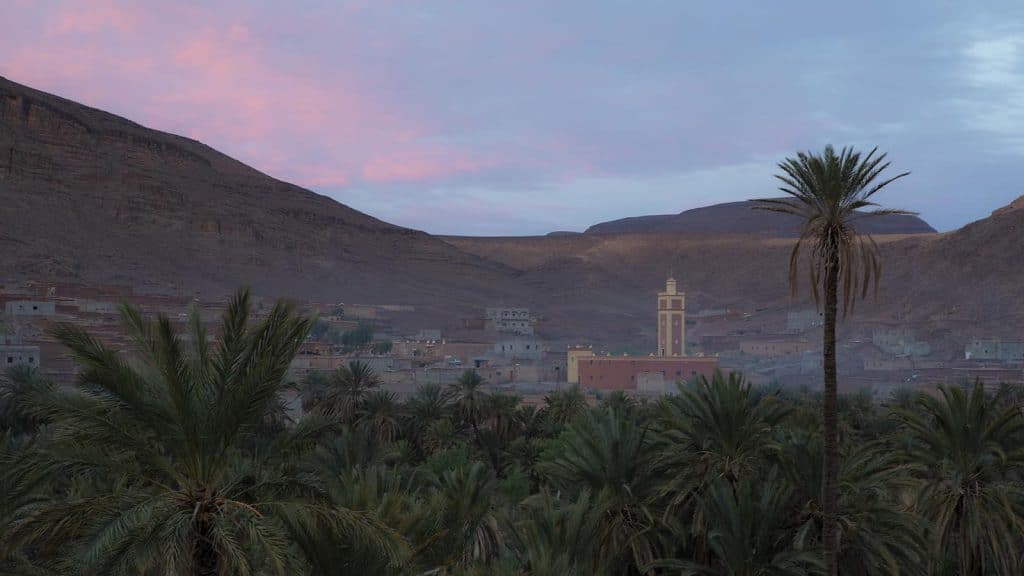
The sun rises over the Oasis of Fint. Fint, a secluded oasis of just 1,200 people in central Morocco, enjoys water all year long thanks to a river that cuts right across it. Despite being just a few hundreds kilometres away, its lush green fields are a world apart from the windswept, cracked parcels in the oases of the Draa valley. With its crystalline pools, waterfalls and creeks Fint looks like a paradise on Earth, a sort of preserved replica of how oases used to be.