

From the Esquire ME archive: November 2013
Khaled Jarrar’s view from his studio in Bir Nabala in the Occupied Palestinian West Bank is rather depressing. It faces the eight-metre-tall concrete wall erected by Israel in 2004, part of a 440 kilometre-long barrier that runs near the 1949 Armistice line, or “Green Line”, between Israel and the Palestinian West Bank but often diverges to include several Israeli settlements to the Palestinian side.
 This contested edifice, which will eventually be 800-kilometres long, is known to the Israelis as the Security Fence and to the Palestinians as the Apartheid Wall. To Jarrer is has become an unlikely muse. For the past year, he has secretly gone to chisel concrete from it, which he uses to make sports objects such as footballs, basketballs, football shoes and rackets. These casts symbolise the detritus left by children who play under its shadow. By repurposing the material, Jarrar says he seeks to provoke a dialogue about possession and reclamation of space.
Jarrer’s latest object is a heavy olive tree trunk that he found by the wall and partly covered in concrete. Before flying to the Jakarta Biennial in November this year, the tree had to be shipped off to Galerie Guy Bärtschi in Geneva, so he and his assistant Luay Jaber built a container for it. Unintentionally it ended up looking like a coffin. “For a dead tree, killed by the Israeli military, by their bulldozers,” he announced as he hammered in the last nail.
Jarrar hopes the box will avoid the scrutiny of Israeli security forces. One of his concrete footballs has been stuck for several months, first at Istanbul Airport, where it was denied entry, then kicked back to Ben Gurion Airport, where Israeli security is denying its right of return – a stateless football, ironically.
Thankfully not all customs departments are so unforgiving and Jarrar’s objects have travelled widely in recent months. They were on display at Art Abu Dhabi in November and have also travelled in 2013 to the Contemporary Art Museum at the University of South Florida, and before that to the Thessaloniki Biennale in Greece and London’s Ayyam Gallery. At the latter show, the highlight was an imposing concrete wall that ran throughout the gallery. In order to pass to the other side, visitors had to climb through a hole shaped like historical Palestine — just like thousands of Palestinians who trespass the barrier every week. It’s a phenomenon that Jarrar is all too aware of.
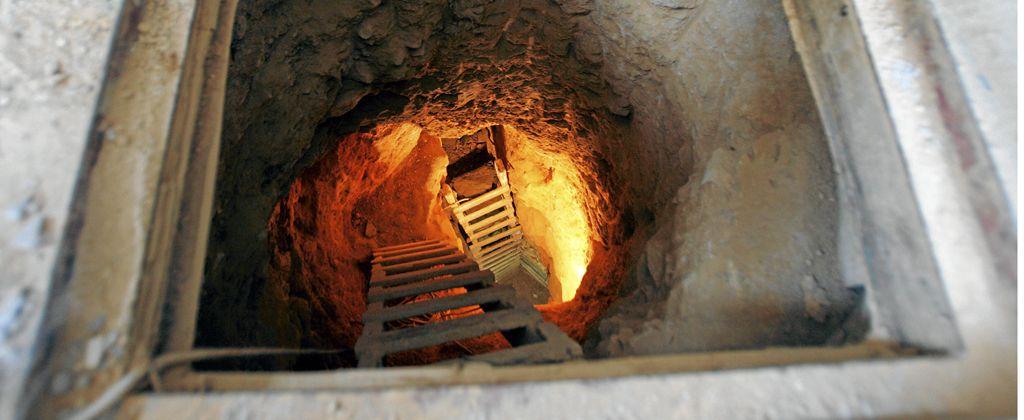
The first time I met khaled Jarrar, his shoes were soaked and he was clearly agitated. He had spent four hours in a sewage tunnel filming people passing from Ramallah to the Old City of Jerusalem, headed to pray at the Al-Aqsa Mosque.
It was a Friday during Ramadan in 2009, and I was on my way to Jerusalem above ground using the main Qalandia checkpoint. (Palestinians from the West Bank can only enter Jerusalem with a permit from Israel.) Jarrar described to me what he had just seen – men, women and children staggering through a 110-metre-long dark tunnel led by paid guides. Some had been warned about the green slimy sewage water and were wearing plastic around their shoes; others just had to stick it out until they reached the end of the tunnel and could crawl up through a tiny passage between the rocks and set their feet in East Jerusalem.
 This was Jarrar’s first attempt to document the many attempts by Palestinians to slip through the wall without permits, and it turned into the film Infiltrators. In the narrative, he accompanies “wall scouts” who search for passages through or over the wall.
He witnesses scores of workers who climb and jump the wall, sometimes to be caught and arrested by the Israeli military. He follows an old mother to a crack in the wall where she can touch the fingers of her daughter and see pictures of her grandchildren. The film won two awards at the Dubai International Film Festival 2012 and has since been being screened at film festivals and in cinemas across the world.
Sneaking into Israel without a permit inspires many emotions. Jarrar is familiar with these sensations of adrenaline and anxiety. After finishing high school in Jenin, located in the north of the West Bank, he was desperate to study art but there was not enough money to grant his wish. So he found a carpentry job in Nazareth, in the north of Israel, where he snuck across without a permit and worked illegally until he got caught by the police.
His interest in art had begun even earlier, sculpting wood as a child, but his passion for the subject was repressed by the occupation and the two Intifadas – Uprisings – of 1987 and 2000. “I grew up as a fighter against the occupation that stole our childhood and freedom,” he says, explaining that his school was closed during the first Intifada and that art was not a priority for the teachers who continued to deliver lessons in private houses.
Later on, Jarrar decided to apply for the police force, which in turn would sponsor his studies. But during an inspection shortly after joining in 1997, the commander spotted Jarrar among the police officers. “What are you doing here?” he asked, as he prodded the biceps and sturdy chest of the twenty-five year-old. Impressed with Jarrar’s physique, the would-be artist was immediately upgraded to Yasser Arafat’s presidential guard. He would remain with them as a soldier until 2007, and is still with the army as a photographer. Yet today he regards the commander’s perception of him merely as a piece of meat. “They consume soldiers as if they were producing bottles,” he says bitterly of his experience.
Wanting to spark a debate about the manufacturing of soldiers, Jarrar created The Battalion, which was exhibited at Guy Bärtschi Gallery in Geneva in March and April this year. It consists of prints on pink material of 540 soldiers, all of them the same picture of Jarrar. “It’s not me, Khaled, it’s just a number,” he explains about the army’s perception of its men.
Using the colour pink was also a deliberate swipe at military convention.
“It’s regarded as feminine and it’s the enemy of the army,” he explains. “But pink is full of energy and warmth. It represents what’s going on, on the inside.”
For years, Jarrar was unable to recall any of his dreams. As he discovered with a therapist, it was a self-defence mechanism to protect him from remembering. Jarrar was defending Yasser Arafat’s al Muqata’a compound, which the Israeli’s invaded in 2005, following the outbreak of the Second Intifada and a string of Palestinian suicide bombings. Confronting those traumas led to nightmares based on those locked away memories. Jarrar would wake up shaking and covered in sweat. But, following advice from his therapist, he began keeping a pen and paper by his bedside, to scribble down what his subconscious had just dredged up…
Boom! Another bomb hit the remains of our compound. The invasion has been going for a week now and I haven’t taken my boots off once since then and hardly slept.
A scream, then blood sprays from the neck of my friend. I try to get to him but suddenly my legs disappear from under me. I look down. Blood is pouring from a big open wound in my right leg.
Red Cross volunteers insist on taking me to the hospital. They carry me out — right into the arms of the Israeli army! They are gonna eat me alive.
“Where’s your weapon!?” a soldier screams to me.
“I want a doctor, I’m injured!”
“Shut up, f*** your whole family!” another soldier screams.
Four soldiers pick me up and carry me, escorted by another four armed guards.
“What the f***, this son of a bitch weighs 200 pounds!” one of them complains.
Which one will it be that shoots me?
They put me on the ground in the rain next to a tank.
Okay that’s how I’ll die, they will run over me.
An Israeli doctor comes to check on me, but he leaves instead.
“You shot at our soldiers!” he shouts and hurries off.
Finally I am lifted into an Israeli ambulance. On my left I see dozens of Palestinian nurses and doctors who have been arrested and are kneeling blindfolded and handcuffed. After a bumpy drive, I am dumped on the street in the pouring rain. I wait again. Finally a Palestinian ambulance comes and takes me to the hospital.
“I needed five blood transfusions and they found thirty pieces from the bullet inside my leg,” he recalls. Today he still has twenty-two pieces that are too small to be removed.
Two years later, Jarrar created his first artwork At the Checkpoint, a collection of photos taken at border crossings and exhibited at Huwwara Checkpoint. “I was so angry at the occupation and how these places harass the people,” he recalls. But along with the anger, he saw that the artistic process could be a meditatative process that could heal his soul from the traumas of army life. Wanting to pass that on to the new generations, he is now building a new studio and art space where he wants to teach children art, painting, sculpture and conceptual photography. It’s an opportunity that he never had to express creative impulses and pursue a passion for art.
Fame can be a blessing and a curse. With Whole in the Wall and Infiltrators, Khaled Jarrar has attracted international media coverage. His work is also being noticed by curators, festivals and galleries, and he is proud of the recognition this brings to his society. That also brings with it high expectations of what he will do next, which at times has been overwhelming. “It’s a lot of pressure. Everyone is constantly asking me what my next project is. Khallas, now I am finished with concrete.”
The attention has brought with it other unforeseen developments. When he returned to the West Bank from London, Israeli security knew who he was and detained him for questioning at the border crossing from Jordan. But instead of feeling intimidated, Jarrar said it made him feel good. “Because I see how my art became noticed by them. I’m doing the right thing and I’m winning with art.”
By Janne Louise Anderson