


Laughter is a universal language. It is a natural human instinct that transcends borders and touches the heart of everyone, regardless of age, race, or nationality. So powerful a tool, it can lift us out of our troubles and transport us to a different world, away from sadness, despair, and bitterness—albeit, sometimes only briefly.
For Saudi actor Saleh Abuamrh making people laugh is an artistic mission. From his YouTube series Roya to the critically acclaimed television show Sekket Safar, and his lead role in Al Maktab (The Office), his work reflects a unique and unconventional comedic style that is unlike anything seen before in the Saudi entertainment industry.
The 36-year-old’s career is still only just beginning to flourish, but it is already proving to be an important one. A contribution that gives more than it takes away. A story that can’t help but make you smile.
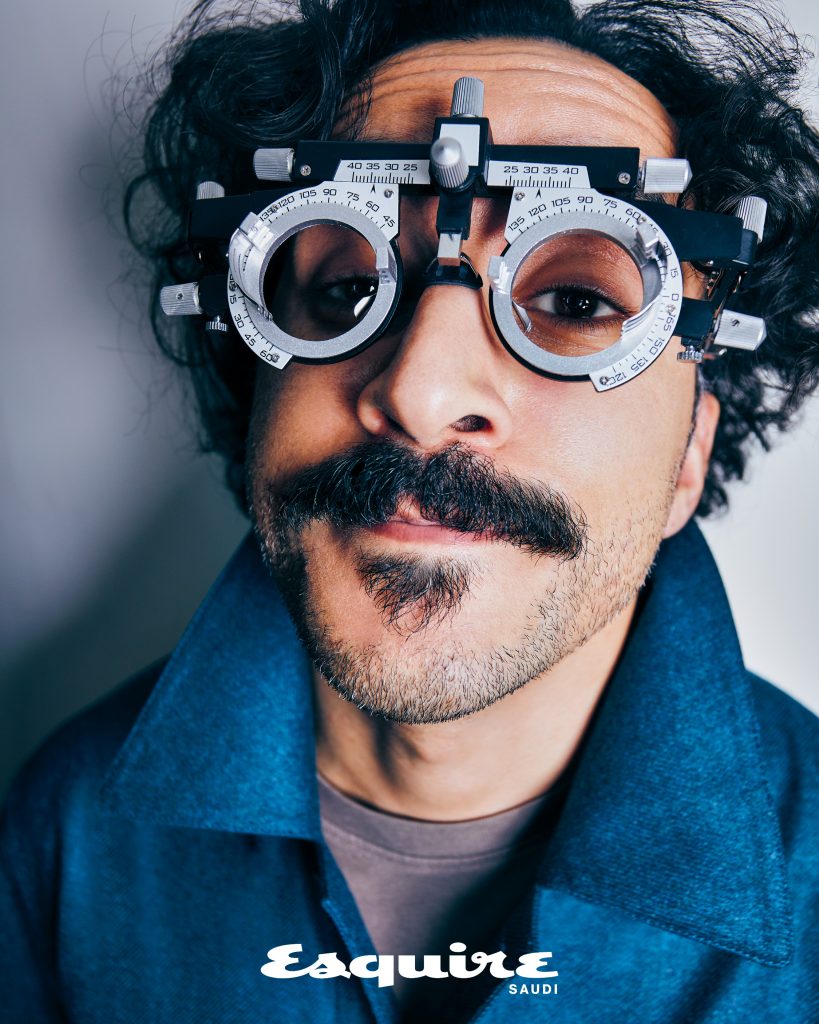
Abuamrh attributes his love of comedy to his childhood. Born in the town of Al-Namas, in southern Saudi Arabia, it was a peaceful, rural, place surrounded by mountains and farms—the quintessential village community. “In a village, you don’t live in a small family but rather in a large extended family with everyone who lives there,” he says, describing it as a normal and uncomplicated childhood in the midst of the beautiful nature. He remembers that the people in village were always laughing.
Comedy has a special resonance with people in southern Saudi Arabia. Abuamrh describes the people in his village as “the best comedians in the region.” Their gatherings were filled with laughter that was genuine and heartfelt, often not adhering to traditional social conventions. “Our gatherings tended to be informal, and rather fun. Everyone loved to laugh and tell jokes, often acting like they were on stage in the theatre,” he says.
Whether it was because it was a happy time, or because if you laugh in the face of adversity, you can rise above it, for Abuamrh finding humour in everyday life around him became a way to cope with relatively harsh realities of rural life. “Life there is busy and full of chores. People in the village have moments that they don’t want to waste by being bored or unhappy. So laughter was the perfect alternative. I envied them for that, and I realized that this it was the kind of life I aspired to have.”

He tells stories of how when he was younger he used to stand in front of the mirror and act out comedy bits. “I just always felt that I had something to offer people. People around me used to say the same thing,” he recalls.
A rural childhood is a double-edged sword. Despite the close-knit community—unlike growing up in the cities of Jeddah or Riyadh—opportunities are fewer. A boy from the sticks often doesn’t have the luxury of choosing his profession or the ability to pursue his passion. “I worked hard to create my own turning point,” says Abuamrh, “I refused to take ‘no’ for an answer, and even though it was not an easy choice at the time, it was only through taking the harder route that I really found out who I was. It takes guts to chase a dream.”
Against the wishes of his friends and family, Abuamrh left his hometown, and a life of working in the harvesting community, in search of his passion for acting and comedy. The journey was tough at the start, financially it was full of obstacles and setbacks, but he persisted, always underwritten with an element of frustration and a fear of failure.
Despite the hardships—or perhaps because of it—it was a very formative time for Abuamrh creatively. Built on a sense of realism his comedic style developed with a sense of satire and social commentary—often using humour to address serious issues. Embracing his roots, he is known for using his local dialects and references to rural Saudi culture. After years of bouncing between cities in the Kingdom, Abuamrh had a new idea. He decided to return to the south, to the city of Abha, to write a new artistic chapter in his story.
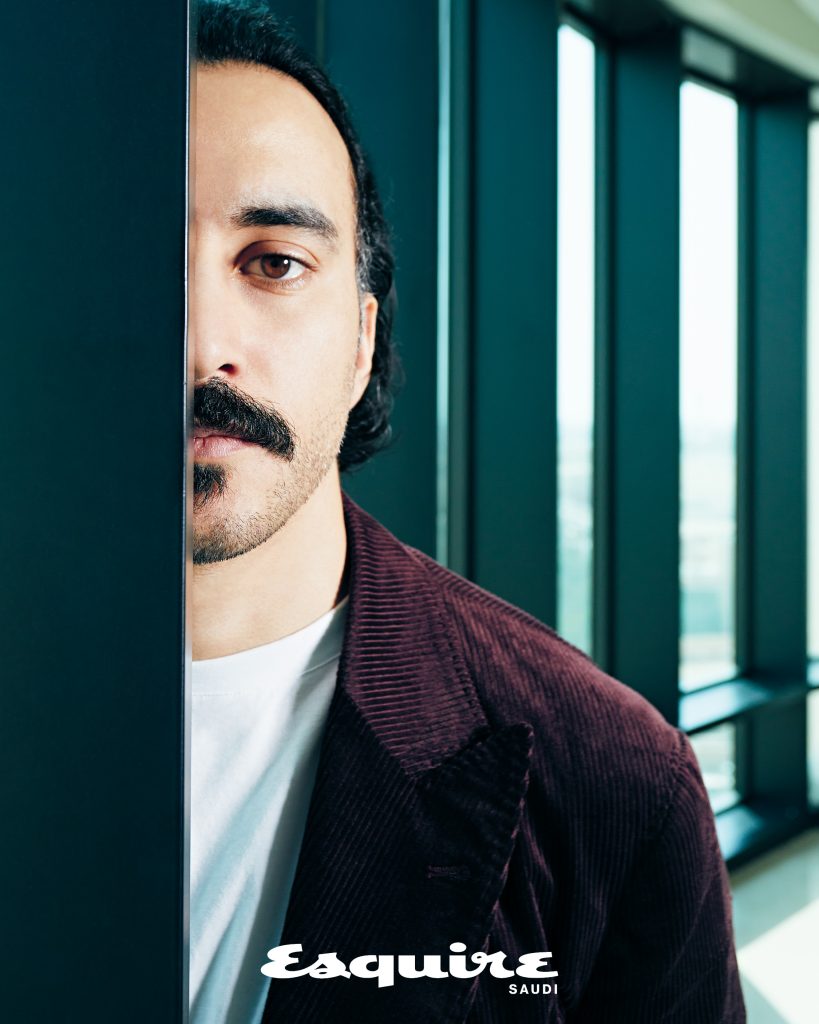
LOCATION: Fairmont Riyadh

LOCATION: Fairmont Riyadh
Before continuing, let’s take a moment to discuss the state of the Kingdom in the rise of the social media era. In the early and mid-2010s, content creators flooded the media landscape in Saudi Arabia. In the Western Region, the “Uturn” network emerged with a number of comedy shows, and in the central region, a group of young creatives called ‘Telfaz11‘ were creating innovative new shows that were being well-received by the local audience. Their shows were characterized by a similar satire-based comedy style that addressed social issues. It was in that same space that Saleh Abuamrh identified the gap he knew that he had to fill.
Despite being good, the aforementioned shows did not appeal to an audience in the southern region of Saudi Arabia, which is a different audience that requires a special language. “At that time, there were no programs aimed at the southern audience,” Abuamrh says, “so I decided to launch my own YouTube program, Roya, which spoke directly to that audience—my audience.” The show grew steadily with an audience that was not accustomed to video content that was targeted to them.

Abuamrh emerged from Roya having developed several characters and fine-tuned his storytelling, determined to move forward in the world of film and television.
“After I finished Roya, I took some time off to recalibrate,” he explains. It was then he received a call from a producer asking him to read a script. That script would become The Fates Hotel—the wildly-acclaimed Saudi TV series that played a pivotal role in the evolution of country’s television industry. While his role was a supporting one, it was a very welcoming first step, after years of grafting and push back. “I was very grateful to be given the opportunity, and I know that I wouldn’t be where I am today without it,” he admits.
If The Fates Hotel was Abuamrh’s introduction to mainstream television, Sekket Safar was his confirmation. The comedy series embodied the core values that he had been dreaming of working on over the years—an innovative, relevant comedy aimed at a new generation of audience, with a script sprinkled with local humour and a relatable cultural realism. While initially Abuamrh was slated to play the role of Nasser, he ended up being cast as Khaled, which ended up being a stroke of genius—becoming many viewers favourite character.

“Sekket Safar was different,” he explains, “it wasn’t so much about the script, but it was about the creative spirit that it fostered. As actors we were allowed to improvise and alter the dialogue in ways that we felt it would best fit our characters, and give more realism to them.” There was a great deal of trust from the producers and directors in Abuamrh and fellow actors Saad Aziz and Mohammed Al-Shammari, who embraced the opportunity.
“Honestly? I was a little concerned when I read the script for the first time,” admits Abuamrh. “The dialogue didn’t ring true to the new generation of audience for who it was aimed at. I reckon that by the end of it, about 80 percent of the script had been changed from the original one I read.”
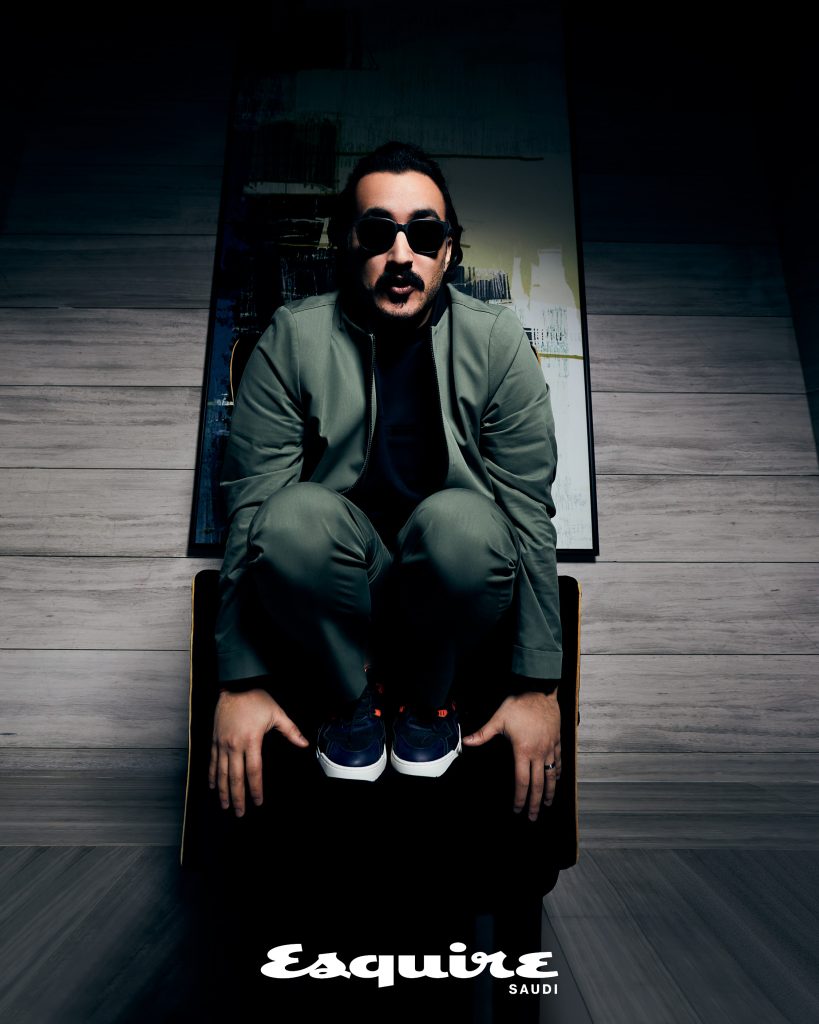
Abuamrh remains aware that success is never guaranteed, and to continue the path of success you need to remember what got you there in the first place. This is a lesson that he learned in the most public of circumstances. His casting as Malik Al Tuwaifi, the lead character in Al Maktab—the Arab-language remake of the global TV smash hit The Office—made international news. However, as expectations raised for it to replicate the success of the British and American versions (with Abuamrh playing the role of the bumbling boss made famous by Ricky Gervais and Steve Carrell), the reception it got when released was mixed—particularily on social media.
But feedback—even negative—is a positive, according to Abuamrh. It is not the first time he has had to look inside himself to find strength in his conviction. “I apologise to the audience if they felt let down by the show,” he says to Esquire Saudi. “I am not a fan of adapted scripts,” he says, “but I loved the English-language versions of The Office. Sure, it could have been better, perhaps with a script that was more compatible with local humour, but I don’t believe it is as bad as some people might say it was!”
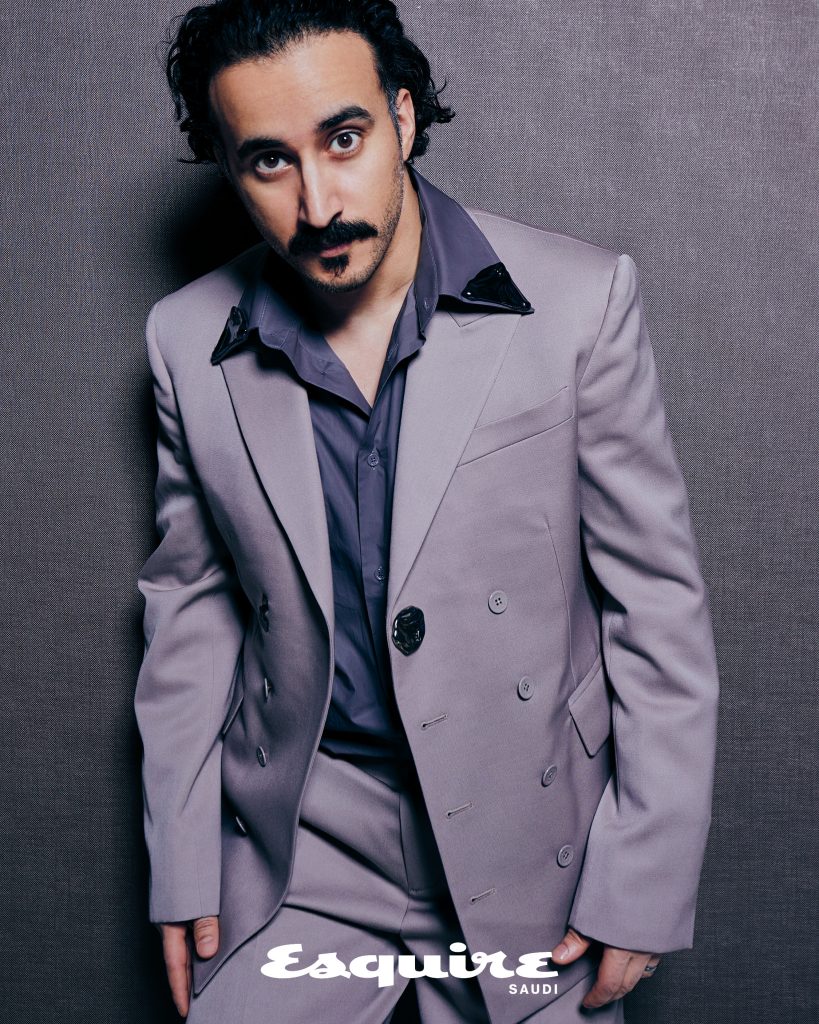
Sunglasses, ABUAMRH’S OWN;
LOCATION: House of Grill at Fairmont Riyadh

Sunglasses, ABUAMRH’S OWN;
LOCATION: House of Grill at Fairmont Riyadh
If the strength of an actor’s character can turn criticism into experience as an armour, then praise and success can be seen as additional blocks to build on. What the second season of Sekket Safar showed us was elements of a dramatic turn for Abuamrh, opening the door to the question: could we see him moving away from comedic productions to more dramatic ones?
“Yes, of course,” he says without hesitation. “I love comedy, but don’t want to limit myself, and so I was keen to present a dramatic side that was based in realism.” He mentions, that when it comes to role models, someone he revers on a global level is Daniel Day-Lewis—notably for his versatility. Locally, he credits the duo of Bakr Al Sheddi and Mohammed Al-Ali, as childhood inspirations.
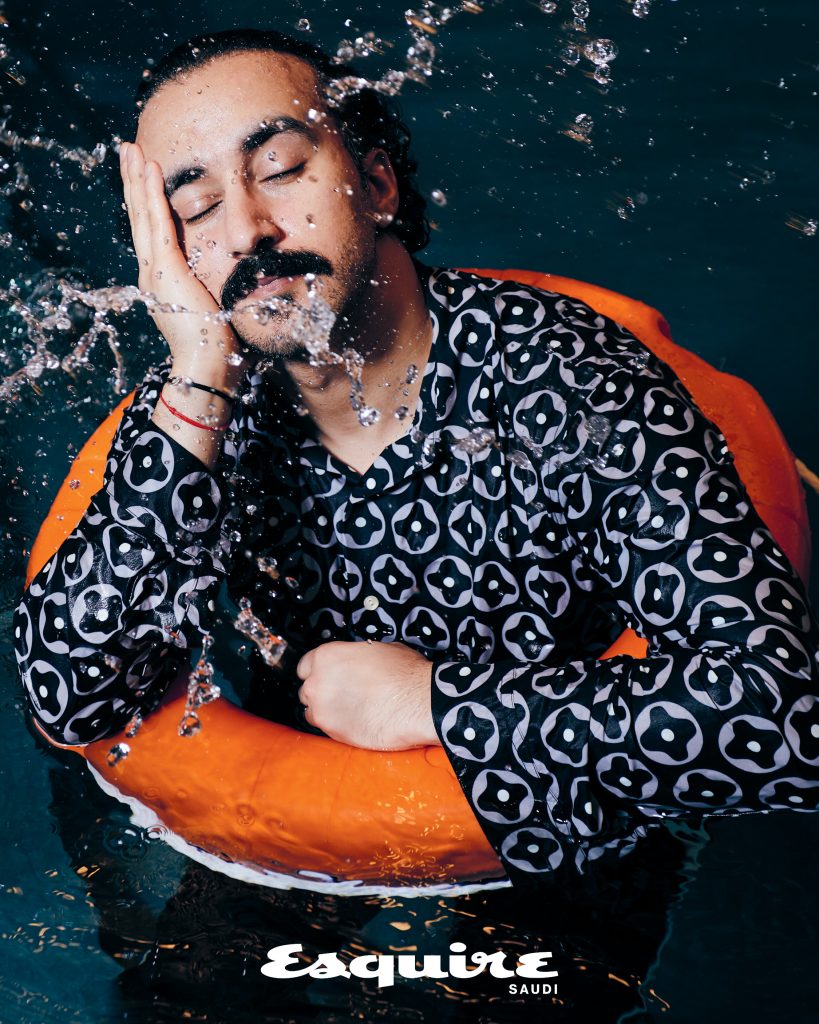
For Abuamrh, his status, star power, and understanding of how to speak directly to a new generation of Saudi audience, a future in film is inevitable. But for the man from southern Saudi who helped re-write the modern direction of comedy in the Kingdom, there is still nothing quite like laughter that can help bring people together.
“Laughter is part of how we overcome life’s difficulties—it is a cure,” he says. “Laughter is my message in this life, and my happiness is indescribable when I see someone smile because of something I have done.”
This article was originally published in Esquire Saudi – Autumn 2023
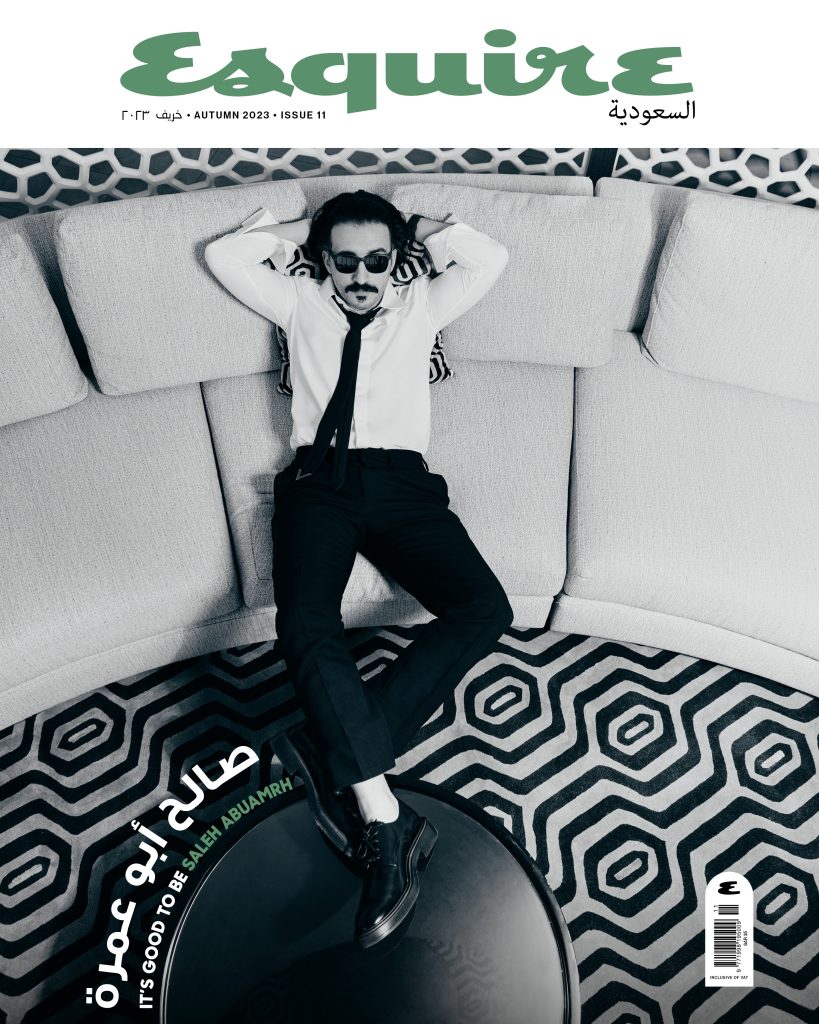
Photography by Oscar Munart / Styling by Nour Bou Ezz / Grooming: Chaps & Co / Senior Producer: Steff Hawker / Styling Assistant: Merhan R / Talent Magagement: Turn Up Agency / Location: Fairmont Riyadh