

There’s an apocryphal quote attributed to Henry Kissinger that neatly sums up the hard political power that the beautiful game possesses: “To be a country, you need an army, a currency, and a national soccer team.”
Earlier this year, Kosovo played its first ever FIFA-recognised game in the divided city of Mitrovica. It was significant on many levels. For one, Kosovo is battling to be recognised as an independent state. Despite being accepted by the vast majority of the EU, the US and other countries around the world, it is unlikely to become a UN-recognised state anytime soon. Serbia believes that Kosovo is an integral part of its territory and will never accept an independent Kosovo. Neither will its ally Russia. And seeing as Russia has a veto at the UN Security Council, that decision seems final.
But the battle for recognition goes far beyond the UN. Sport, and especially football, is seen as a vital symbol of identity for any wannabe state. Kosovo has been trying to gain membership to FIFA, football’s global governing body, and UEFA, its European confederation, since the Kosovo War finished in 1999. When I interviewed Sepp Blatter in Zurich in 2012, he promised that some form of recognition was possible. In the end it was a compromise that won out. Kosovo could play other FIFA teams, but without formal recognition. Last month the International Olympic Committee (IOC) also announced it too would recognise Kosovo provisionally.
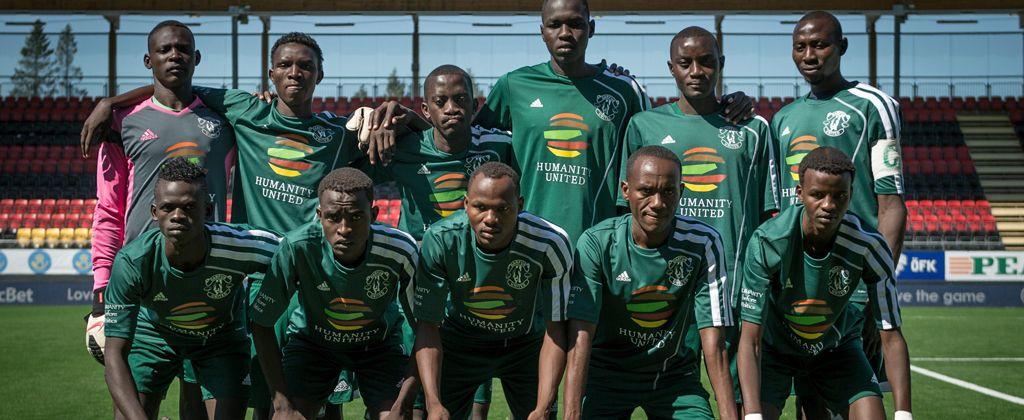
Kosovo is walking a well-trodden path by using football as a means towards statehood. As this summer’s World Cup began in Brazil, a tournament for unrecognised nations, the Confederation of Independent Football (CONIFA) was taking place in Sweden. Twelve teams including Tamils, Kurds, Sami and Occitanians, competed in one of the world’s largest tournaments for stateless or indigenous people, regions seeking autonomy, and other non-FIFA affiliated teams.
The road from a largely unknown tournament in Sweden to statehood might often be a pretty hopeful shot in the dark, but there have been some notable successes in using football as a backdoor route to international recognition. The most famous example is the Palestine national team. Blatter was instrumental in their recognition by FIFA in 1998, despite the territory still not being officially recognised as a state. Other disputed territories have tried to do the same. The Kurds have their own national football team, as do Nagorno-Karabakh and South Ossetia.
But the biggest success is that of Gibraltar. The tiny Overseas British Territory on the Iberian Peninsula was ceded to the British by the Treaty of Utrecht (1713), but the Spanish still claim it as their own. So when Gibraltar attempted to join UEFA in 1993, Spain was livid. It threatened to pull its club and national teams out of continental and international competitions in protest. UEFA and FIFA, terrified of losing revenue and prestige from an absent Real Madrid and Barcelona, pored over the original treaty, looking for loopholes to stop Gibraltar joining. In the end the rules were changed, with UEFA deciding that only UN-recognised states could join, which remains the current stumbling block for Kosovo’s recognition.
But Gibraltar took UEFA to the Court of Arbitration for Sport, and won. They became a full member last year and embarked on qualification for Euro 2016 in September. In November they played World Champions Germany. For Gibraltar, every game, even heavy defeats like the 7-0 thrashing by Poland in their first game, offers name recognition on an unimaginable scale.
Seen in this light, Kissinger was perhaps correct in his observations about the three things that make up a country. But, in a world awash with guns, where a militia can be raised in a week in Eastern Ukraine and where a crypto currency like BitCoin can be set up overnight, starting a national soccer team might prove to be the hardest route to statehood of all.
by James Montague