
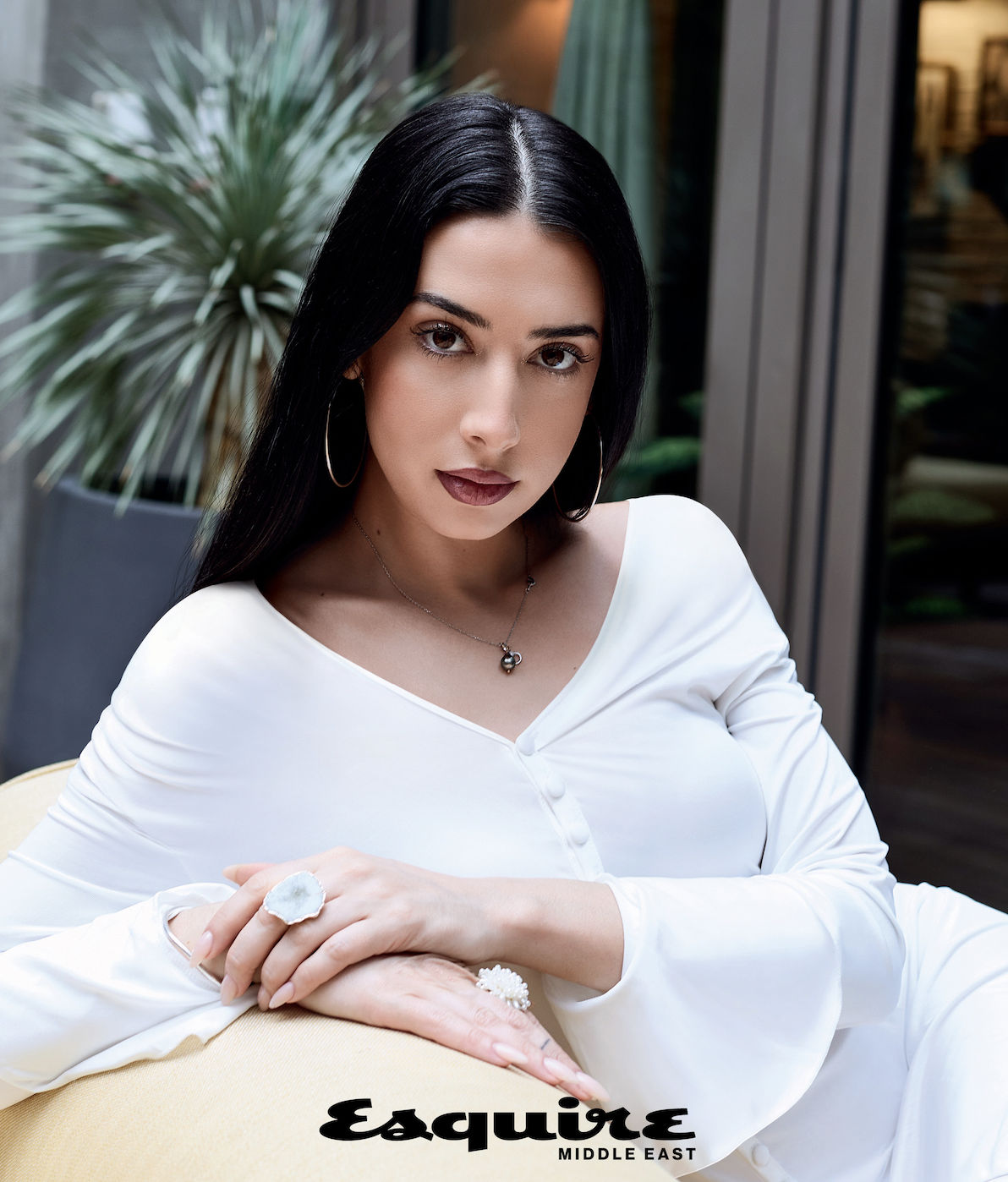

Naïka arrives at the 25 Hours Hotel holding a coffee, her hair pulled back, wearing a simple white dress. There is no entourage, just her and her father. Yet from the moment she speaks, it is clear this is someone whose quiet presence conceals a depth of talent and thought.
“Na, yeah, Ka,” she clarifies when asked how to pronounce her name. The simplicity of her introduction contrasts with the complexity of her music and the layered identity behind it.
We meet shortly after her first full concert in Dubai at Sole DXB. She had played the city before at a private brand event, but this was her debut to a wider audience. “It was incredible. The audience’s response exceeded all expectations. Dubai is such an international city, and seeing people connect with the themes of identity in my music was amazing.”
Identity runs deep in Naïka’s life. Born to a French father and a Haitian mother with Middle Eastern roots, her upbringing spanned continents. Her father’s work in renewable energy meant frequent moves between the Caribbean, Kenya, France, and South Africa. “It was always a bit tumultuous internally, figuring out where I belonged. But as much as my identity crisis weighed on me, it also lifted me. I am a very adaptable person. Home is my people, not a place,” she explains. “That was all I knew growing up. We would live somewhere for three or four years and then move on again.”
Each move added layers to her identity, something she has come to embrace, and continues to influence her music. She describes her sound as global and vulnerable; a reflection of a childhood divided across continents. African rhythms, Caribbean beats, French chanson, and Latin influences from her Miami-based cousins blend seamlessly with pop sensibilities. “I discovered pop music when I was seven. I would copy Britney Spears at school and assign my friends as my backup dancers. I was born to be a leader,” she laughs.
Her multilingual approach to songwriting further reflects her eclectic upbringing. Naïka moves fluidly between English, French, and Haitian, letting the language emerge naturally from the emotion she wants to convey. “Different languages have their own essence. Sometimes one language can express a feeling more vividly than another,” she says.
Her debut album, Ecclesia, is the culmination of these influences. The album follows years of exploration through earlier EPs, Lost in Paradise Pt. 1 and Pt. 2 (2020/21), TRANSITIONS (2022), and numerous singles. “The EPs were about exploring and finding myself. I had to figure out my sound and how to bring it to life. They were a way of solidifying my sound and discovering who I am as an artist,” she says.
For Naïka, Ecclesia is less a collection of songs than a self-portrait. The title, suggested by her father, comes from an ancient Greek word meaning a gathering of people, a sentiment she felt perfectly captured the spirit of the album. “I knew it would represent all the different sounds and influences that make up who I am,” she explains.
Across thirteen tracks, the project blends multicultural sounds and themes, serving as a fitting introduction to her artistry. “I would define my music as global and vulnerable,” she explains. “There are Afro influences from Africa, Caribbean music at the core, French and Latin references, and pop, which I fell in love with as a child. It takes you on a journey through different worlds and topics.”
That sense of movement mirrors how she sees herself. “I like to think of myself as a bridge,” she adds. “I don’t belong to one specific box. I have friends from completely different cultures and worlds, and I love when people come together despite their differences. I want listeners to come in with an open mind, listen from top to bottom, and feel enriched.” Her debut album marks only the beginning. A major tour this year will take Naïka across North America and Europe, with Middle Eastern dates to follow. “For now, my focus is on Ecclesia. The album is out now!” she says, smiling.