
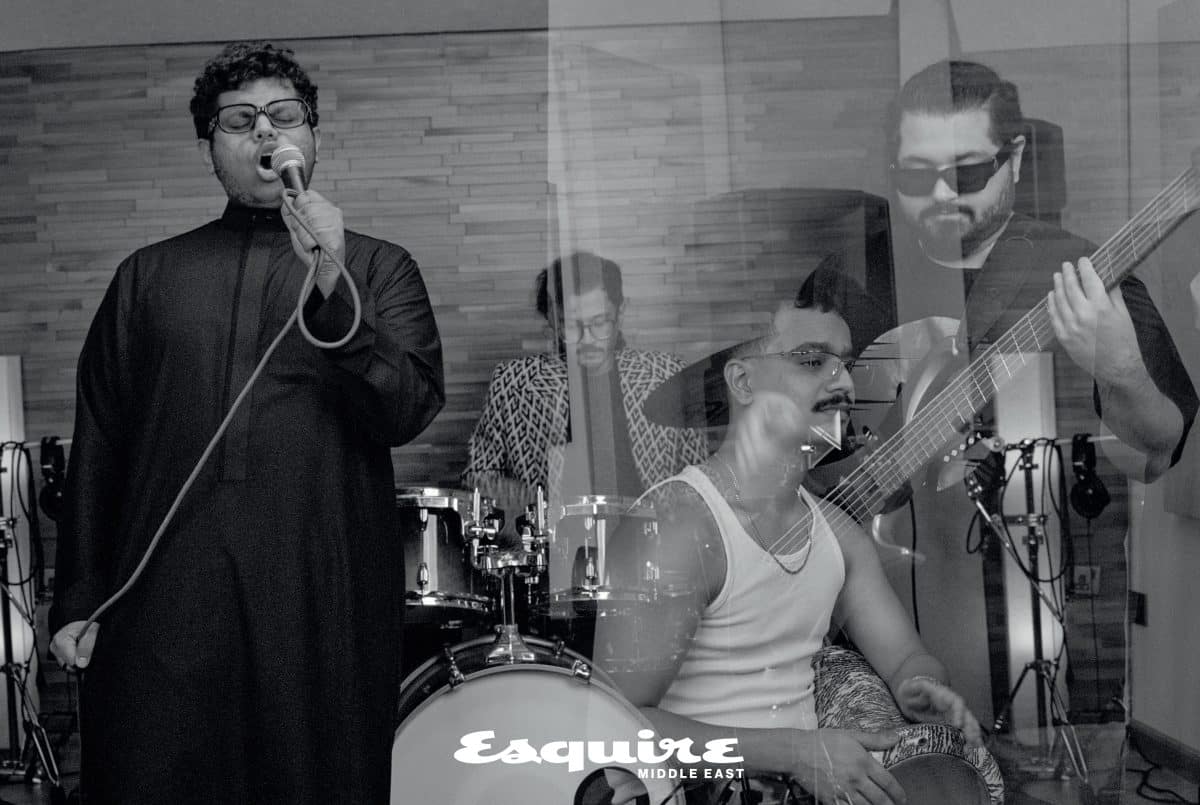
Maan Balila was around 18, when he sat down and tried to work out how to play each individual part of a song by cult 2000’s nu-metal band Mudvayne. “I was just trying to copy what I heard. That was a formative thing for me, to hear music that was a little bit different, a little bit more mathematical,” the ana.n7n drummer recalls.
“I would try and record a full cover of the song with me playing all of the instruments.”
“By the way,” Malik Zubaila nods, Balila’s bandmate and the vocalist and synth player for ana.n7n. “He might not tell you this, but he’s an incredible multi-instrumentalist. He’s not just a drummer.”
It’s only a small exchange between the pair, but it tells a great deal about their band, their approach to music and the obvious respect that the members of ana.n7n have for each other.
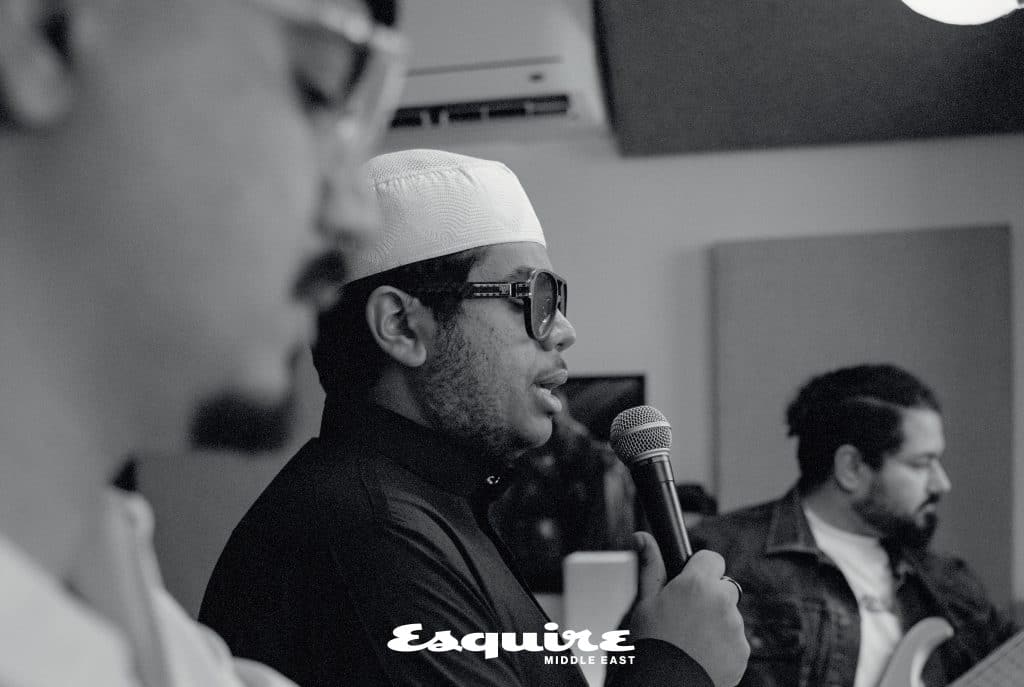
Since their formation in Jeddah in 2019, ana.n7n—completed by Saleh Bin Saif on percussion and keys and dual bassists Saif Mufti and Shaher Karkashan—have been making increasingly unusual and idiosyncratic music.
More than just a straightforward metal band, ana.n7n’s stories of modern societal issues expressed through a meld of harsh, technical riffs, woozy, synth-led rhythms, pop hooks and localised folk melodies are brilliantly unexpected.
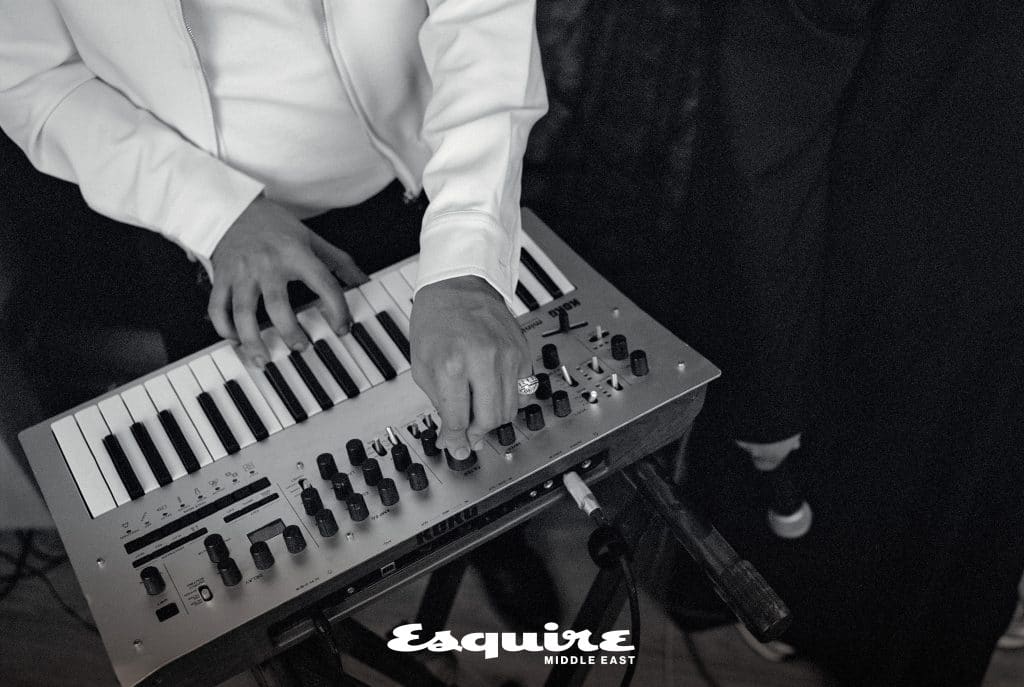
Each member of ana.n7n seems to have been brought in to showcase their own specific set of influences; so whilst Balila enthusiastically identifies as a ‘nu-metal kid’, before excitedly talking about the impact Limp Bizkit had on his life, Zubalia instead details the merits of his dalliances with electronic music, having been initially inspired by video game and industrial sounds, and Bin Saif speaks passionately about his background in traditional Arabic music.
On paper, you’d be forgiven for thinking that this hotchpotch of styles and genres fighting for space could make ana.n7n’s music too jumbled or claustrophobic to work, but that’s far from the case. Instead, the band’s open-minded approach to incorporating each other’s tastes has resulted in a truly unique sound.

“Malik is so talented that I can send him something nu-metal-inspired and he would write something that would fit in perfectly, even though it’s something he doesn’t know much about.” Balila explains. “I find that amazing, the pure talent to be able to do that.”
It’s clear that, although everyone in ana.n7n gets to have their voice heard, the relationship between Balila and Zubalia is the key to making this music gel.
“We decided that we needed to be friends first, then see if we could make music together,” Zubalia smiles. “But we’ve always believed that everything in this band starts from conversation.”
Despite coming from different musical backgrounds, there are important similarities the pair share. The most crucial being that both took time to study abroad where their nascent interests in making music was stoked: Zubalia being encouraged to sing after performing live in front of a summer camp of students in Canada and Balila playfully jamming with his college peers in England.
Due to the pair growing up when Saudi Arabia’s music scene was very much in its infancy, both remember the alien realisation that there may be a future for them in creating music. “I just assumed they’d all be better than me,” shrugs Balila at his first attempt at collaboration. “It took a while to realise I could do this.”
Times have changed. Since finding each other and forming the band, ana.n7n has been one of many musical groups that has benefitted from the Vision 2030 programme. Zubalia describes how the Saudi music scene is rapidly transforming, “From, maybe not zero, more like zero point five, to a thousand in what felt like a second.”
The rise in metal and alternative music is something that has hugely benefited from the investment into the Kingdom’s music scene. “Metal is really interesting. In new markets, two genres you normally expect to see emerge from the underground are hip hop and metal,” remarks Paul Pacifico, the CEO of Music Commission for the programme. “They’re very niche, there’s a strong sense of community, and a strong global network in that niche that has a very communitarian feel.”
That sense of community is something the members of ana.n7n agree exists, enthusing on the abundance of new venues, regularity of concerts and variety of bands and sounds that they have been exposed to. But, despite all of this, there is the sense that they still see themselves as outsiders within the scene. Going as far to suggest that they don’t even identify as a metal band at all, and instead something more amorphous and uncategorisable.
“We definitely don’t appeal to the more mainstream sensibilities,” shrugs Bin Saif. “I don’t think our music is commercial.” Zubalia even believes that the band is more inspired by conversation and thoughts rather than any specific musical genre. “Again, we said ‘Let’s talk about things’ rather than ‘let’s make music’. Every story we tell in ana.n7n is down to an idea that forms a topic of conversation, rather than the musical aspect of the song,” he explains.
It’s another aspect that makes ana.n7n that little bit more elusive, far harder to pin down to a certain sound.
“A huge part of our bonding was our shared perspective of the growth of what was happening in society, the community and how social media affected that,” Zubaila continues. “We’ve never made a concept album per se, but we’re certainly interested in talking about and exploring the themes of how society is changing.”
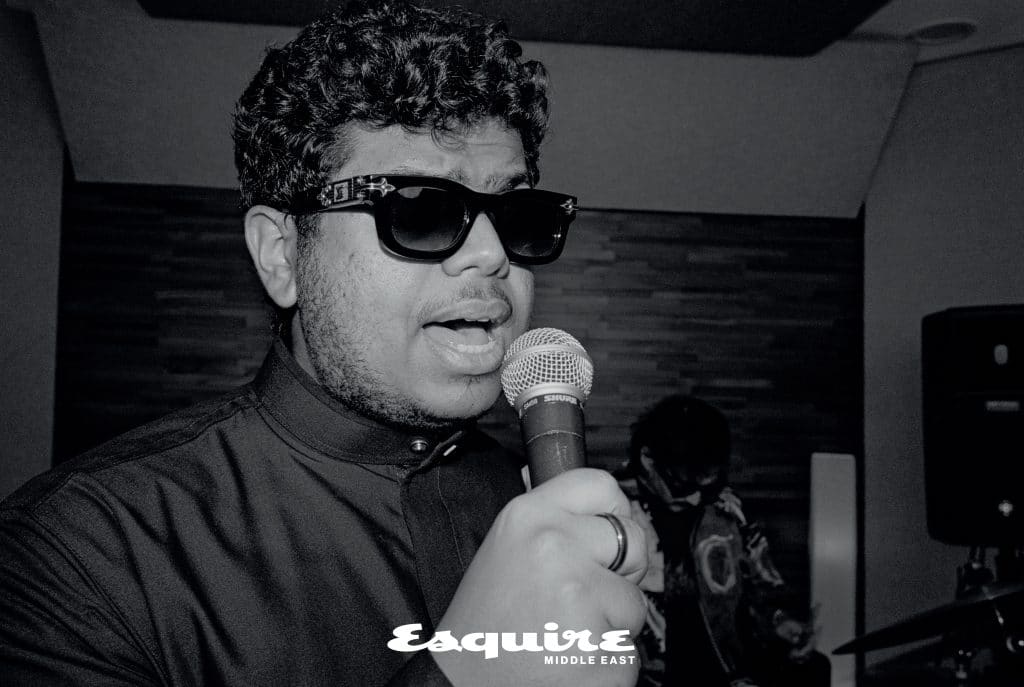
This is also part of ana.n7n’s decision to sing in their local dialect, a choice initially made due to the band members’ memories of being inspired as children by Arabic dubbed anime cartoons. Bin Saif describes the shows as giving them something that they felt was “theirs”, instilling an aspiration in ana.n7n to make music that represents their culture.
“Even the commercial and well-known local songs were not in this dialect,” Zubalia tells us. “It’s very important for us to tell these stories and narratives that can be understood by any single person. Equally, we want to showcase who we are and where we’re from.”
“Culturally and historically, I don’t think there is a lot of music that uses our dialect,” adds Balila. “That was one challenge for us; how do you use this type of language in rock music? Navigating this new and uncharted territory for us was a bit of a tough one to feel out.”
The culmination of tackling those challenges has resulted in ana.n7n’s debut album Fi Maken Ma… Fi Zaman Ma. A record that is so filled with surprises, depths and musical left turns that, even after a significant number of listens, new layers and sounds are constantly revealing themselves. It’s not an easy album to take on immediately, but the rewards of repeated listens are plentiful.
And it appears music fans are taking the time to give Fi Maken Ma… Fi Zaman Ma the attention it deserves. “Since the album’s release, more people are coming to our shows and singing along,” Zubaila smiles. “It’s hard to feel like too much of an outsider when you get that kind of reaction. We’re happy to welcome more people in, but our focus is, and always will be, on creating music that we feel represents us and our values.”
With the Saudi music scene growing at a rapid rate, expect these single-minded, maverick songwriters to keep banging the drum for innovation in heavy music.