With Avatar: The Way of Water and its upcoming sequels, James Cameron is not just setting out to make a dazzling technical marvel. For the legendary director, this franchise is his attempt to change the world
In early 2010, James Cameron, fresh off the release of the biggest film of all time, found himself deep in the jungles of Brazil’s Amazonian rainforest, sitting with the tribal leaders of the Kayapo.
“If they build this dam, our children will die,” they pleaded with the filmmaker. “Please help us.”
Avatar, the film that Cameron had released in 2009 that broke nearly every box office record and ushered in a new era of event filmmaking, was a technical achievement unlike anything the world had seen, but at its heart, it was always a moral project. It was a fictional story of a world named Pandora that was slowly being destroyed by people from earth. The earthlings had traveled across the stars to suck their planet dry after they had already destroyed their own planet doing the same. Like all great works of science fiction, it imagines our future in a way that spotlights our present and our past.
In the aftermath of its release, many in the world that were suffering like the people of Pandora saw in that story their own. They called upon the filmmaker to come help, and Cameron answered the call.

“The rivers and the forests have a moral right to continue to exist as they have for thousands of years,” he said in a rousing speech on his final day along the Xingu river. “And I believe that you have a moral right to exist as you have for thousands of years.”
“The defining battle in human history is happening during our lifetime,” said Cameron.“If we f*** this up we’ve f***ed it up for all of time.”
Life, of course, isn’t a movie. The Belo Monte Hydroelectric Dam was completed in November 2019, and the Xingu River has since been cut by 85%. Cameron knew then, too, that he couldn’t take down the wheels of capital. As an activist, he was a tourist at best. But if there’s anything he could do, it’s use his powers to make the world care about stories like this, and perhaps once those voices become mighty enough, things can truly change.
That, in short, is why James Cameron, 68, the man who made Terminator and Titanic, the man who could get any movie made that he wanted, has dedicated two decades of his life to a CGI world full of ‘blue people.’
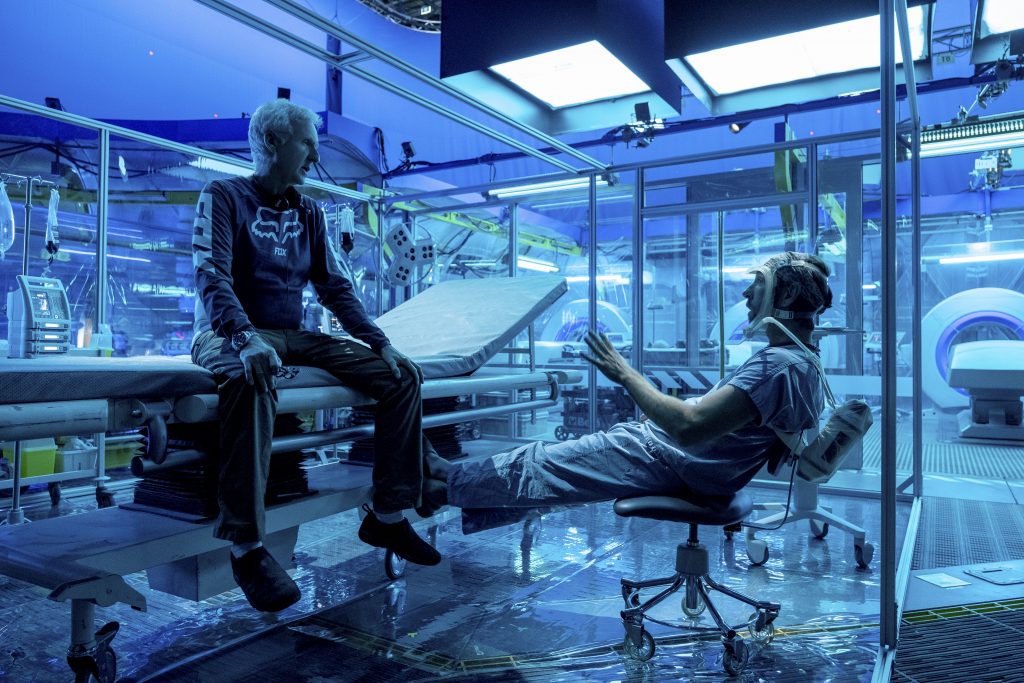
I’m sitting with Cameron now in London, ahead of the release of Avatar: The Way of Water, the second in the series with many more planned to come, and as we talk cynically about the state of the world, as environmental collapse seemed more assured by the day, I decide to drop in my take on his oft-misunderstood franchise.
“These are deeply hopeful films. There’s a moral certitude that I believe answers the question of, ‘why do you want to spend the next two decades of your life doing Avatar films?’” I say.
“Can you come on tour with me? I couldn’t have said it better,” Cameron shoots back.
Sidestepping the flattery, I press on.
“The question that seems to be posed here, as we move into the sequels, is, can humanity transform?”
“Yes, exactly,” says Cameron.
“So do you believe it can?”
“My feeling is yes, but just because we can, doesn’t mean we will. The way I look at it, the Na’vi are not just some aliens. They’re us, writ large, physically and metaphorically. They represent our conscience. With respect to nature, they represent the way we used to be, the way we yearn to return to. Maybe they represent the way we are when we’re children, when we naturally connect to nature and to animals and to plants and being in the forest and being in nature. The thing is, we forget about it, and then when we see it, it reminds us. It snaps us back,” says Cameron.
“Avatar is our better nature at war with our worst nature.”

People really seem to want to dismiss Avatar, it often feels. The debate for the last decade around the film has rarely been a serious discussion of its message, but rather judging it on metrics we hold other films to. Avatar has no cultural relevance, people say, pointing out that because the film was not absorbed into culture the way that Marvel, Lord of the Rings and Star Wars have, for example, with merch and gifs and memes that keep those films always in the background of our conversations, that it has failed.
On moral grounds, people have dismissed the film, claiming that it is just an echo of Dances with Wolves (1990) and FernGully: The Last Rainforest (1992), and calling it just another ‘white saviour’ narrative that is entrenching tired racist tropes rather than doing anything truly revolutionary in spirit.
But those accusations miss what Cameron is actually doing here, I’d argue. The films are thoroughly anti-colonialist in a way comparable films aren’t, indicting not just the most violent aggressors but also the supposedly well-meaning scientists who benefit from the system that is killing the people they are supposedly helping. Its white hero, Jake Sully, helps the Na’vi not by outshining them, but in fully rejecting the world and the identity that had ruined him, betraying his homeland and becoming a true ally. Deep down, the film, while entertaining and easy to watch throughout, is as radical as they come—built to change people’s minds about the world they live in, not to placate them with easy narratives. Our only path forward, Avatar argues, is to reject the evils we’ve come to accept.
The humans represent “our worst nature—our greed, venality, lack of empathy, lack of connection, all those things. it’s a movie by humans for humans. It’s not about some alien race, you know? And yeah, there’s, there’s an optimism there,” says Cameron.
“If people liked the movie, it answers the question, right? This is what I took away from the first film. We put this idea out there to the proposition to the world, and we had resounding financial success. That is a metric of acceptance of the of the audience of a work. And I took that optimistically my interpretation was people care about this stuff too. We made an environmental film—heaven forbid, we made a commercial environmental film, of which there are very few. I’d love for somebody to name the other two.”
“Now, we’ve done it again, we don’t know if we’re successful yet. But let’s see,” adds Cameron.

While Avatar 2’s early box office success, grossing $441 million worldwide in its opening weekend, seems to signal that the world is still ready for the wholehearted sincerity and pointed ethics of the Avatar franchise, that Cameron will be able to continue his quest, he is aware of the challenges.
After all, it’s been 13 years since the last film—long enough to start to be forgotten but not long enough for nostalgia to have properly kicked in—and the film he’s made is by no means a retread. In this one, Jake Sully (Sam Worthington), now fully a Na’vi himself, has five children with Neytiri (Zoe Saldana), and to try to save their lives from the humans who continue to hunt him down, they seek refuge with the sea people, which opens them up to the plight of the oceans themselves.
“The film is structurally very different. Its intention is very different. It plays by a lot of the same cinematic vocabulary as the first film, but I didn’t want to just make a clone of the first movie. For better or worse, whether people like it or not, it’s very different,” says Cameron.
Linking this particular aquatic concern with Cameron himself, of course, is easy. Cameron has long been fascinated with the ocean’s depths, a pursuit that has not only gotten us films such as the Abyss and Titanic, but has turned him into a renowned explorer and expert, completing the deepest solo sub dive in history down in the Mariana Trench, amongst other achievements.
In the Way of Water, we are introduced to the Tulkun, a hyperintelligent whale-like species that are being hunted by humans who want to harvest their most valuable innards. The Tulkun are, for many who have seen the film already, the film’s standout stars, and as the film moves to a climax as the Na’vi fight to protect them, Cameron found himself faced with another problem: His deeply moral film, which was ultimately an indictment of violence, was in fact too violent.
“I had a bit of a crisis of faith as we were cutting the movie together. It was too violent. I wanted a balance between the beauty, the epiphany, the kind of spiritual aspect of the film, with the action, and I felt it had gotten a little too grim,” says Cameron.

“I actually cut about 10 minutes of the movie targeting gunplay action. I wanted to get rid of some of the ugliness, to find a balance between light and dark. You have to have conflict, of course. Violence and action are the same thing, depending on how you look at it. This is the dilemma of every action filmmaker, and I’m known as an action filmmaker,” says Cameron.
Reckoning with this led to transformation within Cameron. After all, this is who he has always been—the man who had Arnold Schwarzenegger dropping bodies left and right to the glee of his audience. The Cameron of the 80s and 90s, of course, was happy to offer those thrills. The Cameron now is a bit uneasy with the whole thing.
“I look back on some films that I’ve made, and I don’t know if I would want to make that film now. I don’t know if I would want to fetishize the gun, like I did on a couple of Terminator movies 30+ years ago, in our current world. What’s happening with guns in our society turns my stomach,” says Cameron.
“I’m happy to be living in New Zealand where they just banned all assault rifles two weeks after that horrific mosque shooting a couple of years ago,” he adds as an aside.
That doesn’t mean that Avatar: The Way of Water, of course, is actionless. In fact, the film has perhaps the most difficult to watch scene in Cameron’s filmmaking history, in which we watch the slow, methodical hunting of one of the Tulkun, with glee on the faces of its hunters and an unconvincing grimace on the face of the accompanying scientists.
“That’s excruciating , but it serves a purpose,” I pose to Cameron.
“Yes, exactly. There’s a moral crime.”
In the end, while the film does have a final battle, it doesn’t work like the first film.
“The first film has the good guys and the bad guys seemingly equally opposed, and then the good guys get crushed and defeated and many of the heroes die. Then there’s this almost ‘deus ex machina’ where Jake invokes the forces of nature—a ‘deus ex machina’ I think is earned by the way. The second film doesn’t work that way at all. The battle is not even a battle, it’s a rout. It’s the revenge of the Na’vi and the Tulkun. The real challenge, and the real defeat, and the thing that must be recovered from, happens after the battle,” says Cameron.

While it remains to be seen how far Cameron will be able to get into his saga, it’s clear where things will go from here. The violence inside Jake Sully, and one that he instilled into his children, will have violent ends. But the compassion that the Na’vi have always championed could still win out—and convert even the worst of the humans to their side. And if they can, we all can, in Cameron’s mind. If the worst in us can change, then the world can change with it.
It’s all very big, sincere, high-minded stuff. But sitting across from Cameron, it’s hard to be cynical about any of it—to think this is a cash grab or a vanity project. He’s clear-minded about his intentions, and as easy as that makes him to make fun of, I don’t have the will to do it. At the end of the day, I hope he’s right. I hope we can. And I wish more films of this scale, films that will be seen by masses of people like no other piece of entertainment, had a similar heart to these films. That sounds corny, I know. But just like Cameron, I’d rather be corny than give up hope.
Read more from Cameron and co. inside the January issue of Esquire Middle East