
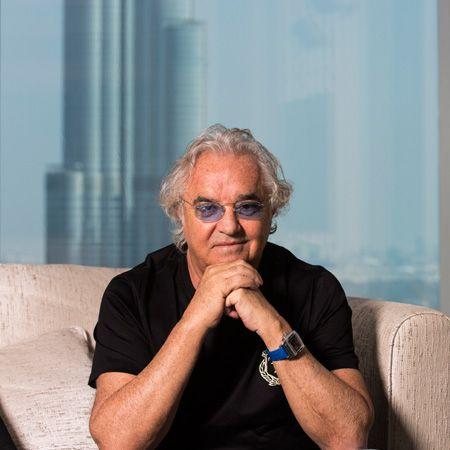

No stranger to controversy, Italian businessman Flavio Briatore is rarely one to hold his tounge. This year, the Italian businessman will open Billionaire Square, a $150 million lifestyle development project in Dubai, where the ex-Benetton formula boss regaled Esquire Middle East with stories of supermodels, super yachts and why owning a football clubs is only a good idea if you are looking for a creative way to waste money.
***
I started my first business when I was nine. I was at school selling pictures of footballers to my classmates.
My first job was as a ski instructor. I grew up close to the Italian Alps and it was pretty much the only job available. I didn’t even really like skiing, but all girls fancy the ski instructor so it made sense.
Billionaire is an arrogant name but I wanted a name for my brand that was exciting. I started the brand back in the mid-Nineties, when everyone was dreaming of being a millionaire, not a billionaire! I suppose if we were to start it again now, we’d have to call it Trillionaire.
A flashy beach club in Sardinia was the first property I opened. The island was full of rich holidaymakers, but there was nowhere for them to go to party. I went to see three or four locations, and eventually saw an amazing villa with a huge pool. I knew it was perfect. The idea was to attract big spenders to fly over from Milan and London for a crazy weekend. On our opening party we flew over a young, up-and-coming DJ called David Guetta.
I always try to spot a niche in the market. When I started Billionaire’s couture line, I noticed that men had nowhere near the amount of high-end fashion brands that women had.
I think it’s fantastic if you want to be that guy who works one job his entire career, but that is not for me. I want to have different experiences and I motivate myself by setting huge challenges, like I did with Formula One and Benetton.
In Formula One, I won seven championships. It was a hugely enjoyable and successful part of my life, but I had nothing left to accomplish. Nobody would care if I won an eighth title.
I wake up every morning looking for a challenge, that’s why working with hungry, young people is so fun. I like to have a young management team around me, because if you give people a chance then they will strive to give you their best and grow with you. I did this in Formula One, where I brought through young guys by the names of Michael Schumacher, Jenson Button and Fernando Alonso.
Everyone was laughing at me when I first started in Formula One, because Benetton was a T-shirt manufacturer and I had no experience! But over three years I built a great team around me and we beat everyone — McLaren, Ferrari, Williams, everyone.
No one was sure about Michael Schumacher, but I had a good feeling about him. We didn’t have as much money as the other teams, so we had to concentrate on young, unproved talent. We narrowed it down to five drivers
“I’ve dated supermodels, but at some point you have to decide: do I want to spend my life chasing girls around the world?”
I introduced the Grand Prix to Spain. No one in Spain was interested in Formula One. They preferred motorbikes. We had just signed a young Fernando Alonso and I knew how much potential he had. One of the first things I did was buy the rights to bring a Grand Prix to Spain from Bernie Ecclestone — and I gave him the first year for free. But the following year in Barcelona the track was packed with 80,000 people all wearing Benetton hats. It was pretty emotional.
Formula One doesn’t care about the fans anymore. I was involved in it for 20 years and many of my best friends are still involved in it. I still talk to Bernie [Ecclestone] every couple of days. But these days the sport has changed. It used to be that the drivers were fighting it out like gladiators, but today it’s more like a PlayStation game for engineers. There are so many technical rules and regulations that the only people who can understand it are the engineers. People want to see Lewis Hamilton versus Alonso, not spreadsheets.
Owning QPR was a fantastic experience, but it taught me to never to buy a football club again! Bernie, [Indian billionaire] Lakshmi Mittal and I had a four-year plan, where we took the club out of bankruptcy, invested in the stadium and saw them promoted to the Premiership.
Investing in a football club is only a good idea if you’re very rich and looking for ways to waste your money. In two years you’ll be very poor and won’t have that problem anymore.
I’ve dated supermodels, and I am still friends with most of them. I’ve been pretty lucky, but at some point in your life you have to decide: do I want to start a family or do I want to go around the world chasing girls?
Work is important, but you have to be able to enjoy life. I love what I do, and I am very serious about it, but that is only one part of my life. If you work too hard then your private life is a disaster and that will affect everything else. Outside of work, I try to leave everything out, laugh and enjoy myself.
I don’t care if I am remembered or not. People forget so quickly, and life moves on so quickly. I think the people that you want to remember you are the ones that you helped along the way. They will remember you fondly for a few seconds, but then they’ll probably just forget about you. But honestly, I don’t care.

– – –
This article was originally published in the February 2016 issue of Esquire Middle East. To buy a copy, click here