

Because of the way that Marvel characters live in people’s hearts and minds, dominate people’s screens through memes and passionate fan-pages, and often getting caught in vigorous debate, it can be hard to notice how little time we actually spend with them on screen.
Take Falcon and the Winter Soldier, for example. Both characters debuted in Captain America: Civil War (2014), directed by Joe and Anthony Russo, played by Anthony Mackie and Sebastian Stan respectively, and both became instant fan favorites, inspiring fanfiction and DeviantArt abound. But how well do we know them, really?
In many ways, as the two get their own six-hour Disney+ miniseries, streaming exclusively on OSN in the UAE, Saudi Arabia, and the rest of the Middle East, much like with WandaVision, we’re getting to know them for the first time.

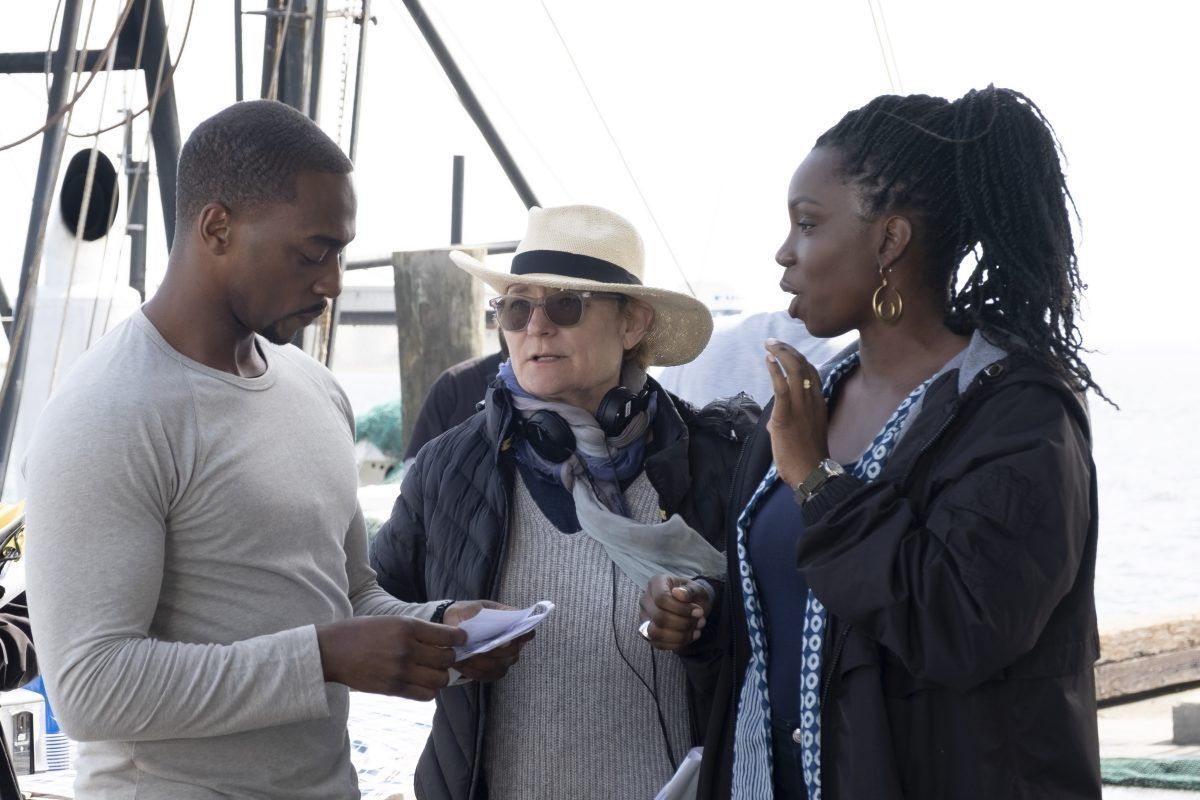
“We had the time to learn a little bit more about them, from a very intimate space, because we are just with them. The movies are like a snack. And these series are like the meal. And when you have a meal, you get to savor the flavors. We get to spend time with these characters in ways that we haven’t before,” director Kari Skogland tells Esquire Middle East.
The Falcon, also known as Sam Wilson, that we’d met, for example, in the four Russo brothers films, was a soldier and a friend to Captain America Steve Rogers, but we never saw the real man out of that context, or out of that costume. In Falcon and the Winter Soldier’s first episode, we spend time with him and his family in Louisiana, watch him apply for bank loans and try to help his sister’s small business.
On the other side, Bucky Barnes, the Winter Soldier, is the childhood best friend of Captain America who spent decades as a brain-washed secret assassin of the evil Hydra organization. Now finally, we see a different side. In the first episode of the show, Barnes is struggling to interact with people on a social level, only able to talk to his therapist about what’s really going on inside his mind.

Both are suddenly, startlingly, fully-fledged people. For Skogland, that means people with visible flaws.
“No one’s ever black and white. As a result, we get to dig into the gray zone. No one’s purely evil, and no one’s purely good. We’re allowed, you know, to find new aspects to every one of the characters just because we’re allowed to spend time with.”
To portray these characters on screen, Skogland wanted to stay true to the vision that the Russos had laid out for them, capturing the right balance between spy thriller and buddy cop action-comedy, but she purposefully wanted to forge her own path, choosing not to contact the Russos before taking on the characters, she reveals to us.
“No, I didn’t speak with the Russos. And not because I didn’t want to, but because I felt I was informed enough by their movies to know what the characters were based on those movies. We have six hours, they had two and a half, or whatever it was for each of the movies. And then the characters weren’t as big a part of their universe. So we were really inventing. We were we were going a deeper dive. While that was the platform, for sure, we were going to now go into just brand-new territory,” says Skogland.
Skogland and the team producing the show didn’t feel they needed the esteemed directors in part because they had the two best people to help them guide these characters right in front of them—Sebastian Stan and Anthony Mackie themselves.
“What I also did was really trust the actors, because Sebastian and Anthony Mackie, were also very, a big, big part of building those characters within those worlds. We really work together, very collaboratively, to do much deeper dive into who they are behind the scenes. We get to see them without their costumes on, we get to see them—the real-world people. So that was new territory.”

Skogland herself is a tenured director of film and television, helming episodes of The Handmaid’s Tale, The Walking Dead, and Marvel’s The Punisher. She’s purposefully alternated between male-driven and female-driven series, believing that as a woman director she should be seen as a director first, not a person who must cover specific genres and perspectives because of her gender.
“The fact that I’m female, and the fact that I’ve directed a very muscular show, are not not related. I’m a director, and I can do a muscular show. I also can do a very feminist show, I think a lot of men can do a very feminist show, and I think they can do a muscular show. I think it’s really important that we start to take those labels off of it,” says Skogland.
Skogland is of course keenly aware of the glass ceiling that exists for women directors especially in the world of blockbusters, but she’s never felt herself hit it, something she in part attributes to her personality.
“I don’t think I even know what glass ceilings I faced or didn’t face. I just kind of hell bent went ahead and did what I had to do. Maybe the fact that I’m bossy helps. I just got bossy, and got my way through it.”

Her being a woman, she says, is not what guided her approach to these characters.
“I might have brought, just because of my sensibility, some vulnerability to the characters that they haven’t had in the past quite so much. We went down that space, and went down that rabbit hole, and we really found ways for those characters to live and breathe and perhaps more relatedly as humans, so but I think that is me Kari, not necessarily me female.”
The Falcon and the Winter Soldier is now streaming on OSN in the Middle East


