
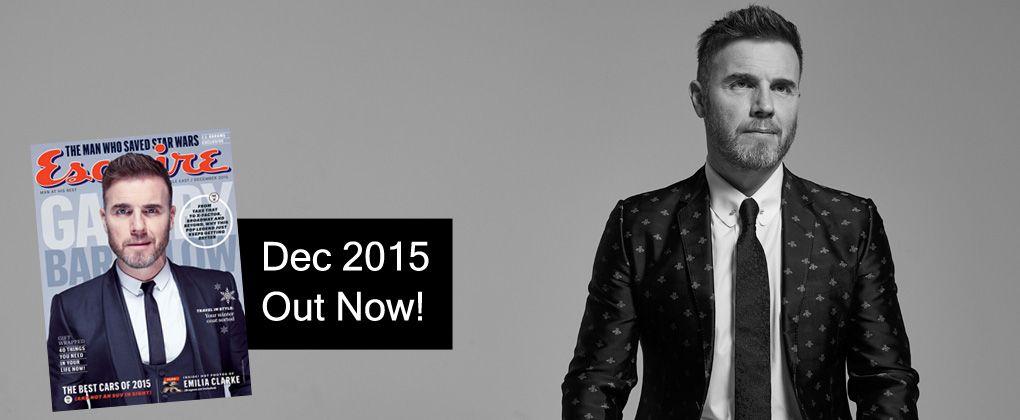

A slim, polite Englishman, dressed in a casual American Eagle shirt and flip-flops, is making small talk with some new faces about mutual acquaintances. It’s an unremarkable scene with two exceptions: from the waist down he is clad only in boxer shorts, despite having been introduced mere moments ago. And also because this unassuming, half-dressed chap happens to be Gary Barlow, a singer-songwriter who has been an indelible part of western pop culture for a quarter of a century.
Just how famous are we talking? In statistical terms, a lot. As frontman of British pop-group Take That, he notched up 56 number one singles and 37 number one albums, worldwide. There are a further three number one singles, six top 10 singles and two number one albums as a solo artist. And in between all that, he has been a judge on The X Factor, received six Ivor Novello song-writing awards and sold 50 million records.
But statistics alone do not explain what Gary Barlow represents to the public. It’s not just about a love, or even a passing appreciation, for his work. It’s the fact that his music has been an ever-present backdrop to our lives.
The best way I can describe this association between his life and that of his audience is to look back at my own recollections. I remember, in 1991, the way my school friend, with whom I was slightly in love, giggled when she played me a forgettable pop song (“Do What U Like”) from her new-favourite boy band. The video, more unforgettably, involved nudity, jelly and a mop. A few years later and I can vividly picture the faded wallpaper in the room where my housemate at university would play “Back for Good” at full blast while getting ready to go out. Fast forward again and I know where I was when band announced their breakup on February 13, 1996 (a service station by a motorway near Hull, England, in the rain).
Then of course there is Take That’s reformation ten years later, first as a four piece – Mark Owen, Howard Donald, Jason Orange and Gary Barlow – and then also with Robbie Williams. I watched a DVD of their five-piece Wembley show on a plane in 2008 and had never seen anything quite like it. The new songs, and the whole visual spectacle that went with it, were as powerful as they ever had been. The magic had not deserted Barlow and his bandmates, nor had its effect lessened on us.
“That’s all I ever wanted to do. To connect with people”
Herein lies the power of great pop music. It is not just that it is moving or uplifting or catchy but also that it is omnipresent. A great song that gets played over and over makes us not only remember what we were doing at key points throughout our lives; it also reminds us how we felt during those times. And that’s what Gary Barlow’s songs have done for us.
So how did an unassuming boy from Lancashire develop that gift, and what did it take for him to keep it for so long? And why is he here, in an unremarkable photography studio in Dubai’s Media City, the day after a sold-out show with Take That, sitting in his underwear, sipping a mug of tea (milk, no sugar) ready to go to back to work?
The answer to the second part of the question is that he doesn’t like photoshoots and so gets them done as quickly as possible. This means getting straight down to business, stripping off one outfit and trying on another. As to how he got to here in the first place, and why he keeps on doing it, I get my answers on the way back to his hotel, sitting across from him in the back of a people carrier.

Lesson #1
Work hard, pay your dues
Perhaps the most remarkable aspect of Gary Barlow’s story is just how committed he was from such an early age. He began, aged eleven, playing in the dingy working men’s clubs that were slowly dying a death in the UK’s northern region. This was a tough training ground for any entertainer, let alone a pre-teen, and it’s a circuit that barely exists today, due to the changing class and economic structures in the UK. In this respect Barlow is the last of a dying breed, a musician who paid his dues and learned his craft early on. As we crawl through traffic in Dubai Marina, which might as well be a million miles and a hundred years away from post-industrial Lancashire in the 1980s, we wind our way back to that time.
Does your old-school work ethic come from the lessons learned on the club circuit?
Do you know what it is? The clubs are brutally honest. The audience tells you straight away what they think of your act. And because it’s where I learned my craft, when I walked onto the stage at Wembley Arena, aged 19, and everyone went crazy, I thought it was an easy crowd. They’d bought the tickets, they were going to have a good time. Back in the clubs there was never much of a reception but you bloody earned what applause you did get. It taught me how to craft a set.
What’s the most memorable thing that happened to you during those early days?
Let me think… Henry Africa’s, a club in Preston, was a good paying but hard gig. You’d start at about 10 o’clock, just when the people who were eating had gone home and the clubbers weren’t quite in yet. You could have 10 people in the audience or 100. On this one night there were about 20 people sitting in these booths that they had. I basically sang for half an hour while a couple got it on in one of these booths. I was the only person in the room that could see them.
What were you singing to stoke that atmosphere?
All the good ones. “Hello” by Lionel Richie most probably. I was bringing them all out!
Do you look back fondly at that period of your life?
Yes it was brilliant fun for the seven years I was at it, but I’m glad I left it. Unfortunately, I’ve got friends who are still doing the same circuit, and that’s not as much fun.
I find it interesting that you started out very much as a solo artist, and somehow ended up in a band with a manager who gave you very specific instructions.
I never wanted to be in a group. In fact, I told Nigel Martin-Smith [Take That’s first manager] before we first started that I didn’t want to be in a group. And the real reason was I didn’t fancy carrying amplifiers and drums back and forth between venues. He showed me New Kids On The Block and I thought, Oh, that sort of group, a harmony group, I’m into all that. I do love the solo stuff, but there is nothing like that feeling of being in a band. It’s not just about the songs and lyrics, it’s the whole company. You care for everybody because everyone has a job to do, they are working their butts off and they’re all passionate about it. Being successful as a team is much more rewarding than when it is just you in a corner raising a glass and saying cheers to yourself.
Do you think your love of working in a team stems from the loneliness of going out there on your own so much in the early days?
Yeah, it was a bit like that. They were very thoughtful, my teenage years. In a way that was what I wanted. I didn’t really have friends when I was growing up. Well, at school I had friends, but I’d go home afterwards and they would all go out while I sat and played the piano. I was just obsessed by that instrument. Somehow in the back of my brain I knew that it would pay dividends eventually. I knew it would be an important part of what I was learning to do. Even if I wanted to be a singer I understood that if I could play it then I’d always have a job.
Your song-writing partner, Eliot Kennedy, who you’ve worked with on-and-off since the Take That days, describes it as you missing out on your BMX years…
Yeah, and missing out on Ibiza, and all those places with friends. I didn’t do any of that. I was working. I was rehearsing. I was writing songs.
And then, of course, Take That became really famous. What was that period like for you?
We had a really great time, but there was no question about my priorities. There was work for me to do. The ’90s was a stressful time for me. Everyone used to go to Greece for their holidays and the night before everyone went away, our record label would say they needed the next album in two weeks. And so I would spend the holiday thinking, Oh my God, what happens if I don’t write anything? I’d be s****ing myself trying to come up with this stuff. Fortunately, I always did in the end. And stuff that was good enough to be successful.
The buck stopped with you
If you look at any group there is usually a worrier. Someone checking if the PA is working, stuff like that. That was always my role. It’s nice now because we share the responsibilities but back then it was different. I’m not big on regrets, but if there is one thing I do wonder about the ’90s it’s why did I f***ing worry so much? It was actually all going to be alright.
It also led to you writing some classic songs
Yeah, I don’t want to emphasise those regrets too much. I’ve always cared and respected what’s been given to me because I have many talented friends who have had a fiftieth of my success. I’ve just been lucky and I’ve always respected that luck. I like to go home as much as anyone, but I’m going to put the extra hours in first. And I always thought like that.

Lesson #2
What doesn’t kill you makes you stronger
The wilderness years that followed Take That’s extraordinary rise and then fall have been well documented, but the facts aren’t as clear-cut as the established story suggests. Yes, Gary Barlow was an easy target for a crude narrative that crowned Robbie Williams as the winner (and, therefore, Barlow as the loser) of the split. And it’s true that Barlow’s career as a frontman seemed to be over. His weight ballooned to the point where he was unrecognisable and he has since admitted that on some level he was probably depressed.
But he wasn’t doing nothing either. He and old friend Eliot Kennedy were developing new artists, plus he had a new wife, Dawn, and three young children to think about. “It switched my attention completely,” he says of that time. “Anyone who has kids knows the incredible perspective that it gives you. And over the next seven years we had a second and then a third child, so there aren’t an awful lot of moments where you have time to feel sorry for yourself.”
This is a remarkably grounded assessment when you think of how many people who taste fame and wealth at a young age lose the connection to their audience, and their sense of perspective. That didn’t happen to Gary Barlow, who had several years to contemplate life away from the spotlight. “I really enjoyed growing up during those years, looking around at the world and realising my place in it. It was like getting my life back.” he says. “I truly believe that without those experiences this reincarnation of the band wouldn’t have been the same. It needed to happen this way and has been all the more enjoyable because of it.”
It also made him a much bigger star than he’d ever been the first time around, with all the benefits and dangers that this entailed…
When I watched the five-piece Take That Wembley gig, I’d never seen anything quite so spectacular. During that whole period when Robbie came back in 2010, did you feel the hype was getting out of control?
We really were trying not to be; we have never been a band that has traded on publicity. But yeah, it was big again and it’s just so difficult to control that stuff. One huge factor was how much The X Factor changed things for me. It’s a level of fame that I never knew existed. Suddenly it’s not just 35-year-old women, it’s everyone. I was on that show for three years and you have to put everything else on hold. It’s just complete chaos. I think I’m still coming off that even though it’s two years since I finished. I’m still leaving that arena.
How have you maintained your authenticity through this period of being in the spotlight so much?
I’ve been really careful with TV work. I’ve always had a rule that I am only going to be on a programme if I am talking about what I do – i.e. music. For the Commonwealth show I was making a record, which is what I do every day, but just doing it on telly. With James Corden I was talking about my career, what I’ve done and how songs are written. Even with X Factor, that is what I do every day. I’m not a TV presenter or an actor and I do not want to be one. But I’m happy to talk about music and as long as you stick to what you are good at doing then I think the audience will respond positively to it.
Were you worried about the repercussions for you personally if the press turned on you again?
Yeah, it did worry me. And it still worries me on a personal level because in the UK you can’t really do that much out in public. But then again I’ve always seen it as part of what we do. If you think that it’s only about writing songs and going on stage, well forget it because it is not. You have to be out there and doing stuff. You have to put on a suit and do a photoshoot. I don’t like it, but it’s part of what I do and it’s how people discover my music. So there are many angles to what you do; they’re not all very natural but they are part of the end result. As for trying to make the press go one way, it’s impossible. You have just got to go along with it because if you fight against it then you are seen as being a d***head, but if you court the attention then you are in this business for a different reason.

Lesson #3
Never stop learning
Perhaps the secret to Gary Barlow’s longevity is that, although he is still wedded to Take That and all it represents, he’s also stretching his talents in multiple new directions. He released his fourth solo album in 2013 along with a successful tour. And he and Kennedy recently finished the music for Finding Neverland, produced by Hollywood mogul Harvey Weinstein and starring Kelsey Grammer, which debuted on Broadway in March this year. Just last month another musical, The Girls, based on The Calendar Girls, this time written with Tim Firth, debuted in Leeds, England. And he has also begun work, once again with Kennedy, on Around the World in 80 Days, due to be produced by Weinstein.
A Broadway musical is a hell of a way to make an entrance. Were you aware of the magnitude of the project?
It was more of a gradual process. I got the call from Harvey about three-and-a-half years ago to say that he wanted one song. They’d shown the musical to an audience and the research they got back was that a lot of the material wasn’t strong enough. He asked for a number to help fix the problem. And so we watched a DVD, realised that a lot of the music wasn’t very good and got more involved until the point where we’d replaced all the music. Going back to what you were asking, if someone asked me at the start to do it all I would have refused because I didn’t have the time. It was a big job; a lot of time, heartache, sadness and joy, but it has been an incredible experience.
The point about all this is that you are putting yourself back in the firing line. You didn’t need to continue Take That as a three-piece. You didn’t need to do a musical that could get slated by the critics
Yes, but you cannot think like that. You cannot think that if I do this project then so-and-so at the Daily Mail is going to write about me. If you spend your life doing that then you’re never going to leave the house. I have an audience that loves my music and I love delivering new music. I am only 44 and I feel like in some ways I’m just getting started and that my passion is stronger than it has ever been. I’ve watched audiences leave the New York show having had the nights of their lives. Why deprive those people of that experience just because six journalists are going to write something bad about it? Also, I’m a big believer that you should do things that scare you, things that you are not good enough to do but if you work at them then you could be. Stuff that’s slightly out of reach. I hate the thought of just repeating what I’ve done in the past. You can’t work like that; you need to look at new avenues to go down.
That’s happened anyway in your career
[Laughs] It’s been interesting. It’s been brilliant and I couldn’t complain about anything. Along with these things comes heartache and it is horrible reading what people write about you, but it’s gone within a couple of days. I have the joy of watching Neverland open in London and Sydney next year and also go on tour in the USA. These are amazing times.

Lesson #4
What goes around comes around
A few days after the interview, I call Eliot Kennedy, the man who has possibly spent more time in a professional capacity with Barlow than anyone else, including his Take That band mates, to get his opinion on what drives his friend and colleague to keep developing. Kennedy, also from the north of England, is a gruff-speaking Yorkshireman who developed the Spice Girls, won a Grammy and helped Take That conquer the planet. He was also there during Barlow’s fallow years, helping him get back on track with their shared projects.
Kennedy speaks of them both having the same working-class work ethic and of being thankful every day for doing what they love. Most interestingly he also talks about how their careers have gone full circle. “In the beginning, you aren’t doing it for the money because no one is paying you anyway; you just want to do it. But then it becomes your living and you do it because it pays the mortgage. And then you come around to a point where you aren’t doing it for the money anymore, which changes your perspective because you are back where you started, doing it because you cannot not do it.”
Which is pretty much the place where Gary Barlow now finds himself.
You must be relieved about the success of your first tour since the departure of Jason?
If you were to wind back a year to when we announced that Jay was leaving, I haven’t had as much doubt about the band since we came back in 2006. Everything had run so smoothly so this was the first milestone. But what it does is make you up your game. It was like, ‘Wow, we have to fight for our place here’. So although it has been a bad time, it has also been really good for reigniting our passion and creativity.
Were you nervous about the reception?
You have times of doubt where you’re worried about whether people are going to accept what you’re doing, but in music it’s all about the audience. You can write or sing whatever you want but if the audience doesn’t like it then there is no place for it. And especially these days, you really don’t know what the response is going to be like from year to year.
When you look ahead, is there a way you can control your career?
I really don’t know. You can try and plan but ultimately you’ve got to just get ready for anything that is coming. At the moment we are all really enjoying the live stuff. We have a big 25 year anniversary coming up in 2017 and I imagine we will do something quite big for that.
Presumably there is going to be a lot of pressure to get Jason and Robbie back?
There probably will be and it will all be dependent on diaries. We’re five adults now, we all have kids, except for Jason. So whether it happens will depend on what everyone is doing at that point. If we end up doing as a three-piece I will be happy with that. Doing a nice hits package, 25 years of music.
And busting out a few of the old outfits?
[Laughs] If they still fit.
“If there is one thing I do wonder about the ’90s it’s why did I f**king worry so much?
Are you aware of the role you have played in the public consciousness?
Very much so and I love it. I love the fact that when we played “Pray” last night, people were imagining themselves at 16 again. We’ve been a soundtrack for people’s lives and you cannot buy that. To me that’s brilliant and should only ever be celebrated. There are artists who don’t play their old stuff and I don’t get it because it makes me feel warm when I see the audience go mad to it. But what’s great for us is that it’s not like we have to play the old stuff. Our new songs are as successful as the old ones. That just makes it even better.
Is that why you are so loyal to Take That?
Part of it is looking out for your mates. But ultimately these are people I’ve known all my working life to the point where we may as well be brothers. We’ve been through so much together. I can’t explain to you what it’s like to walk on stage, the power and strength of being a member of Take That, it’s a brilliant thing. It brings back all those memories for all our fans, as well as for us. It’s just fabulous.
So when you do the dance routine for “Pray” do you look over at the guys and think of the million others times you have done it since 1993?
A little bit. You work hard to get a reaction during a gig, then you do a couple of moves and everyone goes crazy. That’s just part and parcel of it [Laughs].
All of these years later, all those Ivor Novellos, and it’s still the dance from “Pray”
[Laughs] I know, sad isn’t it? Showbiz!
Will you be remembered as a song and dance man, or a serious artist? And is there anything wrong with the former?
I don’t mind that title. I’ve been called worse and probably will be again in the future. Do you know what? I have never taken that side of it seriously to be honest. I am happy doing what I do and I’m honestly not bothered about getting awards. I’ve been around the business for too long; I sort of see it for what it is. Everyone knows it’s the industry giving awards to the industry. So I take it as it comes.
Speaking of the record industry, the reaction to Adele’s new single suggests there is still a market for good songs sung by artists who care about their craft
I have these chats every so often about the state of the music business and you could talk for days about it. But then you just hear Adele’s single, which is a nice song with beautiful lyrics, sung beautifully. And really, it is that f***ing easy. What will always, always sell are the songs that tune into people’s emotions and what they have been through in their lives. You can get caught up in styles, you can be the coolest thing out there, but honest-to-God, it’s about a great song with a great singer and that is it. And that’s what it is for me as a songwriter. That’s all I ever wanted to do. To connect with people.
Lesson #5
The show goes on
A few hours later I get to see this life’s mission in action. At Dubai’s Hard Rock Café, in front of what can’t be more than 300 people, Take That end their tour in front of a curious crowd of die-hard fans along with the usual crowd of blaggers and corporate VIPs, some of whom seem more interested in the free chicken wings.
But it doesn’t stop the boys from turning what could be an underwhelming night into a triumphant display of their history. They play all the old hits with as much relish as ever, including “Pray” where Barlow looks at the crowd, knowing what they want, hangs back a few seconds and then drops to his knees to perform that famous old dance routine, while his bandmates look on and laugh.
Midway through the set they slow the pace. Barlow sits at the piano to play “A Million Love Songs”, the ballad he wrote aged just 14-year-old, and the song that convinced Nigel Martin-Smith he’d found a star. The sweetly innocent lyrics elicit the same reaction from the females in the audience that they have always done – they’re somewhere in the ’90s, falling in love with a memory.
Then they pick up the pace, playing a succession of Grade-A pop bangers from the new album III. These songs, co-written by all three members, demonstrate how much they have progressed as a unit, and are as good as anything they’ve done before. The crowd also loves them – a rare feat for a band that has been going this long. And from then on every song towards the end is a home run – “Rule The World”, “Shine”, “Never Forget”; every one of them a bona fide pop classic.
Earlier on Barlow had told me about some smaller gigs he’d done on his solo tour a couple of years ago and the lessons he remembered about working a crowd. “You can’t hide behind smoke, fancy lights and big video screens,” he’d said with a note of pride. “It was like going back to when I was 17 at the clubs, relearning the art of taking the audience on a journey. Start off with the chaos, then do the chat, get it all warm and build towards a big finish.”
And here he is again, putting all those years of experience into action, away from the TV shows, and the paparazzi; the mega-gigs and the Broadway musicals, doing his level best to win over an unforgiving crowd, playing with an utterly un-ironic mission to lift an audience and send them home with a smile on their faces. This, as he’d joked in the people carrier, is showbusiness, although to him it is not a joke, and neither is it to the fans with whom he has made this journey. They know as well as he does that this is a beautiful, nostalgic, life-affirming soundtrack to our lives.
***
To watch the behind-the-scenes video on Esquire Middle East’s photoshoot with Gary Barlow, click here