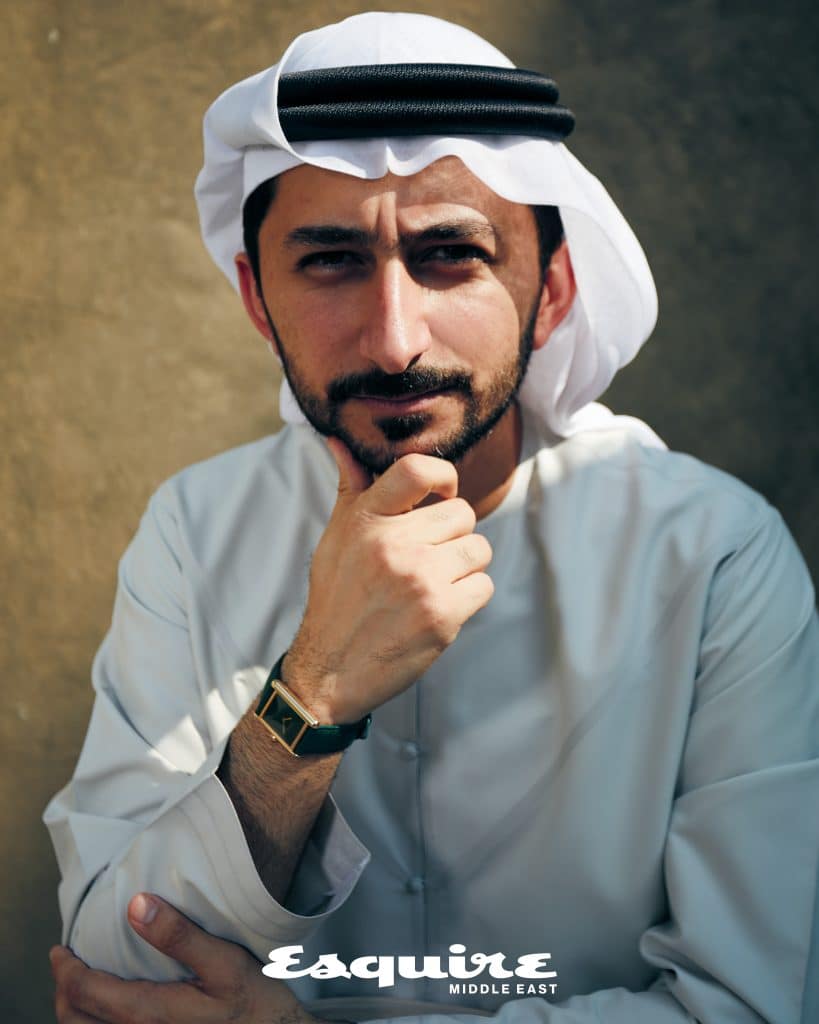
You realise one thing pretty quickly when speaking with Abdalla AlMulla; the Emirati architect has a genuine desire to empower you. Not in a self-help sort of way, (although more on the emotive nature of architecture later), but rather in a sense of creativity coming from within you. It’s a fine trait to have, and one that seems rare in a field where grand monuments often speak of the even grander egos who created them. But there you have it. AlMulla wants you to be the star of your own design and well, we like him for that.
“If a client was designing a villa, for example, I would say, ‘please don’t share any architecture interior pictures.’ Send me pictures from your phone, shots of fashion, food, landscapes, objects. I would look at them and think, ‘what’s the personality of someone like this?’. Then we would try to solve that challenge through design.”
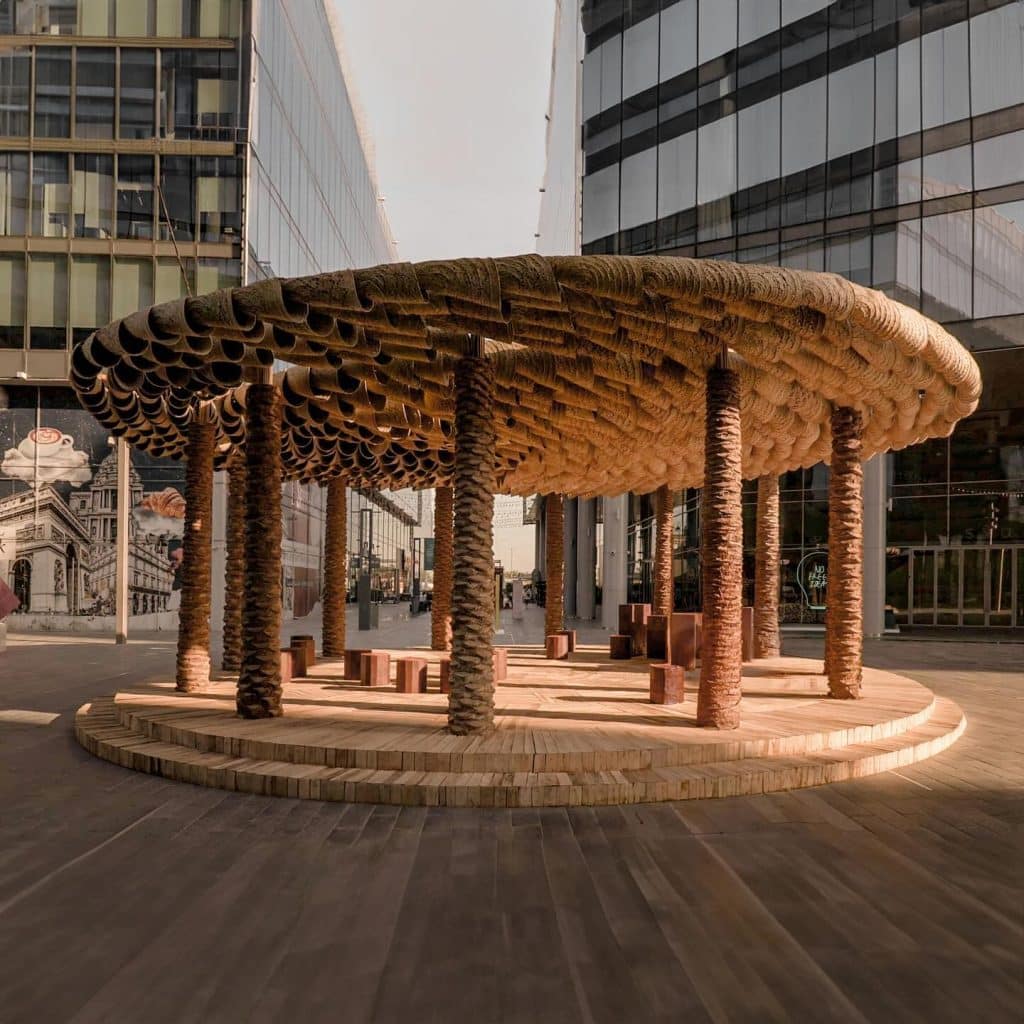
Chances are you’ll know AlMulla—who set up his design practice, Mula, in 2018—through his stellar work creating a pavilion for this year’s Abwab exhibition at Dubai Design Week. A grand structure made entirely using parts of palm trees, Of Palm, takes a natural resource and finds a creative way to expand its usage beyond the original purpose. It’s a concept that speaks of how AlMulla approaches design in general (“we basically create a question that we solve through design”). Now finding pride of place at COP28, Of Palm has caused quite a stir.
“People react to it in different ways,” he tells us. “A Mexican guy who had been living in Dubai for 10 years was so happy. He was like ‘finally I’m seeing something that’s local…but new.’ Then there was a guy who drove from Fujairah to Dubai just to see it (‘I’ve heard you use the material I’m surrounded by in a different way?’). Meanwhile my aunt, well she was so happy that she was almost in tears.”
It’s the same emotional reaction to design that had an impact on AlMulla at a young age. “I was into design from around the age of 12, but more graphic design back then. All my friends wanted to go into engineering, that was the thing to do, but it wasn’t really for me. Thankfully, as I was researching I found architecture—which is actually a nice blend of design and engineering. So it made total sense. When I began to study it I think I fell in love with the idea of designing experiences, and how you can enhance someone’s life through architecture.”
That AlMulla took a different career path to that of his friends perhaps speaks of the changing attitudes in the UAE. “When I was studying, around 2008, we had the financial crisis. Some of my instructors would tell me that Dubai was going to be a ghost town with no work. Then the country went and built Burj Khalifa, and Dubai Metro. This just inspires me because, in the Arab world, you’re often told that you can’t do something. Since opening my design studio I have wanted to showcase what we can do. Through our own lens, culture, and materials. We’re respectful to everyone, but we’re doing it our way.”
A quick scan of Dubasi’s skyline will leave you in little doubt that there are a lot of ideas going on there. Myriad styles and ideas stacked high and wide. But in a city so young—and with such international influence—it’s perhaps understandable that, as Dubai found identity, so too did its architecture.
“I think it’s developing [UAE architectural style] but perhaps something was lost in translation a little,” ponders AlMulla. “Maybe we need to take a step back and learn from everything we did to then take things forward again. I mean, even Burj Khalifa [built] today may not have glass. But when you look at it, it’s an identity. The World Trade Center, also, is beautiful and iconic. I learned so much from it. So I would say that [UAE design] is still developing. But that’s a good thing, because it will encourage more local architects and designers. That’s when we will challenge each other to emphasise our culture and architecture.”
Ultimately, for AlMulla, design and architecture is a labour of love. It’s about heritage, responsibility and diversity. It’s about finding creative solutions to problems, but triggering an emotive response in the process. “I want to create familiar things in a different way. Things that will touch people’s hearts,” says AlMulla. “For me, that’s the power of design.”