
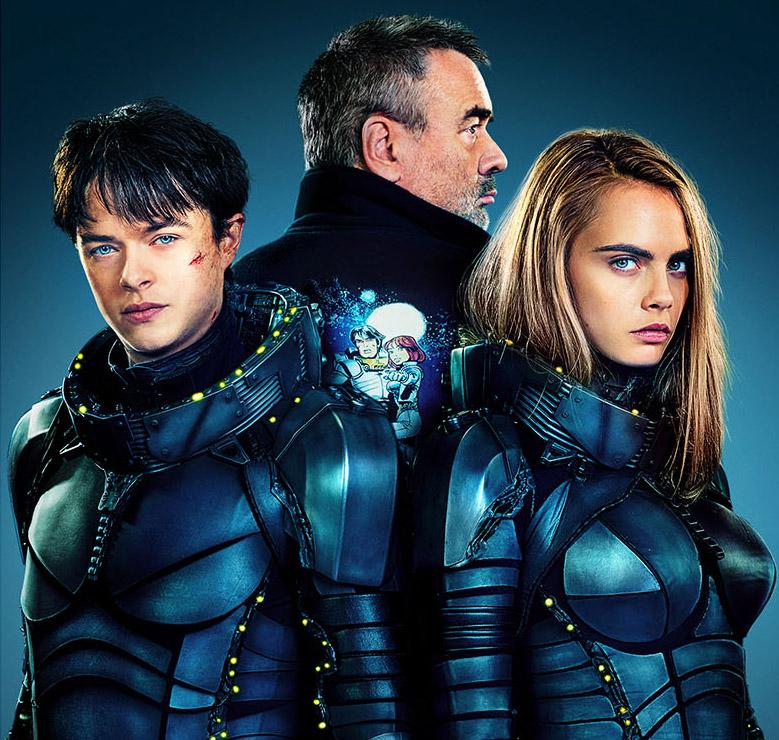

French filmmaker Luc Besson gained the praise of the film industry for directing cult classics Leon: The Professional, Nikita, and The Fifth Element. His distinctive wow-the-pants-off-the-viewer filmmaking style sets him apart with stunning visuals usually take precedence over intricate plot detail. This looks to be the case in his upcoming passion project Valerian and the City of a Thousand Planets, where he engages his filmmaking style to bring the comic to life on the big screen.
Esquire Middle East sat down with Besson ahead of the Middle East premiere of the sci-fi adventure:
***
ESQ: We read that you were a huge fan of the Valerian comics growing up, so this must have been a real passion project for you…
Luc Besson: Well, I knew that it would be difficult to bring to life. I’d studied the comics and asked myself, ‘Oh my god, how am I going to do this thing?’ I think I studied for three years before I said to myself, ‘OK, let’s try’. That was how difficult it was. Probably because at the time I didn’t feel I had enough experience to do it. The technology was just not there. And it was me who was not there also.
What did you feel you needed to learn to bring your imagination to reality?
Many, many things… To spread, your effort, your energy over seven years. To have 2,000 people working for you. Motivating everyone, finding the right actors, making the right choices for the creative aspects of the film. Finding the right guy who will bring that creative aspect you want. It’s a huge enterprise to prepare. Let’s say that I had been across the Atlantic by boat but now I needed to go around the world. And you need more experience to do that.
Perhaps what scared me the most during the process was to lose the creative thread. It’s a thin rope – the arc of the characters and their emotional journeys. The film takes place over one day but it took seven years to make, so you’re always scared that you’ll do a scene and then six months later you’ll do another one but now the actor has lost or gained three kilos. The most difficult thing was to come back every day to the same music, the same rhythm and to be sure that it’s the same thing. To keep track of it is a nightmare in fact.
Seven years in one day…
Yes.
There’s a sense that this was the film bursting to come out of The Fifth Element if you’d had more control and money. Was that the case for you?
I learned a lot on The Fifth Element for sure. It was a nightmare to do. I was young and I did my best but the special effects were very difficult. It had 188 special effects shots. Valerian has 2,700. Lucy helped me a lot. There were 600 special effects shots on that film, so I learned the process.
The feedback from Valerian is that people want to see more of the world you have created. They want a sequel.
Really? Already? Oh my god, can I take two weeks off first? [Laughs]
Where would you like Valerian [Dane DeHaan]and Laureline [Cara Delevigne] to have their next adventure?
It’s funny, some films have in their DNA the possibility of sequels and some films don’t. Most of the time my films don’t. Everyone wanted a sequel to Lucy, but it’s difficult. Even Taken was not made for a sequel. He finds his girl and that’s it. End of the story. But we found a good idea for Taken. In fact we cheated. It’s not a sequel. It’s the second part of the first film, in that he gets the girl back but now the guy vanishes.
But, for sure, Valerian is made for it because it’s a couple of cops and every film is an investigation, so you can easily imagine more. That’s why there are 29 books, amd you could make as many as you want.
And do you have plans to do that?
A lot. Always. I wrote the second one already. And half of the third.
Wow!
My friends ask me, “Why are you writing when you don’t even know if you have another one?” But I’m like, “That’s ok, I like to write.” So I have it and it’s good. I hope we do it.
Are there any other movies that inspired Valerian?
No. It’s the worst thing to do. If you re-digest what someone has already done then it’s like families making babies together. It’s not a good idea. I have 29 albums of Valerian to work from, I have other sources of inspiration. I work with young designers. I don’t need any other inspiration. They did almost 6,000 drawings for the film.
You crowdsourced the funding and it’s the most expensive independent film ever made. How much pressure did that put you under?
None.
Really?
Honestly none. My pressure every day is to do the best I can as a director. The dialogue, the actors, the rythmn, the cover shots, my discussions with the special effects guys. How it’s going to look at the end. The real pressure is to make the film the best you possibly can. You don’t see the money. Everyone has been paid, that’s why it is expensive, and I’m happy they are paid. My first film, I couldn’t pay them.
Do you have to put yourself in a certain frame of mind to not feel the pressure?
No it’s the reality. This pressure doesn’t make your film better. The fear is in the editing room, hoping that you have everything. And then at the end of it all you go through this filter where some people want to sit and watch your film and other people just don’t want to do that. That’s the truth for everyone.
There was a French journalist who when The Big Blue reached 10 million admissions in France, asked me: “How do you feel about this huge number,” and I replied: “I don’t understand why 50 million other French people do not want to see it.” It was such a big cultural thing at that time, but after 20 weeks in theatres, 50 million people are going, “Eh, no thanks”. And you have to accept that this happens.
My role is to express myself and to offer it to the world. The rest is totally not in my control. And I think not one of the painters in the history of the world ever thought about it either. They just paint. Some of them finish up at the Louvre, some of them not. But they paint with the same art.
How does an independent filmmaker pull in $200m to make a film?
It’s actually pretty simple. There is always a moment where, for example, you go to Cannes. Three years ago we went there with the script and with thousands of drawings. You go in a room with 150 buyers from around the world and you have an hour and a half to explain what you want to do. Then they go in another room, they read the script, and then they make an offer, or they don’t. If they don’t like it then you know that your script isn’t good enough and you just have to go back to work. I’m not even nervous when I go. I know I will have an answer.
On this particular day we found more than 80 percent of the money, so I knew we were greenlighted. And it’s very healthy to have an answer. If they say no then you just have to be humble and go back to work on it. For me, the trick is not to go too soon. I’m a bad salesman. A good seller could sell a fridge in Greenland. I don’t know how to do that. So it takes me a lot of time to prepare and be ready with the best I can offer. I have a lot of friends who go too soon, and sell a promise, but people are then disappointed because they have oversold.
Was there a moment on set of Valerian that was particularly memorable?
The entire film was done on stage in front of the green screens, so every day is pretty similar. There was one moment when the creators of Valerian, Pierre Christin and Jean-Claude Mezieres, stopped by the set. These guys are 80 years old. I invited them to sit in the space ship cockpit that they designed 50 years ago. And then Valerian and Laureline arrived in their suits. It was surreal for everyone. It’s almost like their characters had escaped them and could speak for themselves. It was actually very emotional and a nice moment on the set.