
Stroller design is big business. Increasingly complex with technical fabrics, suspension systems, super-lightweight materials and some ground-breaking engineering—but is all the high-tech hype really necessary for your kid? Or is the marketing hype and style aesthetics just another example of competitive parenting?
Nick Robinson wasn’t impressed with what he saw. For many years an engineer of surgical equipment, he was used to precision within tolerances only measurable under an electron microscope. So when he joined the Bababing baby products brand launched by his brother, and they considered launching a pushchair, a survey of the market left him rather underwhelmed.
“I thought there would be better quality and more innovation,” says Robinson. “After all, as any parent can tell you, these bits of kit are a lot of money. Invariably they have to outlast not just your first child, but a second child too. I just spent a lot of time thinking, ‘oh, I wish this model did this, or that model had that’. You can’t have everything but all these ideas run through your head.”
It’s an experience many a parent might have too, reading reviews or, too late, having already bought a pram or pushchair—or stroller or baby buggy—and had junior throw up over it. The pram and pushchair market is, after all, expected to be a USD2.8bn one by 2025, and that despite us, all told, having fewer children in more ‘nuclear’ families. That’s a lot
of potential investment.
“Even now you see people wrestling with their pushchairs to get the folding mechanism to work, or having to go through multiple actions to get it to work,” Robinson notes. “Or the pushchair is too big when it is finally folded—fine to go into the back of a pick-up truck but a struggle to get into your Mini. Then you see materials that have faded or frayed.”
He could go on: “Or the wheel bearings are poor so they don’t push well. Or, in the drive to make these products lighter and lighter they lack stability or strength,” he says. “And these things take a real battering—up and down curbs, over rough ground, doubling as shopping carts. They have to work in all environments too—the cold and wet, the hot and humid. There’s a lot to consider. But then inevitably most people don’t appreciate just how technical these products are.”
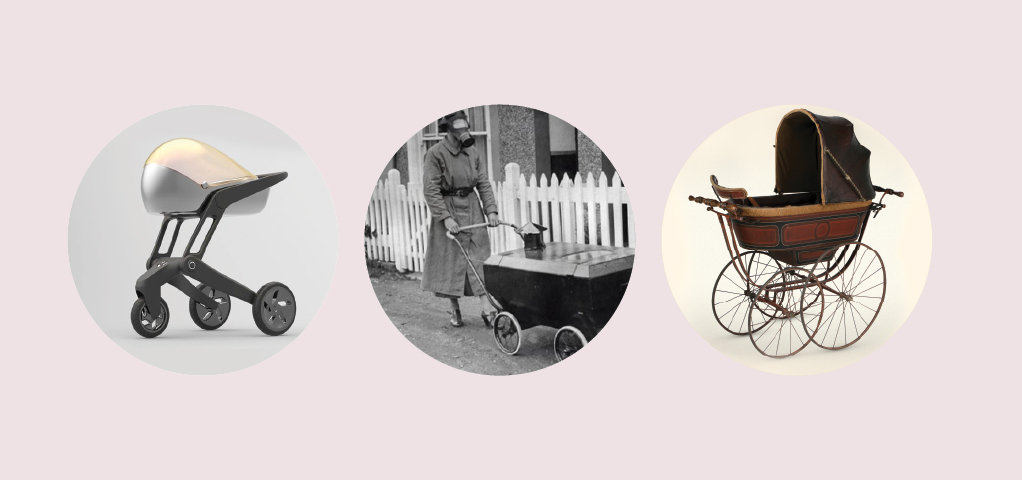
Or, indeed, how the pram has evolved only by degrees. Sure, they have got stronger, lighter, certainly safer, but many of their key concepts are at least half a century old. It was during the 1830s that an American by the name of Jesse Crandall added brakes to what,
by then, had been little more than a glorified kiddy-sized cart. He thought of a parasol and umbrella hanger too, while fellow American Charles Burton added handles, allowing a pram to be pushed rather than pulled. During 1880s William Wilson, founder of Silver Cross, one of the world’s oldest manufacturers, devised a reversible hood and later a suspension system, while one William Richardson added independently moveable wheels—eventually giving rise to supermarket trolleys too—and the first pram in which the bed could be rotated. The first collapsible pram came in 1906.

As for the pushchair, that was devised in 1965 by Owen Maclaren—an aeronautical engineer who’d been involved in the development of the landing gear for the famed Spitfire—with an aluminium framed structure offering the passenger a seated rather than a prone position, and folding down into a compact size. In the year of its launch, he sold a thousand of them. A decade later, Maclaren was selling 600,000 a year—the baby carriage had been democratised and made a nappy-load more convenient. While we tend to think of mum as doing most of the pushing, actually pram and pushchair alike were, in a sense, liberating, in allowing women to get out of the house. Today a growing culture of working mothers only fuels a need to transport children around.
But, hang on, aren’t we missing something? Ah yes. The children. It’s all well and good prams and pushchairs being useful for the parent, but they come with the ultimate and often very vocal back-seat driver. They have two consumers to please.
“Of course, the tendency [with any product] is to make something that works for those who make the buying decision,” explains Celina Levy, product marketing director for Stokke. That’s the Norwegian furniture-cum-pushchair manufacturer which next year marks the 20th anniversary of one of the more recent advances that has come to redefine the industry standard—with a seat that is not just parent-facing but also height adjustable.
“Parents do tend to think of themselves as the primary user, but actually it’s the child,” she adds. “So you end up with situations where it’s like ‘yeah, let’s improve the folding feature!’, and then later remembering that the important thing is how that affects the ergonomics for the person sat in the chair. The designers have to be advocates for the child.”
Not for nothing did Maclaren face a PR disaster in 2009 when 12 kids suffered amputations after getting their finger tips caught in the hinges—though most pushchair-related injuries are just from falling out. It’s why, increasingly, a fourth element in pram and pushchair creation—beyond design, engineering and marketing—is, broadly, medical. Stokke, for example, works with researchers in early physical, psychological and behavioural child development, and with midwifery institutions, in a bid to finesse products according to the latest thinking in these fields, to maximise a pro-child environment.

“It’s an incredibly competitive business and it can be annoying when you wait too long to properly understand if a new idea is right and then someone else takes it to market first,” says Christian Beck, Stokke’s design director. “Everyone is looking for the next game-changer.”
And, it seems, they are willing to pay for it—or, and this is something manufacturers know very well, rather cash-rich grandparents, goodly-eyed over their first grandchild, are willing to pay for it. As Sara Berggren, the international product manger at pushchair maker Thule notes, there was a time when the industry kept expecting some kind of price ceiling to be established.
“Well, that idea is long gone,” she says. “While these are technical products, that is still astounding given that at the end of the day they’re just a seat on four wheels that you can put your child in safely,” says Nick Robinson. “But then unless they’re engineers it’s hard for parents—who, more than with almost anything else they might buy, are looking for a product they can trust—to know whether a pushchair is worth the money.”
The solution? Spend big anyway.
What price your child’s life/staying asleep when you’re watching the game? That’s one reason, perhaps, why it’s not just child psychology that pram and pushchair manufacturers are tuning into latterly. The mind-set of the grown-ups increasingly counts too —and not just in terms of desiring a fully functional product that provides the minimum level of inconvenience and frustration in those already stressful moments that only ever seem to arise as soon as you take your baby outside. When Robinson describes his own hunt for a pram “with the build quality of an Audi”, he’s nodding to the notion that parental pram choices are, more and more, akin to those we make when choosing a car.

Indeed, there’s a reason why, over recent years, car-makers and pram manufacturers have got into bed together to produce the wallet-sapping offspring that is the stroller—or “child travel system” as it’s sometimes put in rather highfalutin terms—with the prestige marque. Maclaren, for example, has teamed up with BMW to create a pushchair with rear reflectors and BMW-inspired wheels. Ferrari and Land Rover—check those leather-stitched handles!—have both lent their brands to pushchairs as well (as have, from the fashion field, the likes of Lacoste and Burberry).
The comparison goes deeper. Sara Berggren at Thule—which was launched in Sweden 80 years ago as a maker of roof racks and car accessories—points out how, much as car buyers look for the reassuringly solid thump when closing the door, rather than a tinny rattle, so both visible and audible cues can be built into pushchairs.
“So something we could make work silently we give a ‘click’ to, to reassure the parent that it’s all working as it should,” she explains, adding that, like prestige cars, there’s a healthy secondary market for prestige pushchairs too; there’s even a DIY trend for pimping your pram. “You know, when it comes to it, for parents prams are an extension of themselves. It can matter to us what a pram is like, like it can matter what’s parked in our driveway.”
Davy Kho was a product designer with a background in consumer electronics and aircraft interiors before he founded young brand, Mima,12 years ago, very much with the intent of pitching not just engineering but pushchair style and design to new parents. Enter pushchairs with EVA seats laminated with smooth leather-effect polyurethane—easy to wipe down but, more important to some, kind of luxury cool as well.

“When I was a father of young children we’d bought the cheapest stroller we could get our hands on, and the experience was so-so. But as a designer I wanted the kind of stroller I could fall in love with, with a purchase experience akin to buying a car,” explains Kho.
“And just as you don’t normally buy a car because it does 250kph, but because you feel good about yourself in it, so strollers now have to be the kind of products you feel good standing behind.”
In other words, prams and pushchairs—much like bicycles too, Kno notes—have been overhauled to become objects of desire, signallers of status and taste, subject to peer pressure. When, for example, Bugaboo launched its Frog model—with interchangeable wheels—in the US 20 years ago, what propelled it to must-have status was an appearance on Sex and The City. When its Bee model followed in 2007, it generated a waiting list longer than that for another product launched the same year, the iPhone. There was, at the time, a demographic shift towards couples having babies later in life—when they had more disposable money to spend on, well, fancy prams—and for men to take a more visible role in childcare too. Prams in pink, with floral patterns, or those that were boring or impractical, were ripe for a design revolution.
Or, at least, a return to their roots. In a way, prams and pushchairs always been signallers of status. Humankind—and, more typically, mother-kind—has carried babies in slings and pouches for millennia.
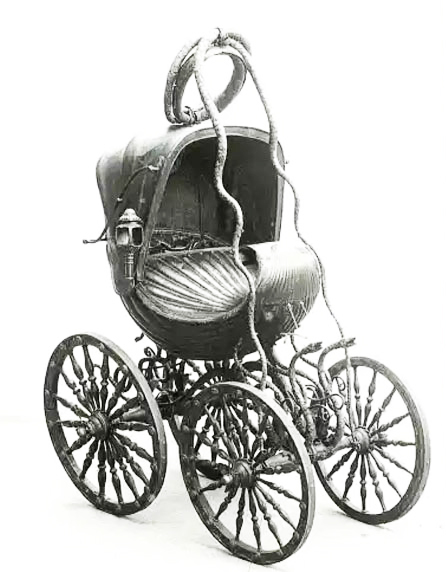
It took the whims of the Duke of Devonshire no less, in England of the 1730s, to have his garden architect William Kent create the very first wheeled baby carriage. It was made made out of wicker and was pulled by goat or, for extra horsepower, Shetland pony. A bespoke-built three-wheeler for the Duke of Wellington’s eldest son was shaped like seashell and upholstered in velvet the colour of the sea.
Likewise, not for nothing is Silver Cross often referred to as the ‘Rolls-Royce’ of prams. Parents may choose a product that suits their lifestyle: whether they’re outdoorsy, for example, or whether they live on the top floor of an apartment block; whether they travel a lot and so need a compact design—a market that has collapsed over the pandemic—or need a stroller they can go running with—a market that’s boomed over the pandemic. In fact, it was only with increased urbanisation during the Victorian era, and the laying of even roads and pavements, that prams—from ‘perambulator’, one who walks in a leisurely fashion—really took off. The increased use of nannies also gave well-to-do parents the incentive to provide a means by which their children might be paraded around local parks without the risk of being dropped.
Yet none of this accounts for those today artfully Instagramming with their pram, “and creating the kind of proudly posed, carefully-lit, beautiful imagery we could use direct in our advertising,” chuckles Silver Cross’s design director Phil Taylor.
“The truth is that while there are incremental improvements to the build of prams and pushchairs, functionality and safety are a given, so now there’s more of an aspirational aspect to them, such that something that’s effectively an engineered chair is less like an engineered chair than it has a right to be,” explains Taylor. “Colour and fabric matter—so we keep on top of fashion and interiors trends. A pram needs to have a nice feel to it, like a good suit. The trim, the badging—they’re all critical. So Bugaboo, for example, comes to fill the space for being about form-follows function, Dutch, cool, while Silver Cross is about Britishness, heritage, royal patronage.”
“Getting engineering and styling to work together isn’t easy either,” adds Stokke’s Beck. “You end up with really nice looking product and then you get a call from the safety department telling you you have to change it all. And that’s before you start considering the fact that safety regulations vary from market to market.”
Indeed, Beck’s job—and that of his fellow designers at other baby mobility companies—is likely only going to get harder, not least as manufacturers struggle to find a competitive edge. While the mechanical heart of a pram or pushchair is unlikely to change much in coming years—even as the use of composite materials, such as the likes used to make tennis rackets, may offer greater rigidity for less weight—arguably it’s in borrowing still more ideas from the car world by which advances may come.
Headlights on a pushchair may be too much, though it has been tried—if it’s dark, surely the child should be in bed—as have prams with LED read-outs of temperature, steps taken and the like.
A gyroscopic, self-levelling suspension has been prototyped too. Heated seats and cooling systems the likes of a ventilated back rest would work for some markets, perhaps too a device giving an on-board rocking motion. And then there’s the preternaturally tired parent to pander to: power-assisted pushchairs, e-strollers, are only likely to become more prevalent as batteries get smaller and lighter.
“There are better ways in which pushchairs might be improved—more multi-functionality, more portability, more ‘plug and play’ modularity, so you can select options for more benefits as you can with a car,” reckons Dr. Umar Nirmal, of the engineering faculty at Multimedia University in Melaka, Malaysia, who’s made a critical review of pushchair design patents of the last 40 years.
“But I think fully electric pushchairs are inevitable—maybe solar-powered, maybe using kind of kinetically-recharging. In fact, the tech for a lot of this is available now.” As he notes though, the history of prams and pushchairs suggests that, with more complexity, comes more fallibility.
Although we may not get them valeted, or take them to a hand wash centre at the weekends, or add spoilers and racing stripes—all surely only a matter of time—our prams and pushchairs have become points of pride. But it’s not a good look standing at the roadside awaiting a tiny tow truck.
This article was originally published in the June 2022 issue of Esquire Middle East
