
Regardless of whether you recognise their names or not, Slats, Jackie, Telly, Coffee, Tanner, George and Leo are bona fide Hollywood icons. Together they have featured in more films than Brando, De Niro, DiCaprio, Eastwood and Nicholson combined.
These magnificent seven have portrayed the same character for almost a century. They were kings of the silent film-era and played a leading role in the development of technology in cinema throughout the 20th Century. And they would accomplish all of this without fame, riches, notoriety or recognition. Just a scratch behind the ear and a big bowl of Kibbles.
The part they all played, of course, was the famous roar from Metro-Goldwyn-Mayer’s (MGM) ribbon logo at the beginning of the film studio’s productions. Ad executive Howard Dietz created the classic trademark in 1916 for the Goldwyn Pictures Corporation. He derived the idea from his alma mater, Columbia University, whose athletics team was nicknamed The Lions. It has since graced thousands of films from The Wizard of Oz (1939) and Ben Hur (1959) to the latest James Bond film, Spectre, plus this month’s Rocky spin-off, Creed.
A lion named Slats was chosen for the original part, making his silver-screen debut in Polly of the Circus (1917) under a banner proclaiming Ars Gratia Artis – the Latin for ‘art for art’s sake’. The Dublin Zoo-born feline became so recognisable that a few years later the newly formed MGM would send him around America to promote the merger of Goldwyn Pictures with Metro Pictures and Louis B. Mayer Pictures.
This was the era of silent movies, and it wasn’t actually until 1928 that the lion first roared. By this point, Slats had been replaced by Jackie and, in true Hollywood style, the MGM lion was given a stage-name: Leo.
The development of audio technology had begun encroaching on the film industry by the mid-Twenties and would signal the end of cinema’s great silent era within a decade. But due to the rampant costs of this innovation, MGM began slowly, using Leo the Lion to test the water for sound.
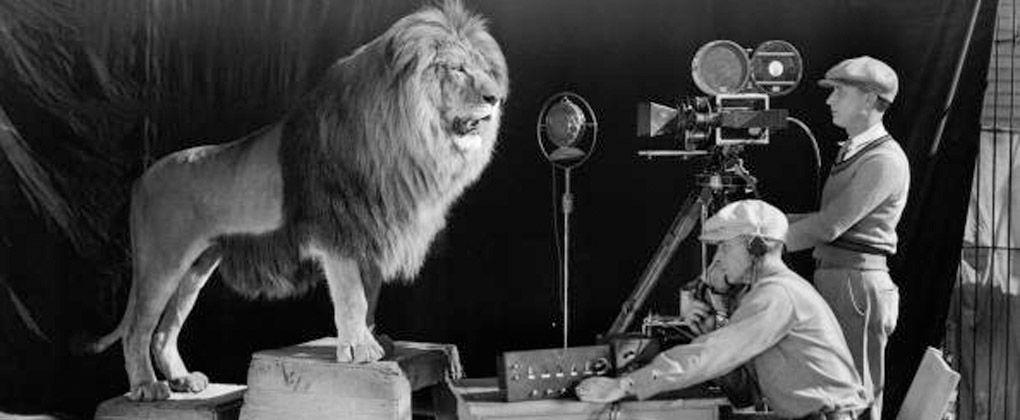
A cameraman and sound technician were tasked with recording Jackie for new the movie logo. As the photograph above demonstrates, they had to get right up close to capture the roar, and would eventually build a sound stage around his cage for safety reasons.
It is not known how they got him to roar, but the resulting audio and video footage was aired in MGM’s first-ever sound picture, White Shadows in the South Seas (1928). This was played in theatres across America via a gramophone record.
Jackie survived two train wrecks, an earthquake, a boat sinking, an explosion and a plane crash
Jackie was a huge success, both in the ‘Leo’ role and individually, featuring in more than a hundred films (including Tarzan) over three decades. Such was the iconic status of MGM’s roaring lion intro, that the studio would animate it for children’s cartoons – most famously, in everyone’s favourite cat-and-mouse double act, Tom and Jerry.
Jackie’s other claim to fame was that he survived two train wrecks, an earthquake, a boat sinking, an explosion at the studio, and a plane crash that left him stranded in the Arizona wilderness for several days (the pilot left him with some snacks while he went in search of help), earning him the nickname “Leo the Lucky.”
Further developments in technology would see the studio trying out new-fangled Technicolor techniques on his successors, Telly, Coffee, Tanner and George. Then in 1957, MGM would introduce its longest-serving lion, who was actually called Leo. He was the youngest actor they’d used – as indicated by the shorter mane – and he has appeared in all MGM films since 1957; the one constant in an often tweaked logo over the past 58 years, although his roar was replaced by a digitally recorded one in 1982.
Such was his impact on multiple generations of movie fans, that in 2014, the film industry recognised MGM’s contribution to 90 years of cinema with a star on the Hollywood Walk of Fame. In fitting style, it was ‘Leo’ who was given the honour of immortalising his paw prints in the wet cement. It couldn’t have been anyone else.