
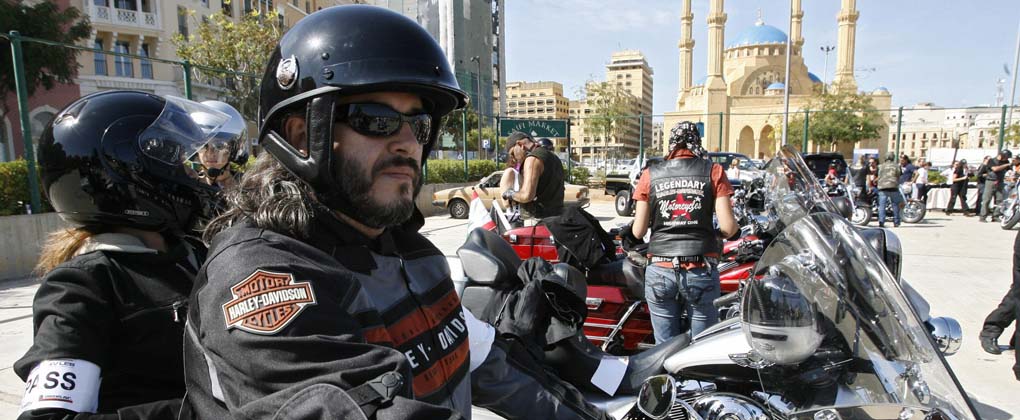

A narrowly missed raid, gun shots and a disco in the dirt are just part of the journey as Richard Whitehead spends a weekend riding Harley Davidson bikes through Lebanon.
***
The crisp morning heralds a peachy autumn day, with clear skies and a cool air blowing in from the Mediterranean Sea. Even my 500 new Harley-riding friends, trussed in leather and coated in tattoos, smell fresh.
These men are H.O.G.s, short for the company-sponsored Harley Owners Groups, a loose amalgam of motorcycle clubs and private riders, that hold annual tours all round the world. They have descended on Beirut from across the Arab world for the Middle East regional rally, and there is no mistaking who they are. Some have brought their oversized bikes from the UAE for the occasion, wearing bandanas and cuts that suggest they have come straight out of Sturgis – Harley’s spiritual home in South Dakota.
There is something about Harley-Davidson that attracts humans like the ones gathered here. Larger than life, in physique and personality, they howl in laughter with the boom of a freight train nearing a crossing. They eat their cigars, the fattest Cohíbas, chowing down on the butts and sucking out the tobacco juices like a breakfast espresso. There is enough flowing hair to fill a Megadeth convention attended solely by Sasquatches. Some even wear chaps.
Each tribe has variations on a theme; the patches on their backs a signifier of origin. The guys from Saudi are the biggest and baddest, all curls, beards and an air of intense brooding that their Gulf brothers emulate but cannot quite match. Lebanon’s contingent are as much about elegance as aggression, the meanest of them every bit as menacing as the Saudis, but behind the mirror Aviators they exude charm as they speak in lilting Levantine lyrics. The Egyptians and Jordanians are a mixed bag, some oversized and underdressed in groaning denims; others in scrupulously clean duds with neatly parted hair and faces polished with moisturiser. Many of the Khaleeji weekend warriors — the type who enjoy a baking blast in the Dubai desert at the weekend — might still carry some heft, but you can make out their pristine leathers from a distance. Husband and wife duos also attend in significant numbers; others bring their mistresses. In some cases, mistresses arrive with one guy and later leave with a different one. This is the freedom of the Harley spirit that everyone talks about.

What all the different groups do have in common is a distinct lack of outlaw credentials. I cannot be certain that absolutely none of them run guns or vice, but I would wager that many spend their weekdays in good jobs at finance companies or advertising agencies. Most have reached a comfortable time in life where they can afford to indulge their joint-passions of riding and dressing as if they are bad guys. Though the Harley-Davidson brand is making a push to attract younger riders, biking begins for many as a middle-age pursuit. Buying pipes for a custom motorcycle and commissioning a paint job worthy of the Sistine Chapel is an economic pastime best suited to those with a generous disposable income.
Still, they put on a good show, wrangling their machines into tight parking lines through brute force and skill. These musk-smelling motorcycle masters look like they could wrestle crocodiles. What they will actually do is spend the next three days covering all corners of Lebanon, a mixture of highways, hill roads and border villages.
Lebanon beyond the capital is pretty lawless, the country marching to its own beat. Somehow, in spite of it all, things just about work out and have done since the Civil War ended in 1990, despite ongoing tension between different factions, and periodic brutal conflicts with Israel. There is also the spillover from the conflict in neighbouring Syria, which has seen one million refugees cross the border into a country of only four million. The threat of this violence spreading became very real last November when 43 people in Beirut were killed by two suicide bombers — reportedly ISIS recruits who had crossed from Syria.
Yet, on my visit prior to this horrific attack, the insurgents bedevelling the region might be in a different continent, judging by the devil-may-care attitude of the locals. This a resilient country, well-suited to the Harley way and its promise of action, passion, camaraderie and freedom. To sample it amid Lebanon’s stunning scenery and hospitality, interspersed with various militia groups, is a thrilling prospect for a sizeable gang of the region’s bikers. And this is evident after just a dozen kilometres into the tour. Heading north on the coast highway out of Beirut, the first handgun appears.
A guy in a beat-up BMW indicates his displeasure out of the window at the police chief, waggling a handgun in his face while driving at a steady 100kpm
The episode plays out something like this: As with most things in Lebanon, there is a strict H.O.G. hierarchy. Our group includes a colonel, who is a big name in the Lebanese army, a chief of police, and Marwan Tarraf, the owner of the local Harley-Davidson dealership. These three men lead the snaking procession of flashy Harleys that are adorned with every known bike accessory on show, from fish-tail pipes and sound systems with enough decibels to power Abu Dhabi’s du Arena.
But not everybody likes what they see. A guy in a beat-up BMW, with his dander up after being forced to leave his favourite fast lane, waves his displeasure out of the window at the police chief, waggling what appears to be a Smith & Wesson handgun in his face while driving at a steady 100kph.
Even in Lebanon there are some things you do not do, and this is one of them. The Beemer (and its driver) soon disappears, escorted away by the glamorous police outriders accompanying us out of town, who had earlier been showing off by pulling wheelies on their own, force-issued Harleys. I never do find out where they took him. Still, if you will play with firearms and threaten one of the country’s top cops, bad things are bound to happen.

Fire arms aside, the first day’s ride is easy. I have been given the run of the bikes on offer, ranging from a good old Soft Tail through to the Fat Bob and V-Rod, the most polarising of bikes, then climaxing with the massive Road Glides. I’ve opted for a Fat Bob for the opening ride, which is a capable bike, though one the hardcore riders might mock you for driving. It looks good, like something from a Forties war movie, complete with a matt paint-job that resembles light brown denim, and it handles well, which suits me fine. But in the Harley world, it’s a beginner’s ride.
We ascend Mount Lebanon, the cedar-covered rock wall bordering east Beirut. Turning off the semi-kempt highway, the narrow, twisting roads become decrepit as dramatic views of Beirut and the Mediterranean hove into view. Somehow the organisers find a crazy way back down that only the locals know about: a twisting, tortuous route through the clouds that attracts most of Lebanon’s four-wheeler nutters in their ancient Renaults as they fly at great speed, plying the wrong side of the road, local music blasting out.
Lunch is taken at a farmhouse in the Beka’a valley, near to Ba’albeck, which offers incredible views of the olive-green mountain range that stretches out to Damascus in Syria. This daunting expanse, I am told, is desperate territory even at times when the region is at peace, though currently it is off limits to everyone but those who are known to be local.
Many countries lay claim to inventing hummus, but regardless of where it first appeared, the Lebanese have perfected it. There is something about the local cuisine, with tomatoes so red they could have burst off the vine only moments before, and tabbouleh so tempting that you have to dive in. The accompanying rice dishes, meat plates and grilled fish, which could have playing in the sea just hours ago, makes Lebanon a culinary powerhouse.
After lunch, many of my 500 friends snooze a little, some snoring with ground-up cigar butts still in their lips. Others nurse endless espresso cups as they regale others of their latest bike adventures. Motorcycles is the main topic up for discussion, along with business, of course. In Lebanon there is always a deal going on somewhere.

I speak to one of the younger members of the tour, an attractive twenty-something tattoo artist from Beirut who has only been riding for two years. Her wealthy parents set her up in business and her well-connected father got her into biking. She is responsible for much of the art on the arms, legs, backs and necks of the other riders. No, she says, she wouldn’t go out with any of them.
The rest of the day is uneventful, though not for everyone in the area. BBC World, which I catch as I flick through the TV channels that evening in my hotel room, mentions how Al Nusra Front, the Al Qaeda affiliate, had made an incursion into the area soon after we departed Beka’a.
The next day we are shot at.
Our assailants use military shells because they are the military — from across the border in Israel. “Tell Marwan they’re shooting at the bikes,” comes the panicked call over the organisers’ radios to warn the head of the group. It is all very surreal.
Fortunately, we have got off the bikes to take in the view of the Green Zone, a brief stretch of heavily mined flatland that separates the two countries, 200 metres away as a gun-toting Israeli army Hummer takes pot shots. Handily, a white UN tank then chugs out of nowhere and puts itself between our Harleys and the path of danger. Nobody really flinches, the Lebanese being the most calm.
Earlier, I had picked up the mighty Electra Glide Ultra, and boy, it looks good. The Cadillac of motorcycles is probably not the sort of bike I would usually plump for — at 40 I’m perhaps a decade too young and also lack the vital accessory of a consort to plonk in pillion, but it feels incredible to try out that mega-machine for the first time.

The first stretch is pretty easy with not much to test the behemoth, as I get to grips with the thing on wide open highways. I plug in my iPhone to play some tunes on the Ultra’s surround speakers.
The Bee Gees’ “Stayin’ Alive” is hardly Steppenwolf’s iconic biking song “Born to be Wild”, but that’s what the shuffle selects, and it is playing at full volume when, on a rocky uphill path that is far too technical for my abilities, the near half-tonne weight of the Ultra gives way and we suddenly flop down sideways like a lifeless koi. It takes a great deal of skill and experience to control a bike of such weight at extremely slow speeds, neither of which I possess. And when you start to go down on an Ultra, you need the legs of a rhino to support its tumbling weight. These are attributes that also belong to someone other than me, so over I go in a clattering, embarrassed heap of metal, leather, sweat and shame.
“Life goin’ nowhere/Somebody help me” squeak the Bee Gees, in tune with my plight. I can’t reach the controls to switch them off.
When you come off a bike that weighs north of 400kg, the only thing to do is stand sheepishly by it and wait for a compadre to stop and put it right. Yet the habibi henchmen chug past one by one, their faces contorted in displays of derision. Nobody stops and why would they? This is the sort of path where you need to maintain momentum, not put down your bike stand so you can help out a brother.
It is only when the sweep car arrives, the last in line and there to pick up stranded bikers like myself, that the Ultra gets perpendicular once more. It takes both burly guys from the car to heave it right again as I look on impotently.
While the bearded brute of the pair rides off through this devilish stretch on the Harley, I cadge a lift and stay in the truck for the next 50 clicks. The driver is a heavily tattooed Englishman, Rob Dean, who is in charge of the Beirut Harley workshop. He’s been in the country for a couple of years and, in his typically British way, he reels off a list of complaints about Lebanon, before admitting that he loves living there and can’t imagine leaving Beirut.
Perhaps to asuage my shame, he explains how the cheap concrete they use to pave the roads here can send you sliding when it’s wet. He tells me this while hammering on the Chevy’s horn, spitting pithy Arabic at a driver we overtake. He concedes sheepishly that the language he has learned is used more often in bar rooms than over the dinner table.
The final day is straightforward, with me on the V-Rod, my favourite of the machines. Its engine, developed in collaboration with Porsche, is water cooled, a departure from the typically air-cooled Harleys. Traditionalists who live for the iconic thumping sound of the 103- and 110-cubic inch Harley engines, knock the V-Rod, but I have neither the right nor the inclination to share that attitude.
The sun sets as we reach Beirut after an impeccable performance on the V-Rod along the winding lanes of southern Lebanon. I reflect on the type of events that can only happen on a H.O.G. tour. A narrowly missed terror raid, pot shots and the UN. All the while, the beauty and lawlessness of the country has provided a fitting backdrop to the freedom that deep down every man craves on some level, and which Harley-Davidson delivers.
I reflect for a while on the Bee Gees, who are not known bikers, and how they soundtracked my disco in the dirt. But I’ve done with them now. In future, I ride with Steppenwolf.