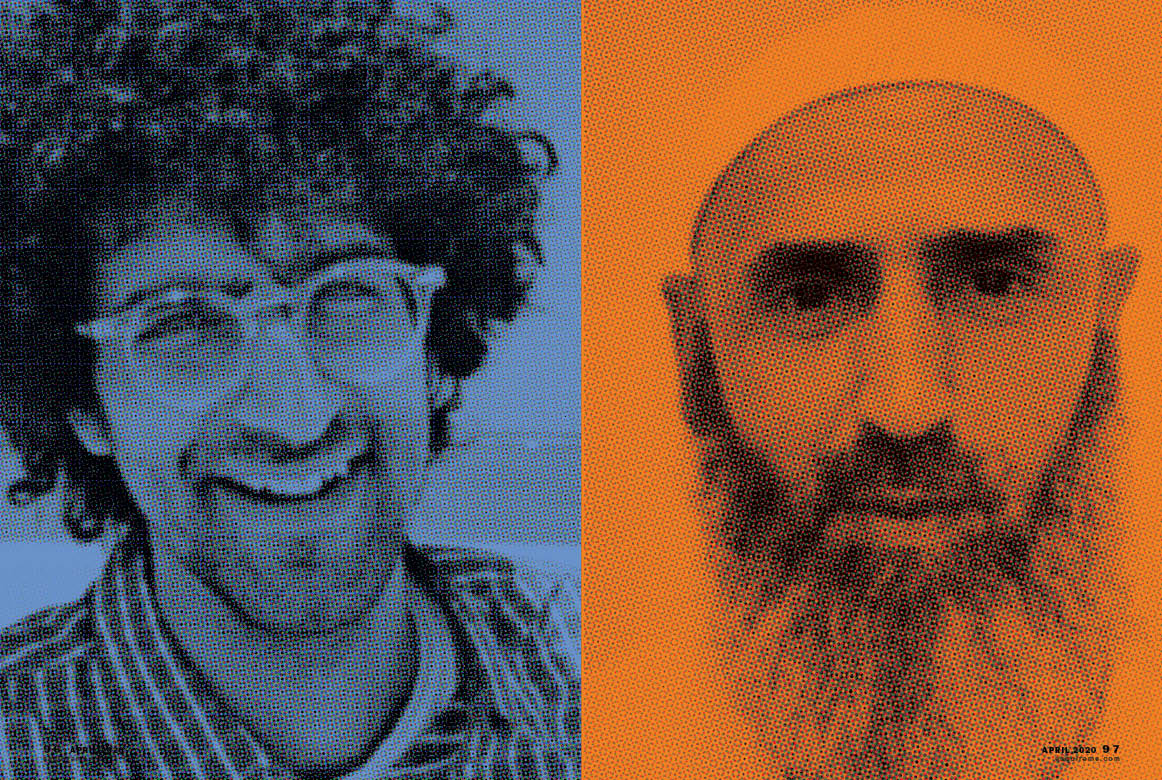

Mohamedou Salahi sat on a bench in January of 2016, waiting for a friend. The friend was late. Mohamedou would have been irritated, except he knew it wasn’t his friend’s fault. These were not normal circumstances.
The bench was just outside the Guantanamo Bay Detention Facility, where Mohamedou was held without charge from 2002 to 2016, suspected of being a member of al-Qaeda. His friend was Abdul Latif Nasser, Detainee 244, who had also been held without charge since 2002 under suspicion of being a high-level al-Qaeda operative.
After waiting, and at risk of missing a flight no one would allow themselves to miss, Mohamedou left without his friend. One of the sweetest moments of his life instantly turned bittersweet. Doubly so, since his friend’s absence didn’t make any sense.
They had both been cleared by the United States government to be released from Guantanamo Bay. The same military and intelligence organizations that put them in the legal equivalent of outer space more than a decade before had, on paper, declared that the two men were no longer considered threats to the U.S. and could return home.
Yet only Mohamedou went back to a normal life. Once home in Mauritania, he made headlines for hosting a former Guantanamo Bay guard he befriended while detained. Mohamedou introduced the former U.S. service member to his family, they celebrated Iftar to break Ramadan fast and bonded over rewatching one of their favourite movies, The Big Lebowski. Meanwhile, Abdul Latif sat in his cell in Guantanamo Bay, where he still remains to this day.

I’ve spent the past three years trying to understand the story of Abdul Latif Nasser, otherwise known as ISN 244. A man without a passport, a driver’s license, even a phone number. A man I’m not allowed to speak to directly because every word that comes out of his mouth is instantly classified. Who is this guy? What did he do to wind up at the most notorious prison in the world? And why is he still there, despite having already been cleared for transfer home?
In trying to answer these seemingly straightforward questions, I’ve been ushered through the bowels of the Pentagon, surveilled by an unmarked car in a foreign country, kept up late at night exchanging WhatsApp messages with alleged terrorists. Altogether, I have interviewed more than 60 people, including CIA officers, former White House staffers, death row lawyers, and even the Marine Major General who first built the detention facility at Guantanamo Bay.
What I found—and have chronicled in my new six-part Radiolab podcast series, The Other Latif—is a story that covers five countries, three U.S. presidential administrations, and some of the most fundamental American values: life, liberty, and the rule of law.
What sparked my interest in Abdul Latif’s story is something profoundly personal: we have the same name.
I was raised as Latif Nasser, in an observant Muslim household in Canada. In university, I did a study abroad term in Morocco, where the ‘other Latif’ is originally from. When I got there, I quickly realized that my first name—Latif (one of the 99 Muslim names for ‘God’, meaning “The Most Kind”)—is considered a sacrilegious name in Morocco. The equivalent to you naming your son “God” in the United States. I learned that I had to add a prefix to my name. So, for the several months I lived in Morocco, my name was Abd-al-Latif (aka “the servant of the Most Kind”) Nasser.
Fast forward to 2017. I randomly saw a tweet about a Moroccan man named Abdul Latif Nasser. At first I thought it was about me. And then, when I realized it wasn’t, I found it thrilling. My whole life I had never met someone with my exact name. I got excited and curious about my namesake. Who was this Moroccan version of me? What was he like?
Read our urgent letter to @POTUS seeking intervention for Abdul Latif Nasser, cleared yet stranded at Guantánamo Bay https://t.co/xZCB4u1AjZ
— Reprieve (@Reprieve) January 19, 2017
As it turned out, the other Latif is a Guantanamo Bay detainee. Yikes. And not just any detainee. I read his file, which Wikileaks released in 2011. Before his capture in Afghanistan in December 2001, Nasser was—according to the U.S. Department of Defense—a top explosives expert for al-Qaeda, directly associated with Osama bin Laden before and after 9/11, and a commander on the front lines at the Battle of Tora Bora against U.S. and coalition forces. Allegedly, he had personally helped to blow up the Bamiyan Buddhas, a UNESCO World Cultural Heritage site. The D.O.D. file— which was written in 2008—claimed Nasser was “a HIGH risk … to the US, its interests and allies.”
Guantanamo Bay detainees gained the right to challenge their detention that same year, when the Supreme Court ruled in their favour in Boumediene v. Bush. Abdul Latif was for a long time considered one of the captives for whom, according to the U.S. government, there was insufficient evidence to justify bringing criminal charges against but who was still far too dangerous to be released. He was one of the “forever prisoners.”
As the Obama administration began to wind down, and faced with a closing window of opportunity to fulfil the president’s longtime commitment to shut down Guantanamo Bay, there was a push to transfer detainees out. In total, Obama resettled 196 prisoners from Guantanamo Bay, including dozens in the final year. One of those men was Abdul Latif’s friend, Mohamedou.
The way most of those detainees won their freedom was through something called a Periodic Review Board hearing (PRB). A PRB is basically a parole board made up of six top government agencies: the Departments of Defense, State, Justice, and Homeland Security, plus the Joint Chiefs of Staff, and the Director of National Intelligence. If representatives of these agencies unanimously agree that the detainee is no longer a threat, then they get to go home. At least that’s what happened for Mohamedou Salahi.
Soon after I discovered the detainee with my name, I reached out to Shelby Sullivan-Bennis, his lawyer. At the time, she worked at a human rights NGO called Reprieve that provides legal aid to multiple Guantanamo detainees. At the time despite being only 29 years old, Shelby represented seven of them. As for Abdul Latif, Shelby told me that most of what I thought I knew about him was false.

To start, she told me, everything I read in those Defense Department documents about Abdul Latif was based on dubious sources. Some of the information came from Afghan militia fighters who turned him over for a bounty in 2001. Other information came from confessions he made under torturous conditions. Still other information came from prolific informants, who were incentivized with all kinds of perks, and whose information even the government
later acknowledged was dubious.
As for his version of the story, Shelby told me as much as she was legally allowed. According to Shelby, Abdul Latif was not and had never been affiliated with al-Qaeda. He never had a relationship with Osama bin Laden. He did not agree with or support what happened at 9/11. He did not blow up the Buddha statues. And he was not on the front lines at Tora Bora. She said that he was in Afghanistan trying to help his fellow Muslims, but got caught at the wrong place at the wrong time.
What seemed to pain Shelby most of all was that her client had never had a trial where he could dispute any of those official claims in court. Instead, the only way for Abdul Latif to contest the government’s story was for his lawyers to prove, for instance, that on a given day at a given time, he was somewhere other than where the U.S. government says he was. From Shelby’s perspective, this was impossible. And to be fair, I’m not sure I could remember—let alone prove—where I was on a given day a decade or more ago, especially if I wasn’t using social media, email,
or even a cell phone at the time.

In June 2016, Abdul Latif had his PRB hearing. His lawyers talked about how he was a model inmate. While in Guantanamo Bay he taught himself English and even hand-wrote a 2,000-word Arabic-English dictionary. They talked about how he has family and a stable job—doing water treatment for Casablanca hotel pools—waiting for him in Morocco.
He made a statement in English as well. In the end, he walked the line, expressing remorse without fully implicating himself.
It worked. Abdul Latif’s PRB decided he was no longer a threat to the United States. And, on July 11, 2016, they recommended his transfer back to Morocco. Pending a little paperwork and a transatlantic flight, he’d be home in no time. But, of course, that’s not what happened. After the hearing, the paperwork seemed to be taking longer than it should. July came and went.
As did August, September, and October, when Mohamedou got off the bench outside Guantanamo and flew home. All the while, Abdul Latif stewed in his cell. Every time anyone approached his cell he thought they were coming to take him to the plane. But they never did. When the paperwork finally did come through, when the Moroccan
and American diplomats came to a final agreement over the transfer, it was too late. Obama’s top advisors were already turning over major decisions to Donald Trump’s transition team.
Then … Trump tweeted:
There should be no further releases from Gitmo. These are extremely dangerous people and should not be allowed back onto the battlefield.
— Donald J. Trump (@realDonaldTrump) January 3, 2017
Shelby immediately realized that Abdul Latif wasn’t going to get out for at least another four years … and who knows how much longer after that.
Abdul Latif now lives in limbo. He was promised his freedom by one administration and then the next one decided to keep him locked up forever. All this at a time when few Americans are talking about Guantanamo Bay.
The detention facility itself is like a ghost town. I know, because I went there on one of the last press tours permitted under the Trump administration. Most of the cells are empty. When we did get to the site where Abdul Latif is detained, he and the other detainees were behind one-way glass. It was like going to see an animal at the zoo. Or watching an interrogation.

Like many detainees at Guantanamo, Latif was tortured. He wasn’t waterboarded, but he was subjected to beatings, sleep deprivation, sensory overload, extreme heat and cold, stress positions, years-long stints of solitary confinement, as well as psychological torture including threats to his family.
I travelled to Morocco to meet Abdul Latif’s family. Soon after I stepped through the door of his childhood home, one of his sisters, Khadija, approached me and began to speak very fast. She said she knew that I was coming, and that I shared her brother’s name, but she did not know that I shared his height and his build, that I looked like him, and that I was around the age that he was when she last saw him. She told me over and over again that it felt like she had gone back in time and that she was with her brother.
I spent two full days with the family. They hosted me with warmth and hospitality. Treated me as if I was part of the family. They hadn’t seen him in decades, long before he had grown the long grey beard he has now. The claim that Abdul Latif had been in al-Qaeda seemed absurd to them. They had been elated after his PRB hearing when they found out he was going to be let out. They renovated their family home so that he would have his own window, something he didn’t have at Guantanamo. They were counting down the days.
On the day of President Trump’s inauguration, a representative from Reprieve went to see them to break the news that he wouldn’t get out. They had prepared a celebratory meal, even a chocolate cake. When she told them, the reversal was just too much of a shock to process. They continued to ask the lawyers how it could possibly be true: why would the US government keep someone in their custody if they had already decided to let him go?
More than three years later, the answer to that question remains to be seen. In no uncertain terms, the fate of Abdul Latif and the other detainees at Guantanamo Bay depends on the result of the upcoming 2020 U.S. Presidential elections. If a Democratic candidate wins, there’s a decent chance Abdul Latif will get released. If Trump wins, that chance is virtually nil.
Guantanamo Bay is unlikely to be a big talking point on the US Presidential campaign trail. For many, it feels like a dark memory from a bygone era, best forgotten. Yet it remains there. Holding 40 men, most of whom have never had a trial. In other people’s names.
***
Listen to full story on The Other Latif podcast available now on Spotify and iTunes. For more visit wnycstudios.org