
Even the shortest-possible answer to the question posed in this story’s title requires a paragraph to explain, so here goes…
Born in 1868 to a wealthy English family, Gertrude Bell rejected the usual social norms of her day and, after obtaining a first at Oxford University, became a writer, traveller, political officer, administrator, spy and archaeologist. Through her extensive travels in of the Middle East she both explored and mapped territories and became influential to British imperial policy-making due to her knowledge and contacts, most especially, the creation of Iraq.
Furthermore, unlike most colonial administrators who are deeply unpopular with the people over whom they ruled, Bell has been described as “one of the few representatives of His Majesty’s Government remembered by the Iraqis with anything resembling affection”.
So why has she been written out of history? Is it just sexism? Is it because T.E. Lawrence had a glamorous film made about him? What are we missing in not knowing the life of Gertrude Bell?
Letters from Baghdad, voiced and executive produced by Tilda Swinton, helps answer these questions. The film chronicles Bell’s extraordinary journey into both the uncharted Arabian Desert and the inner sanctum of British colonial power. But what also makes it stand apart is that the story is told entirely in the words of Gertrude Bell and her contemporaries, excerpted from their letters, diaries and official documents, and set to archive footage, much of which has never been seen before. The result is a unique look at both a remarkable woman and the tangled history of Iraq, as the film takes us into a past that has a powerful resonance today.
Esquire spoke to the film’s creators, Zeva Oelbaum and Sabine Krayenbühl, to find out more about the fascinating riddle that is Gertrude Bell and check out the film trailer below.
***
ESQUIRE: What did you know about Bell before the film?
Zeva Oelbaum: We’d read several books about her. In particular the wonderful biography, Desert Queen, by Janet Wallach, which really emphasised what a brilliant trailblazer she was. So we knew she spoke many languages and we knew about her achievements as a very complex woman and a woman who made a very significant difference to the history of the Middle East But in the process of making this film we came to discover that there’s no comparison between reading about someone and actually reading primary source material. Through reading hundreds of her letters and documents, we developed a firsthand understanding of her passion for the region and her interest in Arab self-rule. She wrote very forcefully in trying to move the cause forward. Plus her delight and interest in getting to know the Iraqi people came out in so many different ways.
Sabine Krayenbühl: It was interesting to see behind the curtain and reveal her personal thoughts and struggles. It was an uphill battle at times, and to see this complex woman in all her beauty and failings made for a very compelling character.
ESQ: What were Gertrude Bell’s principle achievements?
SK: She was the first woman to achieve a first-class degree in history at Oxford University. She had many notable mountain climbing adventures in Switzerland, including several ascents that no one else had made. And she mapped a significant part of Arabia and was awarded a gold medal from the Royal Geographical Society for her explorations and travels in Asia Minor (modern-day Turkey and Armenia) and the Middle East. She helped in the creation the modern state of Iraq and the establishment of the National Museum of Iraq. She drew attention to the preservation of antiquity at a time when it was still something quite new. Her aim was to make sure that antiquities stayed in Iraq rather than go to Europe or the United States, as was previously the norm.
ESQ: What are Bell’s biggest failings, according to her critics?
SK: We would attribute most of her failings to being member of the British Occupation in Iraq. She was always fighting against the more drastic measures that the British were taking, such as the lack of inclusion for Iraqis in the decision-making process, including the mapping of Iraq and the decision to bring in foreign rule. She was a part of all those decisions, but they cannot be singularly be attributed to her.
ESQ: Why has such an important character been written out of history unlike, say, T.E Lawrence? Is it just sexism?
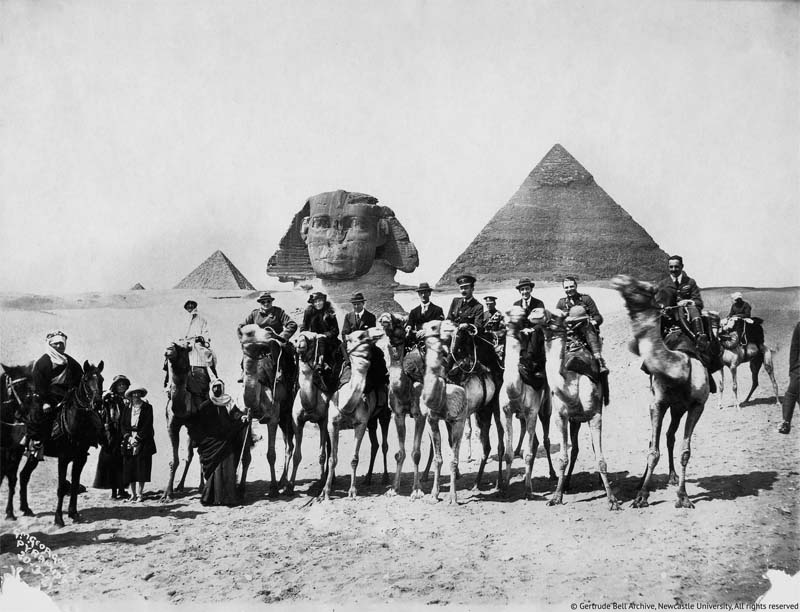
ZO: The “Lawrence of Arabia” legend overshadowed a lot of his contemporaries, including Gertrude Bell. He did significant work in the Middle East, but was also extensively documented at the time. The American journalist Lowell Thomas filmed him during the Arab Revolt and later sold tickets in London to a show entitled “With Lawrence in Arabia” This started the renown of T.E. which came to its fullest with the David Lean film. written out of history can be summed up by the saying “anonymous was a woman”. For example, primary source research shows that during the Cairo Conference in 1921 [set up by the UK to determine how exactly Britain might administer the region after the war] Gertrude Bell attended and contributed to every single meeting with Winston Churchill [the UK colonial secretary], T. E. Lawrence and Percy Cox [high commissioner for Mesopotamia, with Bell as Cox’s Oriental secretary and the only woman among the delegates.] But when it was written about by some of the other men who attended, she was completely left out of their memoirs because she was a woman. General Gilbert Clayton, who was also a British colonial administrator, was recorded to have to said in Cairo at the time, “You to need to hire Gertrude Bell, she is the most qualified person for this job” when a man was hired to take on her role. It was very easy for her to make enemies no matter what she did because she was a woman in a position of power. There were many men who she worked with, like General Gilbert Clayton and Sir Percy Cox, who respected and admired her and there were an equal number of men, and more I’m sure, that resented her, because she was a woman intent on doing something important.
ESQ: Did you get a sense that Bell was frustrated about this situation?
SK: Yes, absolutely. She was writing home to family and to friends, about trying so hard to make people understand what needed to be done, and how she was often ignored.
ZO: There’s a wonderful example of how she wrote a white paper in 1920 that was presented to parliament [“Review of the Civil Administration in Mesopotamia”]. It was a really important piece of work but what really frustrated her was the press’s focus on the author being a woman. Gertrude Bell wrote to her parents saying, “The general line taken by the press seems to be that it’s most remarkable that a dog should be able to stand up on its hind legs at all — i.e. a female write a white paper. I hope they’ll drop that source of wonder and pay attention to the report itself, if it will help them to understand what Mesopotamia is like.”
ESQ: How did you accommodate the various viewpoints of Arabs in the film?
SK: We researched a lot of primary source material and worked closely with the Iraq National Library and Archive. This led us to a newspaper that was published for a short amount of time called Al Istiqlal, which featured opinions pages. There were also memoirs of contemporary Arabs who wrote about Gertrude Bell. We also tracked down the descendants of her contemporaries and obtained personal unpublished memoirs from them. So it was always very important to make sure that we covered the Iraqi point of view. This was difficult, especially since the Iraqi National Library and Archive was severely damaged in 2003.
ESQ: How popular was she in the Arab World? Was there a consensus of opinion either way?
ZO: We came across many Iraqis who have a fondness for her. This is something that was mentioned to us many times from our Iraqi advisers. In fact we had a meeting with the Iraqi ambassador in Washington DC where we were talking about the museum and he was very complimentary when he realised we were speaking about “Miss Bell”. They refer to her as Miss Bell to this day, so I think it’s fair to say that she’s the only British person from that time remembered [in the country] with any fondness. One of her roles was to forge a relationship with the people, trying to bridge the huge gap between the Iraqis and the British. That was her strong point. Of course she didn’t have as close a relationship with everyone, including the Shia Iraqis, so it does depend who you ask.

ESQ: Did you draw any parallels from the situation in the Middle East then and today?
SK: Yes, a lot of them are linked to the American-led invasion of 2003. For example, after the Fall of Baghdad in 1917 [which occurred during the Mesopotamia Campaign, fought between the British Empire and the Ottoman Turkish Empire in World War One] General Maude issued the Proclamation of Baghdad, which included the line, “Our armies do not come into your cities and lands as conquerors or enemies, but as liberators”. And when you read Gertrude Bell’s letters it’s amazing how striking some of the parallels are. For example, the British went into Iraq without any significant plan for what was going to happen afterwards, in the same way the Americans and the allies in 2003 did. Then there is the question of the oil being one of the contributors to the Western interest in Iraq, which was already happening back then. And today when we see the borders being questioned and the idea that they might break up again, I think there is a lot of relevance to what happened 100 years ago.
ESQ: What’s the biggest thing you learned about Bell and the Middle East in making the film?
ZO: I would say the biggest thing we learned was her absolute openness and respect to cultures other than her own, which was a very forward way of thinking for a woman who was born in the mid-1800s. It was really quite remarkable. It is one thing to be a trailblazer in a physical sense but much more interesting to be a trailblazer in your intellectual acceptance for people who are different to you. Those are two types of courage and Gertrude Bell had both of them. And similarly, she said that she found the East to be much more tolerant than the West because of the enormous diversity there. And when we were going through hundreds of archival film clips it was quite staggering to see all the different groups mingling on the streets of Baghdad 100 years ago. The biggest thing we learned about the Middle East of Gertrude Bell’s era was that it was a vibrant mosaic of different peoples living peacefully side by side. It’s one thing to know about it intellectually and to read about it but then when you actually see it in the footage in front you it brings home the message. And Bell had remarkable relationships with everyone there, including the Yazidis, the Druze and many other groups. She was an incredibly open-minded person.
SK: In her interactions with people, it was an equal conversation between two individuals that were different but were still respectful and interested in each other. And the fact that she spoke many dialects and was aware of the differences between people, I think is something that even today you find very rarely.
ESQ: What is your most memorable moment in the film?
ZO: I love the section where Bell is writing to her parents and she talks about what the river was like on a hot summer night. We had extraordinary footage of the mists on the Tigris and the guffa boats, which are these round boats they use; I feel in that scene that she’s right there beside me.
SK: When we first enter Baghdad at the docks on the Tigris, it’s such a vibrant, exciting scene and it throws you right into the middle of that time and place and you can see how unusual that sight must have been for someone coming from another part of the world. It still is for people today.
ESQ: What would you like the audience to come away from the film with?
ZO: What we really want is for people to understand the history of the region and the people there. The Middle East has a rich and beautiful history and we want the viewer to come away with an idea that tolerance is something we should bring into our daily lives.
SK: It’s the idea that we are open to other cultures and that you don’t project your own ideas onto others. Gertrude Bell was an amazing listener who let other people talk and would hear their points of view. That skill is as important today as it ever was.
Letter from Baghdad will be screened at the DOC NYC film festival on November 12 and the International Documentary Festival Amsterdam on November 20 and 21. For more information see lettersfrombaghdadthemovie.com