
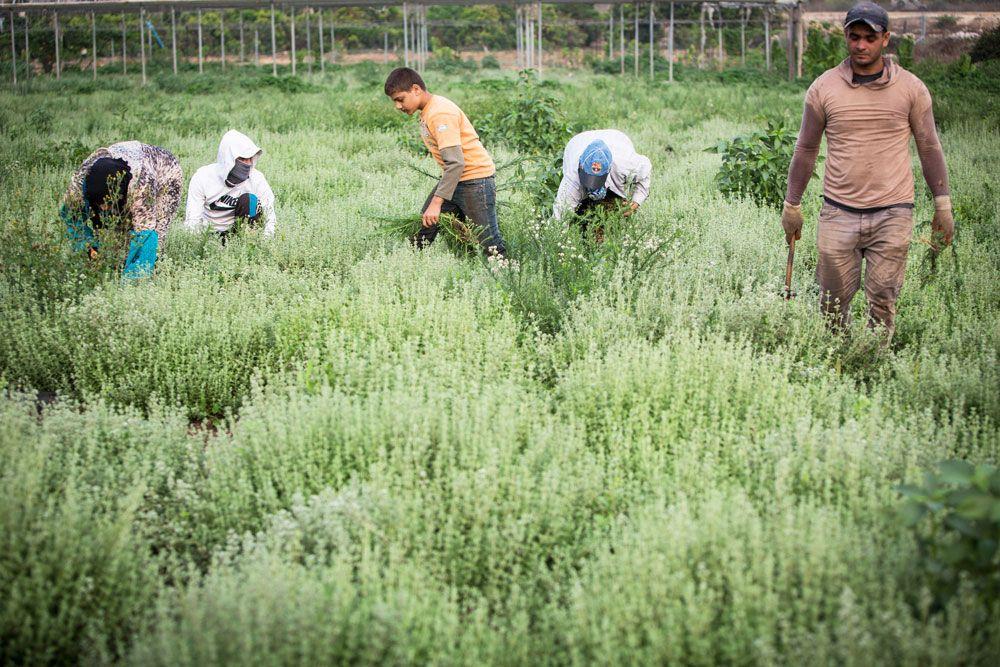

The Daoud’s farm in the occupied West Bank town of Falama is split in two, thanks to Israel’s separation barrier. The small family-run business struggles to access 70 percent of its land as Israeli soldiers control the checkpoint, granting half-hour openings three times a day, but sometimes refusing entry altogether.
The barrier was unilaterally built by the Israeli government during the Second Intifada that began in September 2000, and in places cuts deep into the West Bank, isolating 25,000 Palestinians. The Daouds live with this daily reality, but despite the considerable difficulties of their situation, the family is keeping alive the Palestinian tradition of growing zaatar — the blend of related Middle Eastern herbs including basil, thyme and oregano — alive with both the land and the knowledge passed down through successive generations.
At 5am on an extremely humid day in Falama, the town’s farmers queue with their tractors down the length of the dusty farm road leading to the separation barrier. They arrive early to ensure passage through the checkpoint for just half an hour at 6am. Many of the farmers — there are around 300 who make this trip daily — are asleep on the muddy ground, in the back of their trucks or slumped over the steering wheels of their vehicles.

All of them must have an Israeli security pass, a tasriyah, to proceed through the barrier and access their land. Mohammad Daoud is among those waiting to cross; the rest of the family has stayed behind today to tend their fields.
The Daoud family farm vegetables and fruit including watermelon, olives, cucumber, tomatoes and zaatar herbs.
All the family are in the field harvesting today, including Nabil’s eight-year-old son Mahmoud, who prefers farming and playing on the land to being with his friends. Most of the products are for their own consumption, but any extra produce is taken to market. “We spend all of our life doing this — it is our way to have money, keep our kids in school, it is our life,” says Nabil.
Zaatar is their most profitable product, due to its medicinal properties and reputation as a healthy product. They now farm more herbs than anything else due to their market potential and predominantly farm naturally, only using man-made chemicals when a plant is sick. Nabil, who originally studied accountancy, received his farming and business training from his father, friends and other local farmers. He says the members of the community share their knowledge and support one another.
The process of farming zaatar herbs involves planting, cleaning and harvesting, before creating the final mix that includes a sesame seeds and salt. Nabil hopes to one day develop zaatar into oil to exploit its medicinal qualities. But at the moment, he says, they do not have the economic conditions or power to do this. “We could use it in many ways if we received investment,” he says wearily.

Nabil says the separation barrier greatly reduces the time he can spend on his farm. “Maybe I only have work for one hour on my land but I have to stay there for six hours before they open [the barrier] again. Many times, we have to think if we really want to go. We are under occupation, so the new rules, and the new way they try to increase our suffering and push us to our limits, affects our produce and life here.”
According to Nabil, the border guards also add to these already considerable difficulties. He says that members of the farming community are sometimes told their IDs are fake and are forced to return to the Palestinian side. “Nobody gets arrested but they always try to make excuses to not allow them to enter.” He tells the story of a young farmer who answered back to a soldier about the way she was treating him. The farmer cannot now enter this checkpoint and he has to walk for an hour in each direction every day to access his land via another separation barrier gate.
Even after all these hurdles have been overcome, there are still problems to deal with. The Daoud’s West Bank sales can be affected when Israel pushes its own zaatar into the local market at cheap prices to undercut the Palestinian farmers. The herbs used to have a larger market share in other Arab countries, but since the Arab Spring and ongoing violence in countries like Syria and Iraq, the Daouds’ exports to these markets have ceased and they now just serve the local population.

The Palestinian farmers cannot export to other countries due to the Israeli control of their borders. “We cannot even access most of our land, so how can we access Ben Gurion Airport?” Nabil asks, knowing full well that the answer to his rhetorical question is unequivocal: they cannot.
All of this makes farming zaatar a very complicated business in the Occupied Palestinian Territories. In a region that already has enough economic and social problems, the farming community that could be providing a good-news story instead labours under conditions that turn a difficult situation into an almost impossible one.