

The old joke holds that the modern car could never have been invented, only evolved. That if someone had jumped us straight from horses to 120-kph two-lane jousting, we’d call the whole mess insane. That’s the crazy thing about the new, which we always seem to forget: We rarely know, and often cannot fathom, what comes next until we figure it out. The challenge of the automated/driverless car industry is that no one knows what we’re figuring out.
In order to help clarify that, we spoke to Akin Adamson, director of TRL’s Middle East operations – a company, that provides research and consultancy for all modes of surface transport.
***
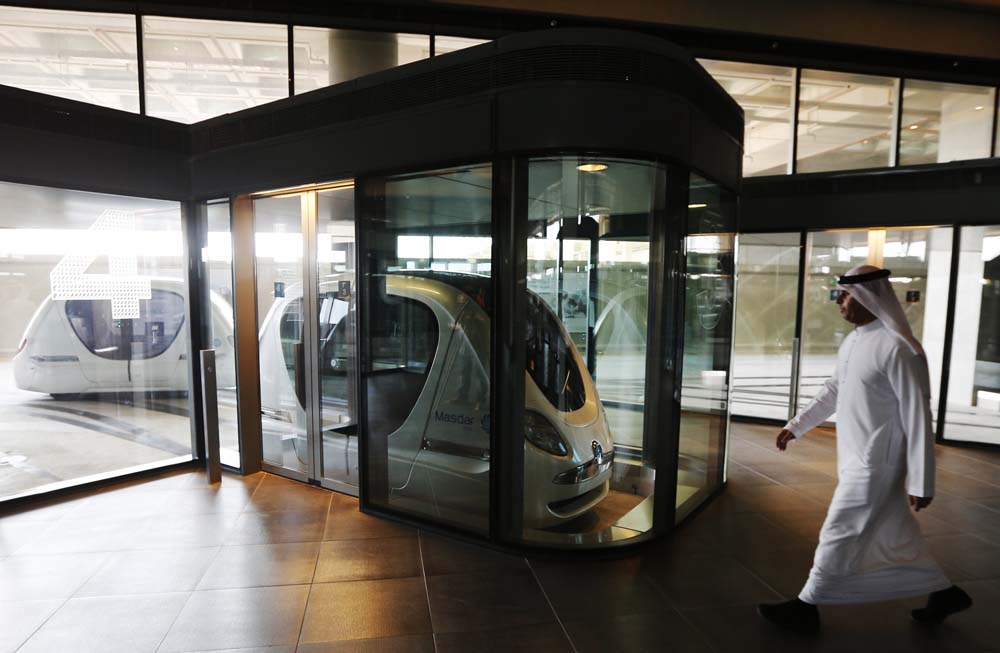
There is a growing interest in thinking about how driverless vehicles might be introduced to this region. Masdar City in Abu Dhabi is running autonomous pods in a controlled environment. And Dubai appears to be looking to take a regional lead for on-road applications.
However, there are many factors to consider before getting to this stage.
For starters, what would be the best use for autonomous vehicles? Do you do what Google has done with the Google car by adapting private vehicles? Or should you start with some form of public transport application, such as autonomous buses or pods? Or do you allow them to be used for some form of delivery service?
Next, you need to legislate for the use of driverless vehicles, including factors such as safety, insurance, type approvals, testing and changes to driver training requirements. And then, of course, you need to start rolling out the technology, which is likely to involve some form of off- and on-road trials. This is where the UK government is right now, and TRL is helping to shape this landscape through its policy development work and also its recently announced GATEway trial in Greenwich, London.
“I’m confident this will happen primarily because 2020 is designed to showcase innovation and this is one obvious chance to demonstrate that at the site”
My sense is that controlled use is a more likely starting point than uncontrolled private vehicle use. We’ve already seen several driverless pod applications. For example, the ones at Masdar in Abu Dhabi or the pods that ferry you to and from the car park at Heathrow Terminal Five in the UK. Both of these applications are autonomous in the sense that there is no driver, but they both run on some form of track guided by magnets or sensors in the track infrastructure. These well-defined routes lend themselves to public transport applications and delivery applications, especially in new developments, but I think in time we’ll definitely see private vehicle applications.
And this will happen, not just in the GCC, but globally. There are a couple of main drivers for this. One is congestion, which leads to pollution. Driverless vehicles would cut down on congestion because you can run them much more efficiently. For example, they can be run much closer together [platooning] or can be programmed to optimise route selection. They could also provide public transport in a more efficient way. For example, as a way of getting people into shared vehicles, perhaps to travel the “last mile” to or from a rail or metro station.
And then, of course, there is safety. Ninety to 95 percent of all accidents are caused by human error, so there’s a huge benefit to autonomous vehicles that never lose concentration or get distracted by phones and other road users.
Finally, when the time comes, it will be necessary to encourage people out of their driving seats. This could be done through financial incentives or penalties (i.e. taxes), or through levers such as land-use planning. For example, by restricting parking spaces for “driven” vehicles. This is likely to be more difficult in the GCC because there is a real car culture and public modes of transport are not yet as established.
However, there are some good examples of behavioural shifts. The Dubai Metro has been a runaway success. There were a lot of naysayers before it launched but now it’s full, and I’m sure that the same would be the case with more autonomous buses or pods as well.
To conclude, I’m confident that we’ll see more driverless vehicles. Dubai Expo 2020 is designed to showcase innovation, and autonomous vehicles are one obvious chance to demonstrate this at the site. And the entire region will follow, which will one day fundamentally change how we move around. It’s one of those things that’s difficult to see right now, but I think if you were to look 15 to 20 years into the future,
I can see a scenario where the vast majority of vehicles do not have drivers. And all that time could be spent doing something else, which will make us wonder why on earth we did it any differently. Autonomy just feels like a better way.