

What do we know about Yemen? The beautiful, historic Felix of Arabia rarely makes the headlines, but a quick scan of Google news one day last month uncovered the following stories: “33 people killed in battles between Shia Houthi fighters and Sunni tribes allied with al-Qaeda…”; “US drone strike kills six suspected al-Qaeda militants…”; “Government disbands in the face of Houthi pressure…”; “US considering evacuation of embassy following suicide bomb in Sana’a…”
Yemen is in upheaval, but we rarely hear the details. This is a land of complex allegiances where tribal, historical and religious divides make it impossible for the outside world to decide on the good and bad guys or make sense of the mess.
It was into this maelstrom that Laura Kasinof landed in late 2009. Seeking to improve the Arabic she’d learned in college, and intent on becoming a foreign correspondent, the 23-year-old journalist hunkered down in the peaceful, friendly capital of Sana’a. Her days soon fell into an agreeable pattern of language lessons in the morning, and afternoons exploring the historic Old City, chewing qat with the locals and hearing their life stories.
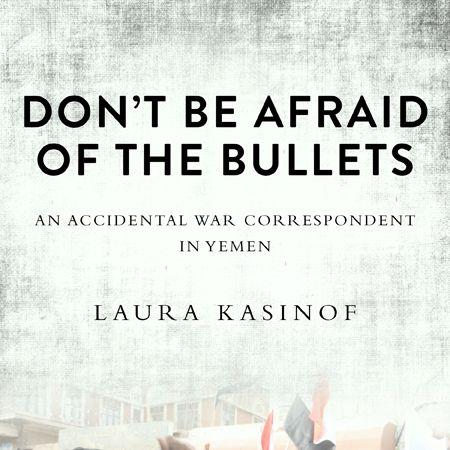
And then the Arab Spring came to town and Kasinof was suddenly in the middle of a revolution. Her new book, Don’t be Afraid of the Bullets – An Accidental War Correspondent in Yemen, is an attempt to make sense of the country and that tumultuous year in her life. She talks of seeing dead bodies for the first time; admits to the adrenaline rush of dodging bullets, speaks of her fears for the future of the country. But mostly she shares her deep love for the land and its people.
“The locals don’t take themselves too seriously, and of course are incredibly hospitable,” she says. “If you’re chewing qat with them, everyone really opens up and wants to talk. You learn about this world which is so different to ours. Everyone knows everyone else in the Old City. I never had that feeling of community back home in the States.”
People tend to think of Yemen as conservative and dangerous. It is definitely the former, though is also surprisingly tolerant to the presence of respectful outsiders. As for the threat of violence, the risk has increased in some parts of the country, though until the last couple of years that didn’t apply to Sana’a. The recent car bombs have sadly brought violence and fear to the capital.
Being female was also not a hindrance. “I’d spend time with the local women, which Western men can’t do, so I was able to see that side of the society. But the men would also go out of their way to help me; 99.9 percent of the time I never had a problem.”
Family medical concerns were partially what pulled Kasinof back to the US in 2012. But if her experience of Yemen was brief, her book is a timely reminder that the country should be in the news. Its destabilising conflicts could upset the whole region. The American drones that wreak havoc from the skies should be questioned. A litany of socio-economic issues demand our full attention. But despite of all this, Yemen, as Kasinof reminds us, is the cradle of Arabian civilisation. This is a fascinating, multifaceted society that deserves more than narratives of war.
Don’t be Afraid of the Bullets by Laura Kasinof is out now
