

When Nooruddean Choudry prays there are levels. He considers the big things, of course. The wishes for friends and family to be happy, healthy and successful, but also the smaller things, too. Quite recently that list included a swift return from injury for Manchester United’s Danish midfielder, Christian Eriksen. If you believe, you believe, right?
“I don’t see football and religion as separate,” explains Choudry, the author of Inshallah United, a new book about growing up in Manchester in the 1980s and ’90s as a devout Muslim and a diehard Red. “Both of those things are just fundamentally part of who I am. Religion is so intrinsic in my day-to-day life that football feeds into it.”
Chances are you’ll know Choudry from his Twitter account @BeardedGenius. Posting primarily on football, but increasingly about politics and world events, too (“there’s only so many jokes you can make about Harry Maguire’s defending—believe me I’ve tried!”) a rapidly rising follower count meant that his posts went from fun pastime to professional opportunity. Hence a book he never really felt capable of writing.
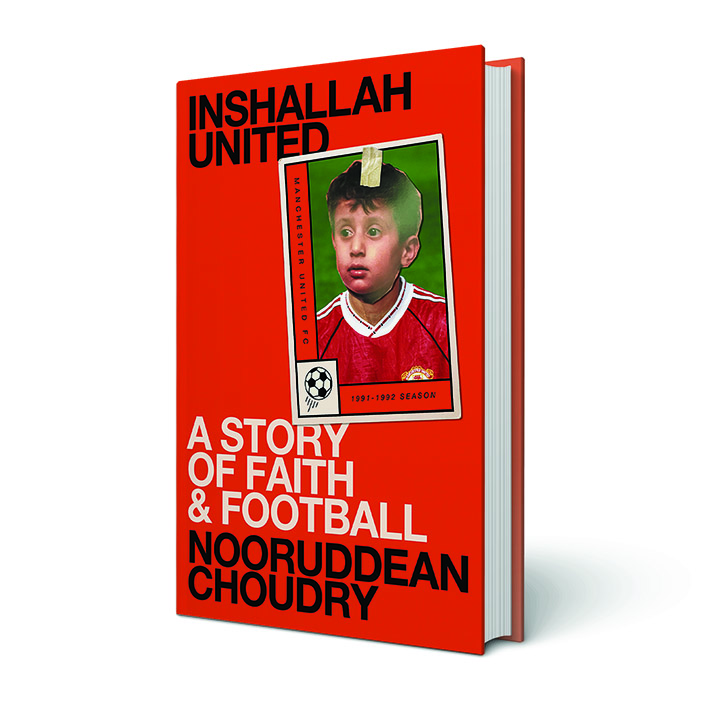
But while Choudry saw little worth in telling his own tale, the result is a funny, thoughtful account of not just the magically maddening life of a football supporter, but also a subtext that explores stereotypes in faith and football.
“There’s often an idea that Muslims—or people from any religion—have a tendency to be overly serious,” says Choudry. “But there are also stereotypes about football fans, too. Especially in the time that I grew up watching the game. The Thatcher government in the UK (1979-90) depicted football fans as thugs. My parents would see this in the media and would often be concerned about my going to the game, ‘isn’t it dangerous?’ they would ask. Even some of my mates were surprised by my burning desire to go to Old Trafford—it felt a very white environment. But I always found football fans to be incredibly welcoming. Football is magical in that it breaks through all kinds of barriers. As soon as you identify as supporting a club, you’re instantly part of that tribe. Muslim, Mancunian, Asian, working class. Football allowed me to have that identity. But also, once I shared an important part of who I was—a Red—my fellow fans accepted and respected everything else that I was automatically. I think there’s something quite beautiful about that.”
While previous books on a football fan’s unique life view have often focused on the finer details of the game, Choudry’s considers the person more than the player. Even though the setting of the book—1989-99—was an incredibly successful time for Manchester United.
“It sounds a bit daft, but football isn’t about the statistics. When you look back, the trophies you might have won won’t be your fondest memories. It’ll be a goal from your favourite player, or a particular pass or moment of skill. What makes winning a trophy incredible is the shared experience. The celebrations afterwards with your friends. Time spent with the community you identify with.
And should you need any further evidence of how faith and football intertwine, you need simply head to the book’s title itself. “Inshallah is a word that’s so interesting to me,” he laughs. “It’s just an instinct for Muslims, a knee-jerk end to a sentence. But while you say that ‘if God wills it’, it can become a case that, if you don’t say it, something bad will happen.
‘I hope United win, inshallah’. That statement is just ingrained in me now.”
‘Inshallah United: A Story of Faith and Football’, is out now in hardback, ebook and audio, published by HarperNorth