
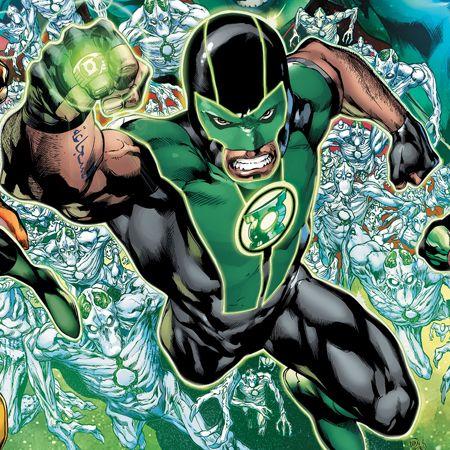

Admittedly, the name Simon Baz does not resonate in popular culture in quite the same ways as Clark Kent, Bruce Wayne or Peter Parker do. But then the secret identities of Superman, Batman and Spider-Man respectively have been around for decades. By contrast, Simon Baz, aka the latest Green Lantern. But he’s the first mainstream superhero who
is Muslim.
There have been Muslim and also Arabic comic book characters before, but nothing on this level, and certainly not as prominent a hero. Geoff Johns, chief creative officer at DC Comics and writer of the Green Lantern, believes it is long overdue. He also thinks it is necessary to squash cultural stereotypes. “It was my idea to say where the character is from, and I just thought it would be interesting to introduce him into this universe,” he tells Esquire.
There was initial speculation that Baz would be from the Middle East – he isn’t, he is Arab-American and from Detroit, a city with a large Arab population. Johns is clearly drawing on experience – he grew up there and is of Lebanese descent on his father’s side. “I knew I was going to build a storyline where the main Green Lantern, Hal Jordan, was taken off the board and given a side adventure. Somebody new was going to get the ring [the source of the character’s powers],” Johns explains. “And it’s unique, doing the things we can do with this Green Lantern.”
What that means is unclear, with the character’s debut in September’s Green Lantern #0 giving only a few clues. The first page opens with the events of 9/11, which have clearly had an effect on Baz’s upbringing and how he is viewed by the world. Johns worked very closely with the Arab-American Museum in Detroit, to develop his ideas, and is proud of the result. “He did his research,” the museum’s Matthew Stiffler told Detroit Free Press. “He came to the museum because he didn’t want to reinforce stereotypes of Arabs and Muslims.
He’s really helping to break those stereotypes down.”
And not just break them down – more like give them a laser blast from his Green Lantern ring. “The thing about Green Lantern rings is they pick whoever has the potential to overcome great fear,” says Johns. “The idea of Simon Baz fits with the concept – he’s had to learn to live without fear, and I wanted to create a character of this age.”
He didn’t want to reinforce stereotypes of Arabs and Muslims. He’s helping to break those stereotypes
The first issue also explores Baz’s troubled youth. We see him interrogated on suspicion of being a terrorist – he is then granted the ring and escapes. Fans will also wonder why he is not seen in costume inside, but appears on the front cover holding a gun. This may seem a little odd, as he already has a Green Lantern ring to protect himself. What is Johns trying to say? “It’s there for intrigue,” he admits, before explaining how his background, which is less wholesome than the previous Green Lanterns, makes him opt to carry a weapon as back-up.
Reaction so far from the Arab community has been positive. During a presentation given by Johns to launch the character at the Arab American Museum, Bill Swor, whose father is on the board of directors of the Arab Community Center for Economic & Social Services said, “It’s something not only we as Arab-Americans need; it’s something Detroit and the region and the state of Michigan needs.”
Baz will feature in some major storylines and join the Justice League of America. And at the forefront of DC’s major comic books is where he needs to be. He may not yet be as well known as Clark Kent or Bruce Wayne, but perhaps the way he can make a difference – in the real world – is more important.

