
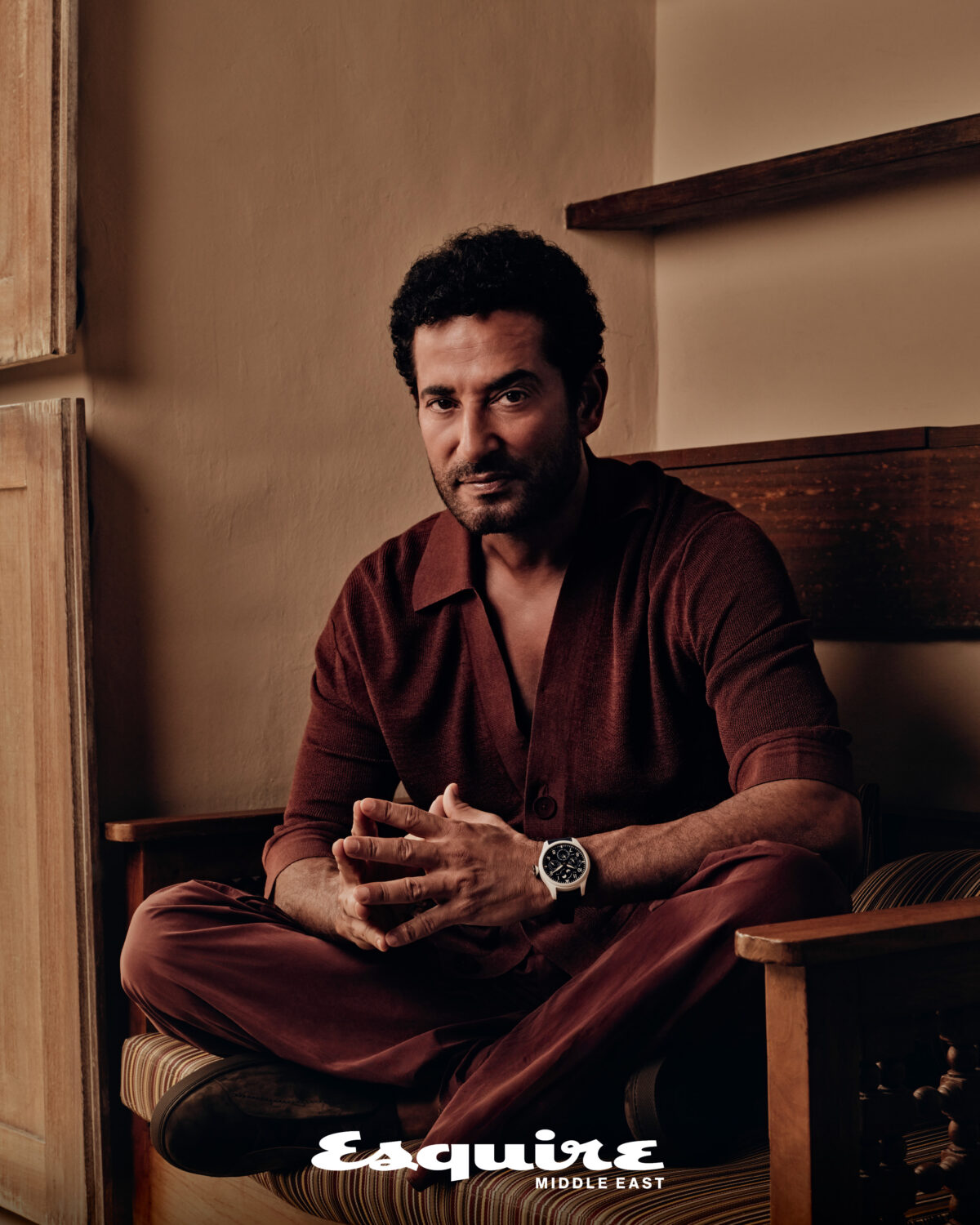

Ristretto. That’s how Amr Saad likes his coffee: short, concentrated, and taken in one sip. No milk, no sugar, no ceremony. Just a quick, purposeful hit. “Three a day,” he tells me, holding the small cup with the kind of precision that suggests this is less a habit than a ritual. “I don’t dwell on drinking coffee. I do it for a purpose.”
It’s a small detail, but it says a lot. The Egyptian actor approaches his work the same way: focused, intentional, and without anything extra. There is no sense of indulgence in how he talks about his career, despite the fact that he has just come off a season that crowned him one of the highest-paid actors of Ramadan television for his series Efrag (2026). Instead, there’s a quiet restlessness, an urge for evolution and for not staying too long in one place.
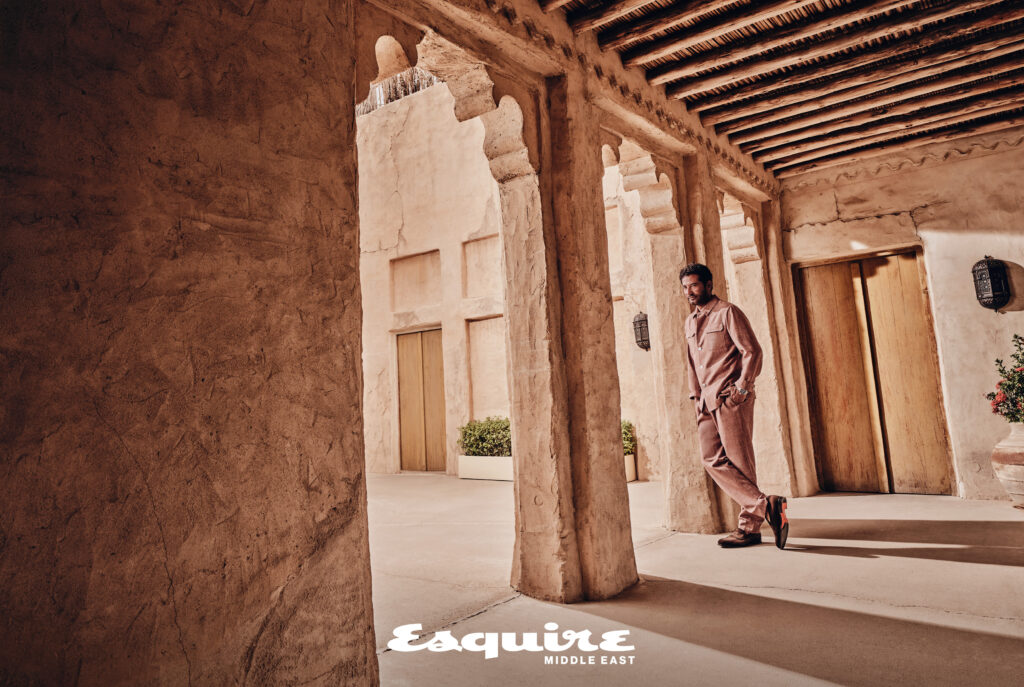
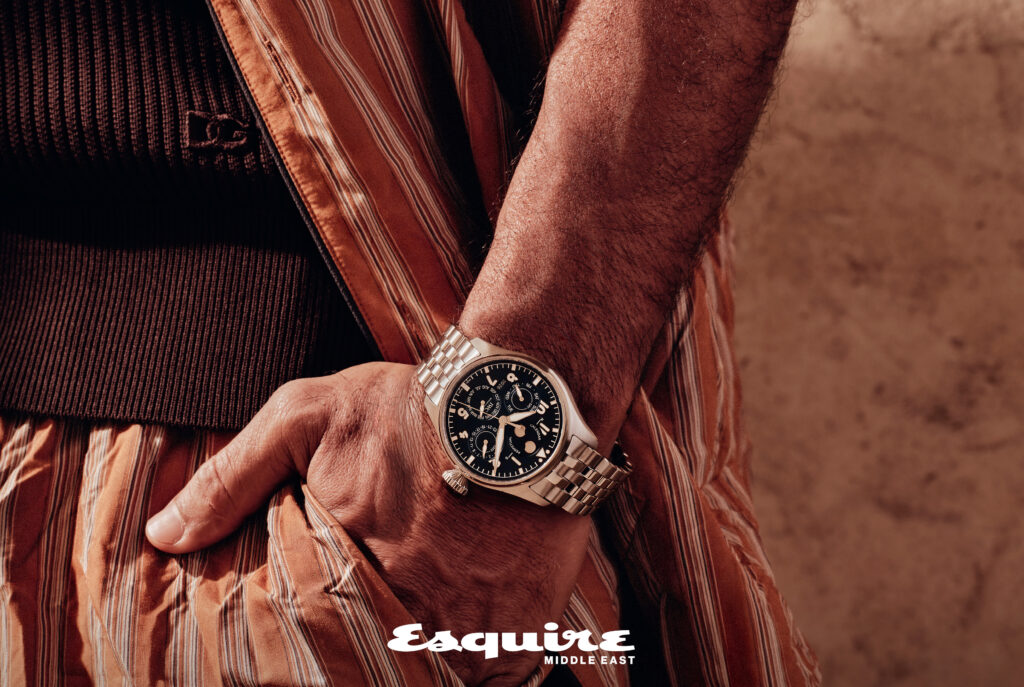
The Big Pilot’s Watch Perpetual Calendar ProSet Le Petit Prince Ref. IW329601, POA, by IWC SCHAFFHAUSEN
We’re walking between sets in the Al Seef district of Dubai Creek when the conversation shifts, almost instinctively, to cinema. The word alone seems to recalibrate him. His pace slows, his focus sharpens, and there’s a visible spark of something like longing.
“I miss cinema,” he says, smiling before slipping into Egyptian Arabic to emphasize the admission with humour. “I’m bored of television.”
Then he pulls out his phone and gestures for me to come closer, as if what he’s about to show me requires proximity, not distance. What follows feels less like a press preview and more like being let in on something personal. On the screen is the unreleased trailer for his new movie Al Ghirban (The Crows), a project he has been shooting for three years.
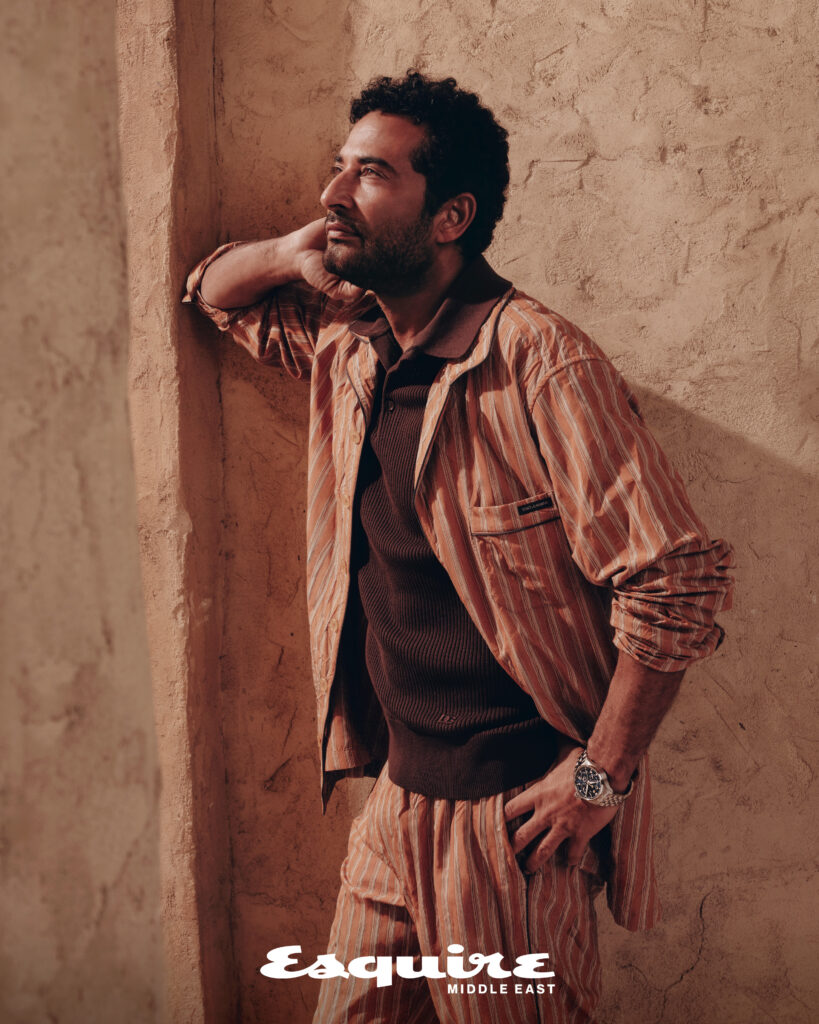
all by DOLCE&GABBANA;
The Big Pilot’s Watch Perpetual Calendar ProSet Le Petit Prince Ref. IW329601, POA, by IWC SCHAFFHAUSEN
The footage is striking in its scale: sweeping, snow-covered landscapes, elaborate period detail, and a tone that feels both epic and intimate. Set in 1942 during World War II, the film draws on real historical events while leaning into a visual language that recalls the grandeur of Gladiator and the unforgiving, freezing atmosphere of The Revenant.
“The production is massive,” he nods, watching my reaction more than the screen itself. “We built the entire set in Russia as it was a city in Egypt.”
There are ongoing discussions about a potential global distribution deal, though nothing has been formally announced. For Saad, however, the significance of Al Ghirban is less about industry milestones and more about something personal—a return to the big screen.
His last film, Hamlet Pheroun (Pharaoh’s War), was released in 2019, marking a seven-year gap that feels unusually long for an actor whose early career was so deeply rooted in cinema. Before television became a dominant force in his trajectory, Saad built his reputation through films that carried both commercial success and social weight. Collaborations with Khaled Youssef, particularly in Hena Maysara (2007) and Dokkan Shehata (2009), helped cement his position as a leading figure in Egyptian cinema and a box office force.
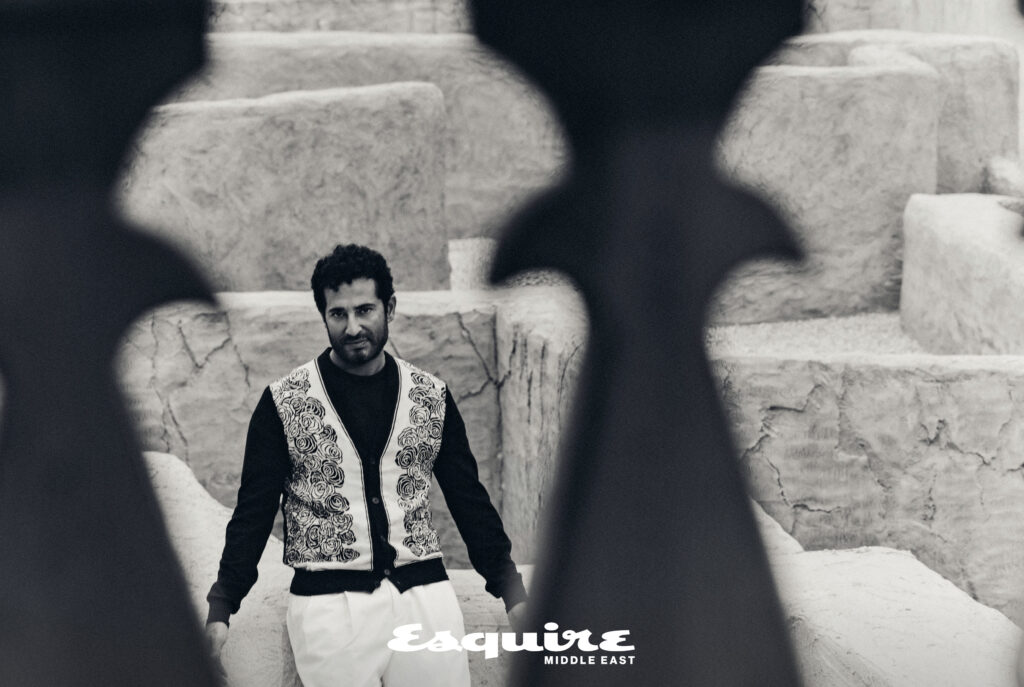
These roles earned him the title Batal Al Share3, or “street hero,” a label that places him in the lineage of actors like Adel Emam and Ahmed Zaki—performers whose appeal cuts across class and geography, resonating as deeply in working-class neighbourhoods as it does in more polished spaces. Saad is proud of it. “It just means people know you, connect with your work, and feel you.”
That connection to people and authenticity traces back to his upbringing. He speaks openly about growing up in poverty, not as a point of drama but as a foundation that shaped his worldview. His parents, despite limited means, prioritised experiences that would expose him to art and imagination. They made a point of buying cinema tickets whenever they could, instilling in him an early appreciation for storytelling and the act of watching films on a big screen. Those outings, along with simple trips to the zoo, became part of a childhood defined less by material abundance and more by observation, curiosity, and awareness of the world beyond immediate circumstances.
“I was studying interior design,” he recalls, “but in university I joined the drama group.”

What began as a casual involvement quickly evolved into something more significant. For a self-described shy young man, acting offered a kind of liberation, a space where expression wasn’t just allowed, but required.
“Acting allows you to achieve everything you are shy of in a virtual world,” he says. “A talented actor doesn’t act superficially. He reincarnates his character.”
It’s a philosophy that has guided his approach ever since. Saad speaks about immersion not as a technique, but as a necessity. In his early career, that meant fully embedding himself in the environments his characters inhabited. While preparing for Hena Maysara, he lived in the same underprivileged neighbourhoods depicted in the film, adopting the rhythms, habits, and daily realities of the people he was portraying.
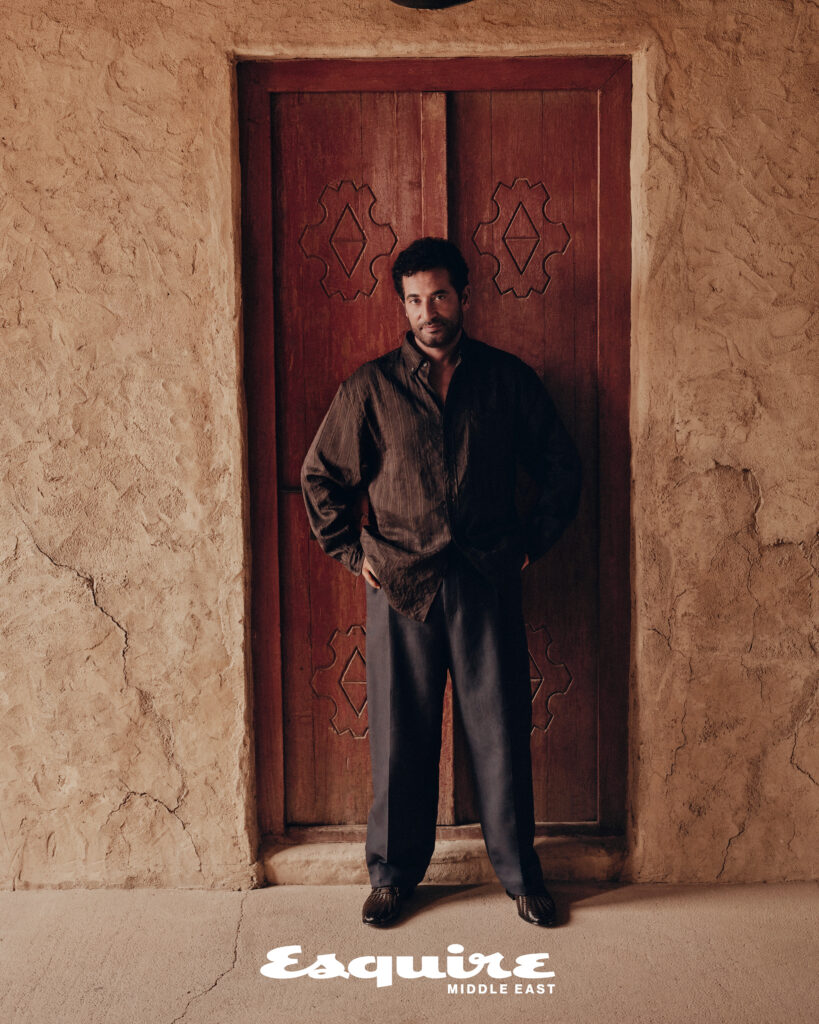
“I lived there, I ate there, I drank there,” he says, describing the experience with a matter-of-fact tone that belies its intensity.
Over time, however, he has learned that immersion must be balanced with detachment. The emotional toll of inhabiting complex, often heavy characters can be significant. There were moments early in his career when the weight of it all made him consider stepping away from acting entirely. Films like Mawlana (2016), in which he portrayed a well-known preacher navigating moral, ethical, and religious debates through his popular TV show, demanded a level of emotional investment that lingered long after filming ended.
“I believed in that story,” he says. “When you are so deeply involved, it takes from you.”
Now, his process includes deliberate steps to disengage. Travel has become a way to reset and to create distance between himself and the characters he brings to life.
Despite his achievements, Saad resists the idea of success as a fixed state. “Success is a moment,” he says. “Then you think about what’s next.”
Financial milestones, including his status as one of the highest-paid actors in Egypt, hold little personal significance for him. “These are success indicators,” he says. “They don’t add to me. I don’t care about money.”
But he notes that success can alter relationships, and people often begin to interact with him differently, seeing the public figure rather than the person, which can create a sense of distance that feels isolating. His response has been to double down on humility, a trait he attributes directly to his upbringing.
That grounded outlook extends to how he views his peers. Saad rejects the notion of competition within the industry, framing it instead as a collective effort. “We are all playing on the same team, trying to entertain and win the audience’s love and acceptance,” he says. “You can’t compare, we’re all different.”
It’s a perspective shaped by experience. Early in his career, he admits, he was far more competitive, measuring success in rankings and numbers. Today, his focus has shifted inward. “I compete with myself.”
This shift is particularly relevant in an industry increasingly driven by trends and metrics. Saad is critical of what he sees as a growing emphasis on viral scenes designed for social media visibility, often at the expense of script depth and originality. “Some actors are looking for scenes that go viral on social media. I don’t like trends. I believe in wow factor, offering something new and something real in a movie or a series,” he says.
While production budgets in Egyptian cinema have increased, the number of films being made has declined significantly compared to previous decades. “We used to make 200 films a year,” he says. “Now it’s much less.”
At the same time, the expansion of cinema screens across the region, particularly in markets like Saudi Arabia, presents new opportunities for growth. “We have talent. We need more films,” he adds.

For Saad, the path forward is clear. “I want to do more movies.”
Television, while valuable, was never intended to dominate his career to the extent that it has. “I wasn’t supposed to be away from cinema for that long,” he says. “I shouldn’t have thought about lucrative deals.”
He pauses, then offers a metaphor that captures his feelings with clarity. “TV is nice, it allows you to enter people’s homes,” he says. “But cinema is different. I like when people come to me. They are my guests.”
It’s a distinction that speaks to the unique experience of the theatrical setting, where audiences make a conscious choice to engage, to drive to a theatre, buy a ticket, and sit in a dark room while giving their full attention to a story. For Saad, that dynamic holds a kind of magic that television, for all its accessibility, cannot fully replicate.

His move into television started as a challenge from Ghada Abdel Razek on the set of Dokkan Shehata. He recalls teasing her that he’d cross over to TV and “make more money” than her. Not long after, an offer for his first series landed, and he signed on the spot, eager to prove the point. Once the reality set in, so did hesitation, and despite already taking the down payment, he began stalling. It took a visit from the director, who explained the project had already been sold under Saad’s name, to lock him back in.
Since then, Saad has appeared in numerous television dramas, primarily during Ramadan, including Mamlaket El Jabal, Share’ Abd El-Aziz (2011–2014), Khorm Ebra (2012), Younis Weld Fadda (2016), Wad’ Amny (2017), Touba (2022), Al Aghar (2023), The Goat (2024), People Master (2025), and most recently Efrag (2026).
Looking ahead, he is actively seeking to diversify his work. His upcoming series Men Awel W Gedid introduces a comedic dimension to his portfolio, with Saad taking on the role of a lawyer in a narrative that blends humour with social commentary. He is also working a comedy film titled I Love the Gang, driven by a desire to create something that offers audiences relief. “People need to laugh. With everything happening, they need that.”
Off screen, that lighter side is already evident, as he was always cracking jokes on set, singing between takes (and quite well, I should add), revealing a musicality that he hopes to explore further. “I want to do a musical,” he says, almost casually.
Outside of work, Saad maintains a routine that reflects both discipline and introspection. His days begin early, with a light breakfast followed by training and prayer. The rest of his time is spent developing new skills, reading, playing music, and revisiting classic films.
Underlying all of this is a principle that has defined his journey from the beginning. “Persistence is my virtue.”
Coming from a background with limited resources and no industry connections, the odds of success were slim. Acting, by his own estimation, is a one-in-a-million path, particularly in a country as populous as Egypt. Added to that was the pressure to support his family, often prioritising financial stability over chasing a dream. “Without persistence, I couldn’t have done it,” he says.
Back in the traditional Emirati heritage district in the late afternoon, another ristretto arrives. He takes it the same way he always does: quickly, without distraction. Watching him, it’s hard not to see the parallel. For Amr Saad, everything is approached with the same clarity of purpose, from the roles he chooses to the risks he takes and the way he navigates an industry in constant flux. Direct, strong, and never without meaning.
Photographer: Greg Adamski @greg.adamski @mmgartists
Fashion Director: Kim Payne @kim.j.payne
Grooming: Aida Glow @aida_glow
Executive Producer: Drew Brown @drewdb_
Talent Management: MAD Solutions @mad_solutions
Styling Assistant: Rawan Kojok @stylingwithrawann
Lighting Assistant: Charlie Jumuad @mrcoolot
Location: Al Seef Heritage Hotel @alseefheritagehoteldubai