

August 11, 1934
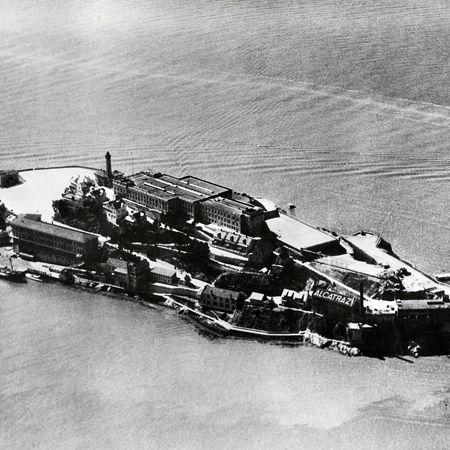
It had been a military prison for close to 70 years, housing deserters, thieves and rebellious elements from various platoons in the US Army, as well as the occasional foreign fighter who didn’t quite understand that resisting American power on their own soil was a criminal offence. It wasn’t, though, until August 11, 1934 that the first federal prisoners were shipped to the outcrop of rock two kilometres off the coast of San Francisco, writing the first pages of what would become the legend of Alcatraz – a prison that architecture critic Allan Temko called a “remnant of medieval penology that has made us all prisoners”.
The transformation of Alcatraz, or The Rock as it became known, into a high-security federal prison was conceived as a means to house both those inmates in the US penal system classified as “most dangerous” and also those deemed an escape risk. A combination of newly constructed fortifications, icy, swirling coastal waters and a highly restrictive system of isolation cells, silence and monotonous routine meant that it was the most feared institution in America – and one from which there was little hope of escape. The most notorious section of the facility was D Block, colloquially known as “the Treatment Unit”, and which included the “Strip Cell”, a steel shell with no toilet, sink, natural light or, during the day, mattress to sit or lie on. Prisoners were put in there naked for up to 48 hours.
In the prison’s 29-year-history as a federal prison, a total of 36 inmates attempted to escape Alcatraz. John Paul Scott, who made his escape in December 1962, is the only prisoner to have managed to successfully swim to shore, having sawn his way through the kitchen window’s bars stabbed a prison guard with a blunt knife and plunged into the sea. He was discovered at Fort Point some five kilometres from the island suffering from exhaustion and hypothermia and was promptly returned to his cell.
There are claims, though, that Frank Morris and brothers John and Clarence Anglin did manage to successfully escape earlier in the same year. Carefully executing an elaborate plan, the trio used improvised tools to chisel through their cell wall, climb into an air vent and, using 50 raincoats to create a raft, sailed over the turbulent seas to freedom. With no trace of them found since, it was assumed they all drowned, although their families claim they received postcards from them for many years after.
Perhaps more intriguingly of all are the repeated claims of paranormal activity in the prison, including the claim that C-Block is haunted by Abie “Butcher” Maldowitz, who was murdered in the laundry room. The sound of a door swinging has been frequently reported, while in D Block cell 14 is said to be significantly colder than others alongside it. Indeed, only last June, a British couple visiting Alcatraz claimed they had captured the outline of a woman in 1940s clothing in the old visitation room, even though it was empty.
In March 1963, Attorney general Robert Kennedy overcame significant congressional opposition to close Alcatraz, which had become expensive to both operate and maintain. The last prisoner to get on the boat leaving the island was Frank C Weatherman. When asked for his comments on the place he replied curtly “Alcatraz never was no good for nobody”.
by Stuart Turton