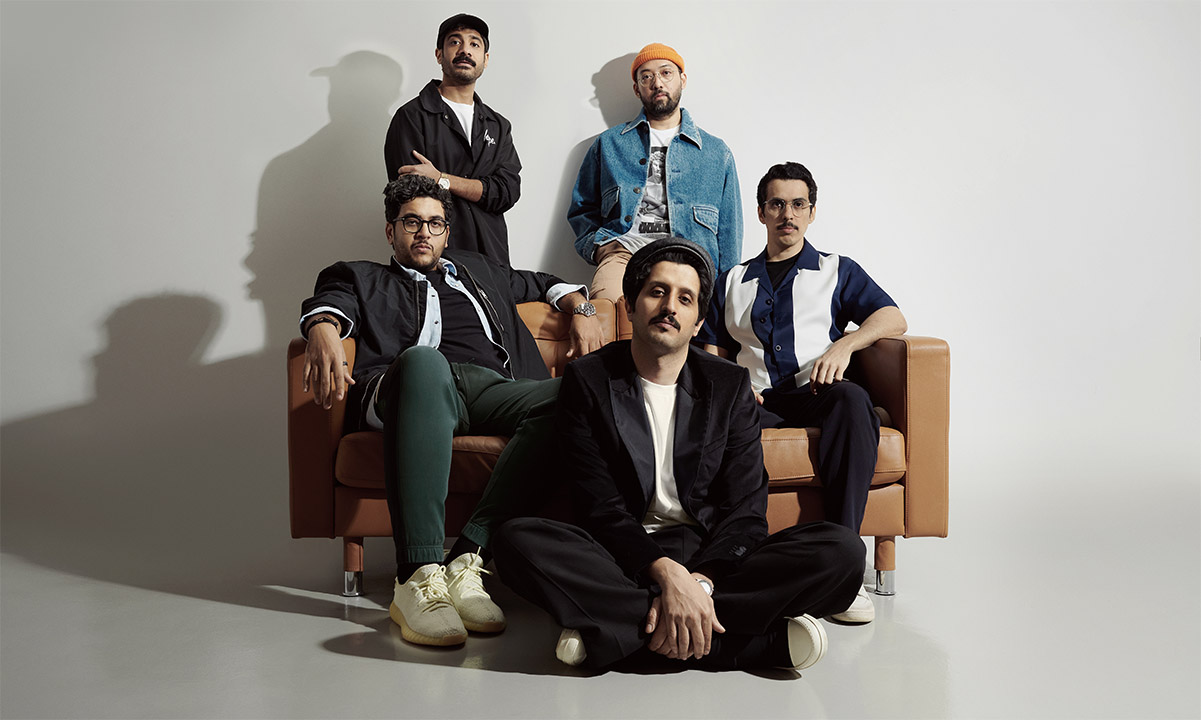
Last year Netflix commissioned the Riyadh-based film company, TELFAZ11, to create eight films for the streaming platform. The mega-deal not only acknowledged Saudi’s appetite for homegrown creative expression, but it could usher in a new dawn for regional film-making, and these guys have the keys…
The path to creativity always starts with a passion. It’s the kind of passion that quietly fuels your day-to-day. It takes over your thoughts, informs the way you see the world, and drives you to learn more, to delve deeper and to push the boundaries. Sleep? That can wait. When you are doing something from the soul, you will often sacrifice other commitments to try squeeze your passion into any spare minute you have, happy to do for free.
This was what brought Alaa Yousef Faden and Ali Al Kalthami together. Well actually it was DSLR cameras. Both in their mid-twenties, they met via a mutual friend and bonded over shooting and making short videos based on elements of counterculture.
At the time there was another quasi underground scene developing in Saudi—stand-up comedy. So the duo began filming international comedians who were coming into town and started to fine-tune their authentic, almost guerilla-style documentary making, telling stories of people that hadn’t been told—comedians, artists, photographers, animators etc. Their goal has always been split, partly they wanted to use a growing online following to change the misperception that people had of Saudi creatives, but the other part was more personal. Deep down, it was about tooling up and challenging themselves to develop their storytelling art.

This was the training ground for the first generation of creative trailblazers—there was no clear path, there was very little industry, but fueled by their passion Faden and Al Kalthami simply asked the question: “Why would you choose to work a 9-to-5 job doing something that you really don’t like, when you could get paid for doing something you love?”
This thinking resonated with Ibraheem Al Khairallah. Before he became popularly known as ‘Fat Khairo’ off the back of his widely popular onstage and online comedic persona, Khairallah was one of those nine-to-fivers, working in a bank.
Frustrated with his desk job, Khairallah’s natural charisma and passion for performing on stage brought him into the stand-up comedy scene—which at the time was bizarrely all done in English in front of Saudi audiences. After finding his groove in the scene, one night Khairallah was on stage and he looked out a saw that the whole crowd was Arab, he saw a chance and instead of performing his bit in English, he started telling his stories and jokes in Arabic. The crowd loved it. Khairallah knew he was on to something. Part of that crowd was Fadan and Kalthami, who sensed it too and, with that—a movement had started.
Comedy tends to travel further than documentary—especially online. In Saudi at the time, social media was booming, with people really starting to take to new platforms, particularly Twitter and YouTube. Sensing the opportunity, the trio decided to create an online comedy show with Faden and Al Kalthami producing the show, with Fahad al-Butairi as the host. It quickly became popular, particularly, as did socially-engaged content including the groundbreaking “No Woman, No Drive” video in 2013, which through comedy helped push the narrative around women driving in the country.
Thanks to a localized relevance and understanding of what people in Saudi wanted to hear and hadn’t had previous access to, it garnered millions of views on YouTube, helping turn people like al-Butairi, Hisham Fageeh and ‘Fat Khario’ into a social media stars.

These days, elevated levels of success in the creative field tends to attract the eyes of corporations and sponsors. But in the world of content, sponsors mean funding and the group—now officially known as Telfaz11—now had the resources, know-how and desire to create multiple shows and spin-offs, leveraging the instant access to millions of viewers online via social media. And then along came Netflix.
At the end of 2020, as it begins to ramps up production in the Middle East, the global streaming giant announced a partnership with Telfaz11 to produce eight new feature films. Having previously collaborated on the short film collection Six Windows in the Desert, the multi-film deal is an enormous sign of trust and confidence in Telfaz11’s methods and vision, and perhaps an even bigger indicator that the future of the Middle East’s film industry is in Saudi Arabia.
ESQUIRE: Hey guys, thanks for giving up your time. Obviously, a lot has been written about the multi-film deal with Netflix. Firstly, congratulations! Secondly, does that bring a whole new level of pressure?
Alaa Faden: No problem, we’re happy to talk. Right now things are pretty good. You can feel something special is going on—we’re not exactly sure what that something is exactly, but it feels like we’re in a really special moment.
Ali Al Kalthami: But like you said, there is pressure. We absolutely feel the pressure, but it is a pressure of responsibility. It’s like everything that came before us has been a proving ground, and now this is the time for us to show what we can do. For us, I think it’s coming at exactly the right time. It feels like recently we’ve been winning every race—getting big numbers and trending every week—all that is great, but it can become boring to a creative mind. Something like this deal is a big challenge, and there is fear, but it is a good kind of fear. It’s like the fear that a musician gets before going on a big stage.

Ibraheem Al Khairallah: The comedian Dave Chappelle once said that whenever he goes into a show thinking that he’s going to rock it, he always bombs! If we make a film with a over-confidence that it’s going to be awesome, then I don’t think it will be. You need to continually challenge yourself.
AF: Over the past ten years, we were making our own path. There was no precedent for content on digital and social platforms in Saudi for what we were doing. We’ve been trailblazing, because we’ve had to—and when it comes to producing premium-level Saudi films to a global audience, we have the chance to write the textbook on the industry here. That’s why it is scary, but it is a responsibility that we want, and believe that we’ve earned.
ESQ: So how far along the road are you on the eight projects?
AF: There’s a lot of work being done on all eight of the films.
AK: Yeah, we’ve finalized most of the scripts, but we’re not in the position to elaborate too much, as we’ve signed contracts to stop us talking about them! What we can say is that the films will span a whole range of genres, and not just comedy, and we are going to be working with some really promising Saudi filmmakers, not just the usual ones. What we want to do is create films that are very local, but ultimately accessible to people who are not only from this region. We are making human stories.

AF: Our focus is to tell Saudi-centric stories because we believe that the world hasn’t seen real, authentic Saudi stories from its people. To many people Saudi is still an unknown world, so we feel there is an opportunity to tell those stories—most importantly, because it is what we know, and they always say that you should write what you know. We’ve been telling authentic local stories for a nearly ten years now, and I think we’re pretty good at it. We are a creative culture canvas and we want to tell good stories and inspire people with those stories.
Obviously the move from producing content on social media to big feature films is quite a dramatic one. How are you guys personally finding the change?
IK: One thing that has changed has been the interaction with our followers. We used to publish and produce content all of the time and we would be always on screen, because we were never restricted to working on other people’s timelines—like network television seasons. Now the cake is a lot bigger, so we need to put more time and effort into these projects and move away from making quick shows.

Changing tact a little here, tell us a little about what each of you guys bring to the group dynamic…
IK: I always liked the expression: with one hand you cannot clap, but together you can make a round of applause. That fits us very well.
AF: We have a pretty good dynamic as a team, and we’re quite lucky that we complement each other well. For example, Ibraheem brings in an infectious energy and enthusiasm to the team. But also through his standup comedy background he understands how to engage and captivate an audience. Ali is the guy who brings the cultural and authenticity standards. He is the guy who will always defend the side of the art and the artist.
AK: Whereas Alaa has a very good taste in…
AF: …in music! [Laughs]
AK: Haha! No, but Alaa has a very fine understanding of aesthetics. Sometimes I still wish he was heavily involved in creative team, but it’s great for us because in his position he is able to think of the bigger picture as well as understanding what it takes to create the content. Ibraheem is a different kind of beast! We call him the ‘ideas machine’. He’s constantly thinking of things and can give you ten ideas in a minute! He spits out ideas, and I’m the one responsible for catching them and dancing with it.

IK: Yeah, Ali has to put up with all my ideas! We work closely because he is a writer and director so we often work on scripts together—and he doesn’t hold back with his feedback! [Laughs] Like Ali said, now Alaa is more focused on running the business, but before that he was a very talented DOP [Director of Photography], but he sacrificed doing that so that he can focus running the business.
Creativity is a hugely personal thing. How honest are you with each other?
AK: If you come to our studios you’d probably think “these guys spend too much time together!” But that’s the truth. The creative process isn’t a job, it is how you interpret life itself. It’s something that is living and breathing, and you want to add to it to help elevate it.

IK: We do quite a lot of brainstorming and challenging ideas, so in that process honesty is very important way to really find the truth in things.
AK: What I like about the team is that everyone comes from a different background. We’re not from the same city or region and artistically we all bring something different to the table—it’s that combination of opinions that sets us apart.
You mentioned being trailblazers. Do you see yourselves as having a responsibility to create opportunities for others around you?
AK: For each project we try to add in new people to keep the ideas fresh—we pride ourselves on being a sort of cultural catalyst. Over the past ten years we have worked with almost four generations of young artists, and we have helped develop them to a point where many have gone on to become prominent artist in the Saudi creative scene. In the past there used to be a stigma about working in ‘the arts’ in Saudi. Music, acting, dancing were all see as more of a hobby or not allowed, but that is in the past now. Yes, there is the legacy of that cultural DNA that still runs through us all, but we are navigating that and we love being a safe environment where people can come and express themselves and find themselves.

Meaning what?
AF: Essentially, when you come to the office we’re going to talk openly and honestly about the work and it is not a criticism, but a critique. That environment is super helpful.
AK: One of most important elements that helped us grow was for us not to be selfish. There is always the tendency to focus only on yourself, to focus only on your project as an individual—but we have to bring something else to the table. We want to attach our success to a new seed of success that is coming in the near future. Continual growth benefits everyone, like a tree that grows and sprouts new branches that create something bigger and better. The core of that is not being selfish. The decision to give some of the energy and opportunity to somebody else.

From the outside it looks like you guys are just living your best lives, making comedy shows and movies with your best friends. How much of that is true?
IK: Yeah, it is kind of that. Most of the day it is fun —but a lot of hard work goes into it. A lot of people always tell me on Snapchat and Instagram, “Oh I wish I worked with you, it looks so fun”, but that is only what you see. On times when we have big pitches for example we’ll stay for days in the office, no gym, no wife, no nothing.
But is it all worth it, right?
AF: Absolutely. We’ve worked hard to get here and we wouldn’t change it for anything.
Photography by Majid Angawi / Styling by Wafa Al Dekhail / Production by Jesse Vora / Talent Liaison by Hatem Alakeel / Grooming by Lama Hatem / Lighting & Camera Assistance by Mohammed Alfarra / Digital Image Technician: Mohammed Fawzi

Esquire now has a newsletter – sign up to get it sent straight to your inbox.
Want up-to-the-minute entertainment news and features? Just hit 'Like' on our Esquire Facebook page and 'Follow' on our @esquiremiddleeast Instagram and Twitter account.