
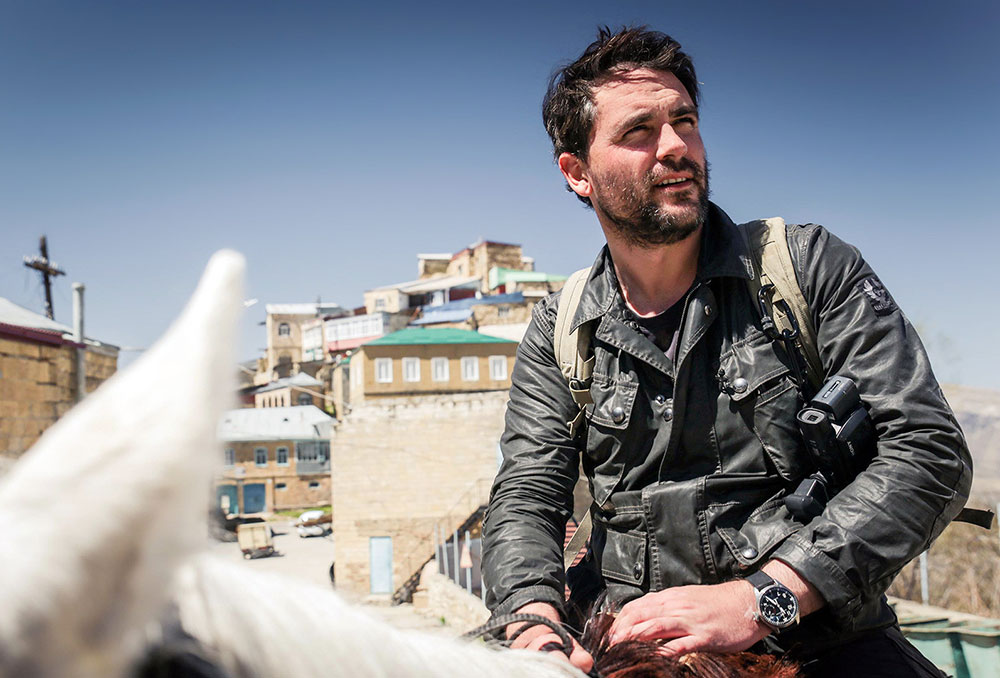
Levison Wood is a British explorer, writer and photographer whose work has featured around the world. He has recently returned from his most ambitious expedition to date – a 5000-mile circumnavigation of the Arabian peninsula from Iraq to Lebanon.
He charts his journey in a new book and documentary series, and sat down with Levison ahead of the Emirates Literature Festival, at the Renaissance Hotel Downtown Dubai:
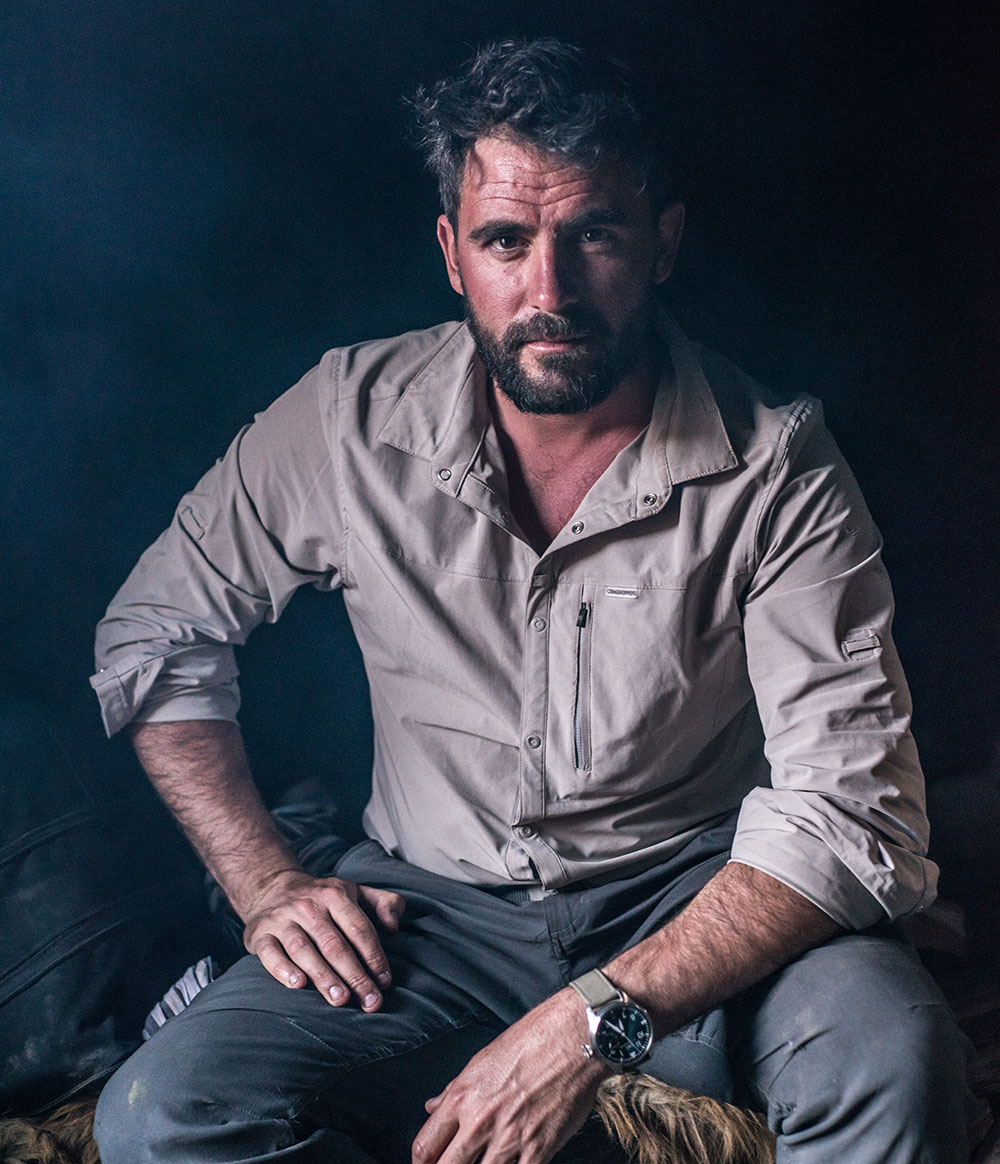
Hi, Levison. A nice easy one to start: what does exploration mean in the modern era?
Ha! Thanks for that. Listen, long gone are the days when people were planting flags on maps and naming mountains. Exploration these days is about documenting a moment in time. We live in interesting times, with borders continuing to open and close.
Only recently, less than a decade ago, an entirely new rainforest was discovered in Mozambique, thanks to Google Maps. We live in an age where technology dictates our potential and our capacity to explore.
Exploring always seems like a very human thing to do.
We like to see what is beyond the next horizon. It’s in our genes — literally. There is actually a human gene mutation called DRD47R, better known as the ‘wanderlust gene’.
Are you kidding?
No, it’s absolutely true. It affects 20 percent of the human population, and is highly prevalent in nomadic peoples, like the Bedouin. It’s all to do with dopamine levels in your brain and how your brain reacts to change and movement, and how likely you are to react to change, risk, and things like trying new foods or travelling. That’s why I believe that as long as there are humans, there will be that desire to explore.
I’m going to guess that you are one of the people that possesses that gene…
Well… Let’s just say I’ve never been tested!
You have recently finished a walking expedition around the Arabian Peninsula. Tell us a little about that…
I have always been interested in the Middle East. I travelled here as a student backpacker and ended up in the middle of the Iraq war in 2003, but I always wanted to come back and do it justice, and look beyond the headlines to tell a more human story.
I saw my expedition as an opportunity to come back to the region. I wanted to do it akin to my previous expeditions, travelling at the slowest pace — whether that be via walking or camel or donkey — and do it the traditional way. I did a circumnavigation of the peninsula, starting in Syria, through Iraq, all the way around the Gulf.
The most interesting thing for me was seeing a side of those countries other than war and conflict because there were lots of people living normal lives there as well.
What are some of the scarier moments that you encountered?
There were a few close calls, I managed to get ambushed by ISIS in Iraq.
Really?!
Yeah. We unintentionally found ourselves embedded in the final assault on ISIS in Hawija in December. That wasn’t planned. Some local guide asked us if we ‘wanted to see some action’ and so we followed him to the front line and found ourselves as the second vehicle in the convoy!
When you undertake these expeditions you find yourself in some quite remarkable situations.
Have you ever genuinely feared for your life?
On my Himalayas trip, we had finished walking for the day and there was a curfew in place as it was during a Maoist uprising. We were advised to get into a taxi, and we were driving up a mountain in the dark.
Just as we got over the crest of the hill the brakes failed, and the car went off the edge of a 140m cliff into a jungle ravine, I snapped my arm in several places, and it took us about a week to get rescued. In those 10 seconds after the brakes failed, that was the most scared I’ve ever been in my life.
What were the most surprising aspects of the Middle East that you discovered?
The one thing I’ve taken away from all my journeys has been the hospitality. From walking the length of the Nile, to crossing the Himalayas, and walking halfway across Africa, the thing that always sticks with me is the amazing diversity, and the hospitality. The places that tend to be in the news for all the wrong reasons always seem to be the places where you are welcomed the most.
Care to elaborate?
One of the most hospitable places I’ve been to is Sudan. Now, before I went there I’d read all the reports about famine, genocide and war. What I wasn’t prepared for was the incredible sense of hospitality, everywhere I went.
People would run out of their homes, offering me food or cups of tea. It got to a point where my Bedouin guides started to get annoyed as it was slowing us down and they wanted to get back home in time for Ramadan.
We only had two months to walk through Sudan — which may sound like a long time, but when every village you walked past wanted to welcome you and build you a shelter to sleep in, it can be quite time to consume.
To save time, my guides insisted that we walked away from the villages and camped out in the desert nearby. Now, if you happen to be setting up a camp a mile away from a village, people tend to become curious of what is going on, so we were often surrounded by villagers who would be asking us why we wouldn’t accept their hospitality.
One time a man was so offended that we didn’t accept his invitation, that he went back to his house and half-an-hour later returned carrying his bed on his head declaring that if I wasn’t not going to come to his house, then his house would come to me.
On the expeditions do you have a team or are you on your own?
A bit of both. For the longer journeys, like the Nile, I am on my own a lot or with a local guide. We would be like that for weeks. And then the film crew of two or three people would fly out for a week or so to particular spots where either the interesting stories would be, or the nicest hotels would be!
I enjoy the times where it is just me and the guide as I feel that I am actually getting under the skin of the country.
A lot of your early trips were done via hitchhiking. Is it as dangerous as we are always led to believe?
When it comes to hitchhiking, you have to be careful. I mean, I started out as a broke student needing to get around on practically no budget. I suppose you can either call me lucky or reckless, but what I found is that getting around by asking and accepting the hospitality of local people, the vast majority of people are there to help you. Especially when you are a little younger, there is this element of human nature that makes people want to look after you — that was my experience.
With the journeys now, I have been wanting to see what the reception is like, being a grown-up, and I have actually had my faith in humanity restored several times because people go vastly out of their way to make sure that you get to wherever it is you want to get to. That is great, because not only does it allow you to meet so many interesting people, but it also helps reaffirm your faith in people.
Of all the people you have met along the way, what virtue have you found to be the most vital?
Due to the nature of what I do, I’ve met everyone from shepherds to warlords, to criminal bosses and the Dalai Lama. The one thing I’ve taken away from it is that people just want to be left alone to live in peace. It is something I have seen in the Middle East, on all sides. Around the world, there is a minority of people who have a vested interest in conflict, but most people just want to get on with their lives.
How important is the writing process, in terms of closure?
Walking the Nile took me nine months, and returning back to city life can sometimes feel a bit like you’ve hit a brick wall. I’ll never forget when I returned back from my Himalayan journey, it was ‘Black Friday’ in the UK.
I didn’t even know what it was, but apparently, it involves people fighting each other to try and get big discounts on flatscreen TVs.
I had just spent lots of time in areas of incredible poverty, with people who had nothing, but would rather die than let you go without a drink of water. It really gives you that sense of humility. Going home and seeing this gratuitous consumerism, you tend to be a bit overawed… but then you just need to go have a Burger King and get over yourself!
Ha!
The writing is a cathartic experience because you get to relive it, and one of the joys of doing these journeys is being able to share the experiences with people who may be interested but who wouldn’t want to do it themselves.
What is the strangest thing you have eaten?
A stew I had in Uganda. I was walking through a rainforest with my guide, Boston, and we had run out of food. We managed to find a little village, and an old lady was cooking up a stew in a pot.
It smelled delicious, and I wolfed down a whole bowl of what looked like beans and rice. Boston started laughing at me, asking if I liked it. I said I did, especially the rice. He then told me that it wasn’t rice, it was maggots.
Levison Wood spoke to Esquire Middle East courtesy of Le Clos.


