
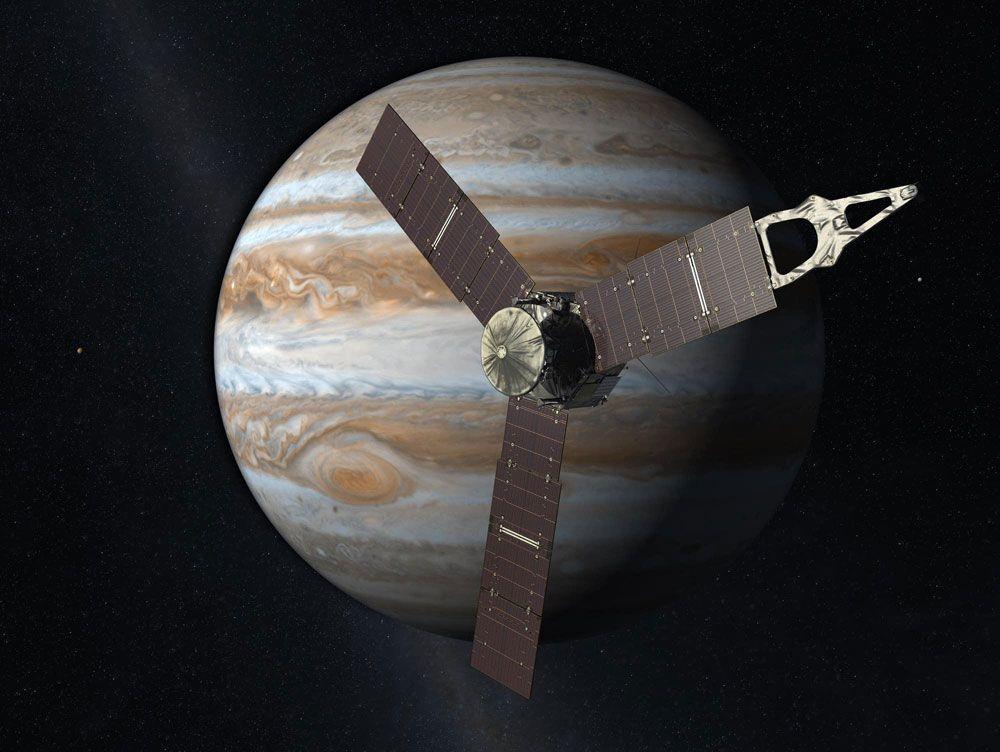

Cast your mind back to earlier this summer, and you may remember a news story about a Nasa probe reaching Jupiter. The craft was called Juno, and it has been in a highly elliptical, 54-day orbit around Jupiter since July 4. Sometime this month it will perform an engine burn and shift to a tighter 14-day orbit, performing 37 circuits in total before its mission ends in February 2018.
For the next 20 months scientists will pore over the findings that Juno will relay back to Earth, but this is just the culmination of a much longer story — and one that will cost a projected $1 billion.
The probe launched in August 2011, taking almost five years to travel the 588 million kilometres to reach the largest planet in our solar system. Perhaps surprisingly to some, this isn’t uncharted territory — space probes have been sent there before, starting in 1973 with a quick flyby from Pioneer 10 on its way to Deep Space, while others have taken photos en route to other planets. Galileo arrived at Jupiter in 1995, becoming the first to orbit it, examining the planet and its moons.
All of these previous probes discovered something noteworthy. The Pioneer missions confirmed the presence of radiation fields, while Galileo determined the composition of the gas surface and monitored wind speeds. Though Juno can’t land, due to Jupiter’s lack of a solid surface, the fact that Jupiter is its sole focus and is carrying the most advanced equipment so far makes scientists hopeful that there will be more discoveries.
So what is it that Nasa wants to learn that we don’t already know? Despite being our largest neighbour, we understand very little about Jupiter — one reason being that it’s not the easiest object to study. The fifth farthest planet from the sun, it’s over 300 times the size of Earth, with 67 known moons.
As with Saturn, Neptune, and Uranus, Jupiter is made up mainly of gas — around 90 percent hydrogen and 10 percent helium. It also has many layers of cloud, and winds that can reach speeds of up to 618kph. It’s thought to have a dense central core — a theory scientists hope Juno will confirm — and its famous Great Red Spot, located just south of its equator, is known to be a huge, continuous storm.

Everything looks promising so far for further revelations, with Juno already delivering thousands of new photos, including the first ever of Jupiter’s north pole. “It’s bluer in colour up there than other parts of the planet, and there are a lot of storms,” says Juno principal investigator, Scott Bolton, of the Southwest Research Institute in San Antonio, in a statement released last month. “It’s hardly recognisable as Jupiter. We’re seeing signs that the clouds have shadows, possibly indicating that they are at a higher altitude than other features.”
Further objectives include measuring the abundance of water in the atmosphere, to see if there are any connections between Jupiter and the formation of the solar system; looking for the planet’s core mass; producing detailed maps of its gravitational and magnetic fields; and learning more about the cloud structure, its magnetic poles and angular momentum.
Most of this work will begin this month when the new 14-day orbit kicks in, and who knows what Juno will discover? Surely the biggest planet in our vicinity holds the most clues to the creation of our solar system and is therefore worth examining closely.
And if it does manage to unlock such secrets, fittingly, Juno will become at one with its subject at some point in February 2018 when it de-orbits, falls into and burns up into nothingness in Jupiter’s atmosphere. The Greek and Roman mythology around the planet seems an appropriate way to finish, as Nasa explains on its website: “The mythical god Jupiter drew a veil of clouds around himself to hide his mischief, but his wife, the goddess Juno, was able to peer through and see Jupiter’s true nature.”


