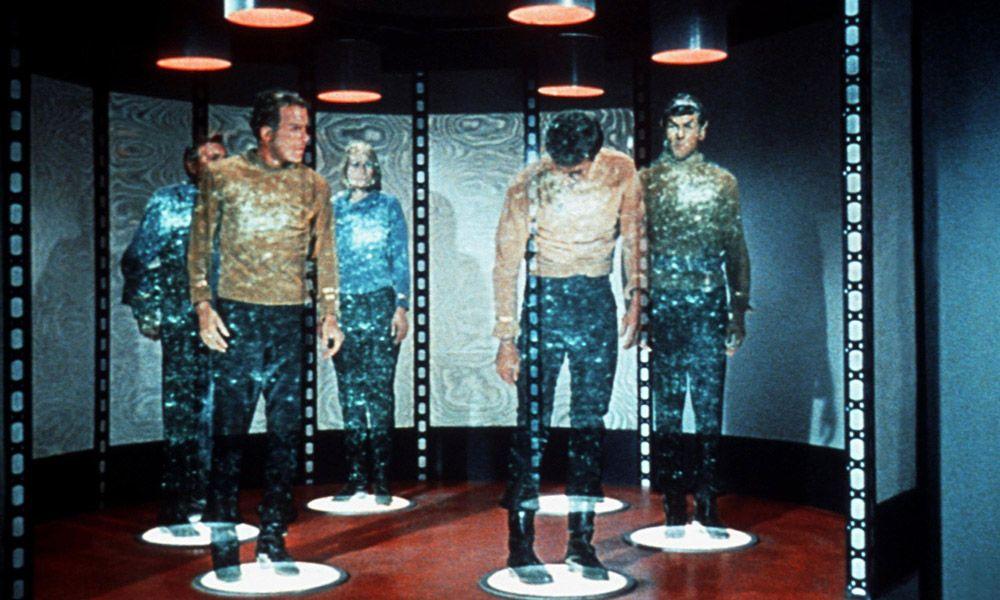

Teleportation — the idea of beaming ourselves from one place to another — is one of those things that the sci-fi genre has long had us believe will be possible at some point in the future. Star Trek fans will have seen it in practice a million times on TV and in the movies, usually accompanied by a command of “Beam me up, Scotty”.
But could a physical object really be broken down into data, streamed to a new location, then reassembled? (The term is a portmanteau of “telecommunication” and “transportation”.) We’re used to streaming data these days, with music and films, and there are 3D printers downloading information to construct a physical object, so could something similar ever be done with a person?
In a way, the first steps have already been taken. Physicists at the California Institute of Technology completed their first ever successful teleportation experiment back in 1998, sending a single photon, an elementary particle, a distance of one metre. More recent tests have increased those distances to nearly 100 miles. There are even plans to teleport photons to the Moon when the next landings take place.
The problem is that we’re still just talking about photons — tiny subatomic particles — whereas a human is comprised of trillions of atoms, each with a specific location. According to the University of Leicester team, if you translate that into data, you’re talking a ridiculous number of gigabytes. Even with today’s fastest computers and a high bandwidth transfer, it would take quadrillions of years to teleport — or around 350,000 times the age of the universe.
So is the answer to build better computers? That’s only part of the solution. Scientists would also need to find a way to scan an individual’s skills, memories and thoughts, turning each into their own data stream, and that’s after breaking down the exact composition of their physical body. Plus, how are they being reconstructed? Can you “print” human flesh? And what kind of resolution would you need to recreate things like nerve cells, and have every single one of them working accurately?
There is also one other minor issue: to teleport, you’ll have to die first. When scientists work with photons, they are destroying them in order to read the information. That photon no longer exists, and what emerges at the other end is a reconstruction — an artist’s impression of the original. As a person teleporting, your cells would need to be broken down for examination, so would it be you that emerges at the other end (350,000 times the age of the universe later), or someone that just looks and acts like you?
There is also one other minor issue: to teleport, you’ll have to die first.
Despite these challenges, it hasn’t stopped certain scientists from continuing to champion teleportation. Professor Michio Kaku of City University, New York — nicknamed “Mr Parallel Universe” for his futuristic claims — believes that technology will soon be able to handle more complexity.
“I think within the next decade we will teleport the first molecule,” he said in September last year.
Others are more doubtful, pointing instead to ideas that use the technology in a different way, not just to advance human travel. For example, if microbial life was discovered on Mars, how about sequencing its genome locally, then sending the information back home to rebuild the organism on Earth? Or in reverse, send human DNA to an incubator there to create clones that can populate the Red Planet?
But maybe we’re not thinking of it in the right way. Whenever Captain Kirk teleports, his atoms are disintegrated, yes, but rather than being read and turned into data, it is seemingly those actual pieces that are sent into the internet or the cloud, rather than instructions on how to remake him. And he gets to reappear anywhere he likes, regardless of whether there is technology present to put him back together again, including alien worlds that he has never visited before.
That just sounds even more complicated — transmitting actual human cells, and having them reconstruct remotely without any assistance whatsoever. If the type of teleportation we have can just about cope with photons, to advance to some form of human involvement at an unspecified date, who knows when we’ll be planet-hopping Captain Kirk-style? Maybe human teleportation will be possible one day, just don’t bank on being able to make your daily commute to the office instantaneously just yet.