
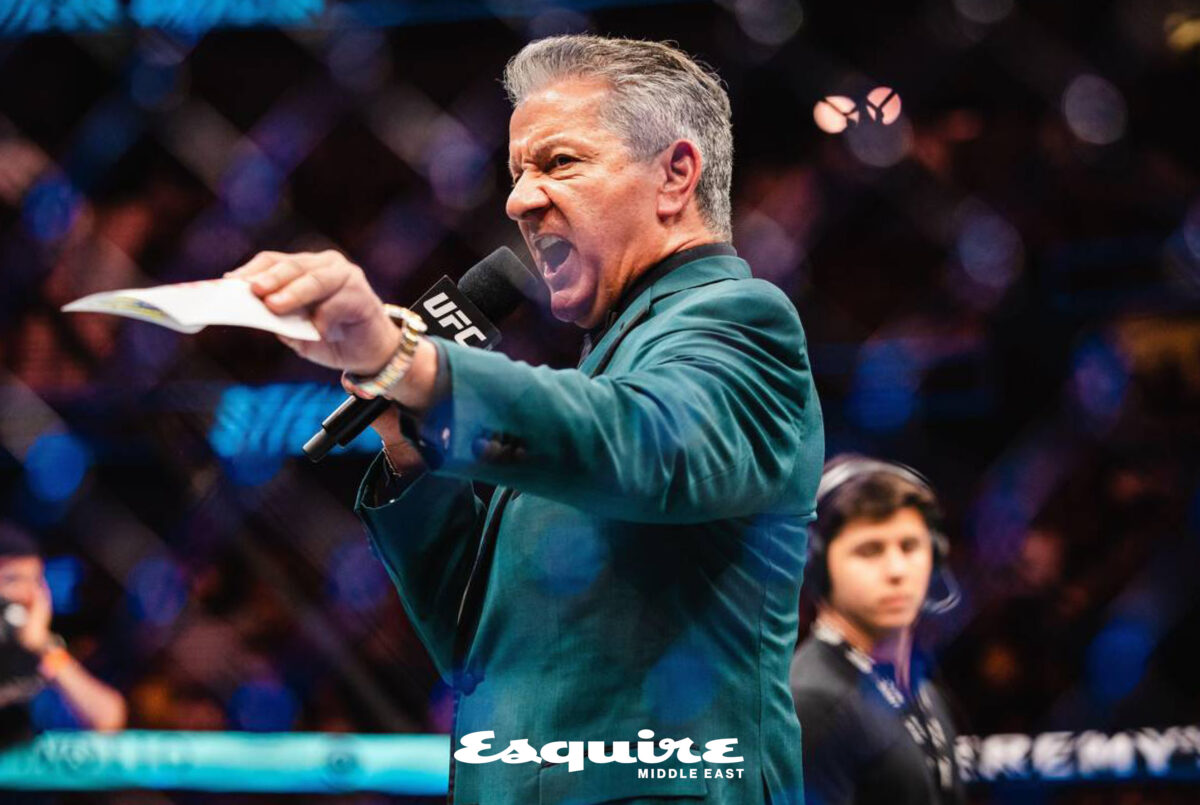

Known as “Voice of the Octagon” ring announcer Bruce Buffer has served as the energetic pulse of the Ultimate Fighting Championship since 1996. Raised in a fighting family by a Marine father, Buffer spent his early career building businesses before discovering late in life that legendary ring announcer Michael Buffer was his half-brother.
Joining forces, Bruce managed his brother’s brand and transformed Michael’s five-word phrase—”Let’s get ready to rumble”—into a global licensing powerhouse.
He brought that same entrepreneurial grit to mixed martial arts, crafting an athletic, unscripted announcing style punctuated by his trademark battle cry, “It’s time!”
Over nearly three decades, he has helped steer the UFC from an embattled spectacle into a worldwide mainstream phenomenon.
Ahead of this weekend’s UFC333 in Abu Dhabi, he shares some words of wisdom gained from his fascinating multi-facitated life…
I’ve always been a huge sports fan. NFL, boxing, MMA, you name it. But my first love was surfing. I’m from Malibu, and I’ve always been a big surfer.
I started my first company when I was 19. I’ve always found a way to make businesses successful. Back in the 1980s and early ’90s, I was basically living the life of Charlie Sheen in Two and a Half Men – minus the alcoholism. I had a house on the beach, and I was making tremendous money, but I was burned out. Making money is fine, but passion is the thing that keeps you getting up every day, and I needed to find that.
My older brother, Michael Buffer, is the greatest ring announcer all time. He changed the entire industry using just five words: Let’s get ready to rumble!
I didn’t know I had a brother growing up. My dad never told me about him, as he hadn’t seen him since he was two-and-a-half years old. I used to watch Michael on TV and saw a guy with the same name and a really strong resemblance. I decided to reach out, and when we finally connected, we became very close. I saw that he was an artist, and so I sold my businesses and convinced him to let me manage him full time.
Together we trademarked his famous phrase, and turned his voice into an empire.
Boxing was a world that I grew up in. My grandfather was a world champion in 1921, and my father was a drill instructor in the US Marines and served in both World War II and Korea. These were hard men, with that old-breed warrior mentality baked into them. They taught me boxing and fighting techniques pretty much from the cradle.
I didn’t want to be a ‘Frank Sinatra Jr.’ I didn’t want to make it in the announcing industry as “Michael’s little brother”. I set myself a goal – if I couldn’t walk into an arena and be recognized strictly for who I was within three years, then I’d quit.
People think announcing is just holding a mic and reading names. I tell them: why don’t you go stand in front of fifty people and speak. Then try fifty thousand. Then try ninety thousand. The entire trick to life is making something brutal look effortless.
You’re introducing men and women who bleed for a living; so you shouldn’t read off a card like a librarian. They deserve you to give them every ounce of oxygen in your lungs.
When you build a business, climbing the mountain is tough, but staying at the top is the real killer. In the early days, the UFC was haemorrhaging cash. Then came the first season of The Ultimate Fighter—Forrest Griffin against Stephan Bonnar. Twelve to fifteen million people tuned in to watch that fight on Spike TV. We made Spike TV that night, and they helped make the UFC. The thing is, Spike isn’t here anymore, and we are.
My catch phrase “It’s Time!” came organically. Every morning when I shave, I look in the mirror and thing: It’s time. It’s time to be the best you can be. It wasn’t dreamed up in a Madison Avenue focus group. It was just a reminder to myself at the sink.
I never rehearse. I want to walk onto the canvas, take the temperature of the room, and let the energy dictate what my body does. In the early days, I would get so hyped that I was leaping three feet into the air – you can’t choreograph that; you just let it rip.
My job is to grab fifty thousand people by the scruff of the neck and remind them that this is the moment they’ve paid for. It’s Time! By the time its the main event, the crowd have been sitting in their seats for six hours, they’ve sat through twenty minutes of sponsors, judges, and rule introductions and the wind is sucked right out of the building. The fighters have spent ten weeks in camp killing themselves for this moment. My job is to pay respect to that and reenergise the room.
I write out every fight card by hand, stats and colours, because the act of writing cements it in my head. By the time I step into the Octagon, the card is practically a prop. I hold it at my waist, so I can glance at it if I need to or read a sponsor’s name without breaking stride. You don’t perform looking down at a piece of cardboard.
I judge a fighter by how they behave outside the cage, not just inside it. Georges St-Pierre is the gold standard. An absolute killer on the canvas, a gentleman on the street.
If you have a platform and you don’t use it to set an example, you’re wasting your gift.
I have a rule, whoever stands within three feet of me, I want them healthy, happy, and make money. If everyone around you is winning, it’s impossible for you to lose. It’s the most selfish, unselfish philosophy you can live by.
Every single show, I treat it like an audition. At UFC333 in Abu Dhabi, I don’t walk out thinking about the last thirty years. I walk out thinking I have to prove to [UFC President] Dana White, to the fighters, and to the kid in the cheap seats that I still earn this microphone every single night.
The second you think you’ve arrived, you’re done.