


The Little Mermaid is the most talked about Disney film in years, and it’s no surprise why. After all, it not only adapts one of the most popular animated movies in the studio’s legendary canon, it also makes a number of bold choices that have been hotly debated amongst fans, as they gear up for the long-awaited theatrical release on May 25.
One aspect people can’t seem to stop talking about is the way the way the film is lit, as the Rob Marshall-directed film embraced a more natural look, unafraid to set some of its most important scenes in the shadows before bioluminescence or a shaft of light dramatically illuminates the lead characters.

Some have said the film may be too dark, others have praised the realistic feel. But why did the filmmakers opt for natural light? We spoke to director Rob Marshall to find out more.
The Little Mermaid director Rob Marshall on the ‘dark’ lighting
One key inspiration point was the BBC Earth’s 2001 documentary series The Blue Planet, Marshall reveals, which made them want it to feel just as believable as that acclaimed series.
“We all spent a lot of time watching Blue Planet. that was very inspiring for us, because we wanted to create an actual world that felt tangible and real, even though there were more people under the water and crabs that speak and so forth. We wanted to make sure that it was something you felt that you could really believe in, and so light was a big part of that,” Marshall tells Esquire Middle East.
It was a choice that Marshall made along with Academy Award-winning cinematographer Dion Beebe, who was nominated first for his work with Marshall in Chicago (2002) before winning for the director’s 2005 film Memoirs of a Geisha.
“Dion Beebe is a master of lighting. Of course, we’ve worked with him for over 20 years. We started with him in Chicago, 21 years ago, so there’s a real shorthand there,” says Marshall.
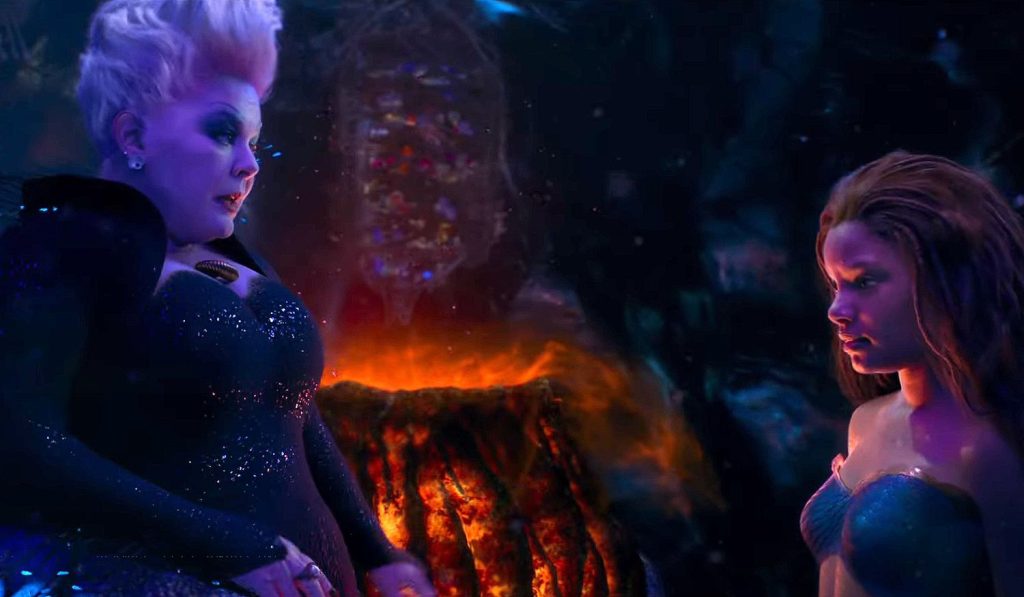
“We talked about lighting at length, because we really felt there’s so many portions of the ocean. There’s the closest to the surface, then you get deeper and then all the way down into Ursula’s layer, which is the lowest portion–the deepest, darkest, purplest bluest water. That was very important to us.”
One key challenge for The Little Mermaid team was trying to make lighting feel natural when nearly everything was created digitally in post-production.
“What was crazy was, because we were shooting on a blue screen stage, it was almost like literally lighting nothing. You had no background, you had no vegetation, you had no rock structures or cliffs or anything. You just had faces, and mostly not even hair, just wig-cap,” says Marshall.
Having a master such as Beebe, who also shot acclaimed films such as Michael Mann’s Collateral and Miami Vice, was key to making that work.
“Dion had such a great eye for that kind of thing. He had to get a sense of how to create all this water that was being reflected on the bodies and so forth throughout, so it would feel integrated,” says Marshall.

Natural light with CGI is harder than it looks
The most difficult work came in post, however, as they created The Little Mermaid’s ‘under the sea’ world with digital rendering technology, in which light was used with intention.
“Then we had to really shepherd all of this light work in the CGI. In the visual effects world, as we were working, not only were we adding hair and tails, and water, and fish, we were adding light, and we were enhancing the light. So sometimes we would have a shaft of light, for instance, that would be coming from above, and that shaft had to tell the story. I mean, of course, it all comes from story,” says Marshall.
John DeLuca, the The Little Mermaid’s producer and long-time collaborator, stresses the natural aspect, something Marshall was in complete control over.
At the end of the day though, a lot of credit goes to The Little Mermaid’s post-production team, as it was their tireless animation that made the film work.
“We handed so much of this over to the visual effects world when we were through—that’s why it took four and a half years, literally, to put this together. Every detail, every piece of seaweed that’s moving is all created. We needed a lot of control in that in that arena,” says Marshall.
Disney’s The Little Mermaid is in cinemas May 25 across the Middle East