

From the Esquire ME archive – August 2013
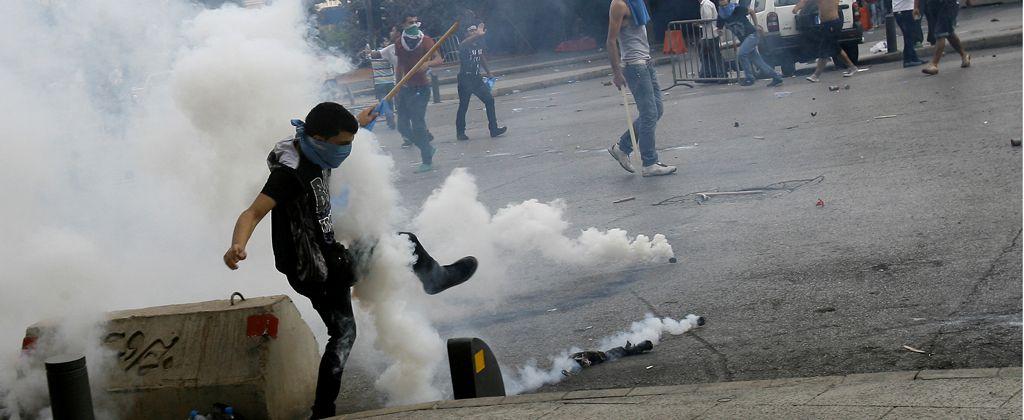
Through thick plumes of tear gas, protesters wielding sticks and stones surged up the road leading towards Lebanon’s Grand Serail in Downtown Beirut. The wave of angry youths quickly punctured the first security line of police officers. Chaos then took hold as they reached a second barrier and everyone scattered.
A barrage of gunfire, more canisters of tear gas and a fortuitous shift in the wind, sent protesters running back from the Serail. As protesters and the police force staggered, a phalanx of soldiers, three men deep, took position at the first barrier. The intervention by army personnel put an end to the scuffle and to the protesters’ hopes of reaching the office of the prime minister.
Last October’s attempted storming of the Grand Serail followed the funeral of the country’s intelligence chief, Wissam al-Hassan. It was another tense day for Lebanon that set the shortfalls of the nation’s poorly trained and disorganised police force into stark relief. Years’ worth of lacklustre performances have seen the army being forced to step in and regain control during dangerous moments of civil strife.
Despite internal restructuring and external aid efforts that channel hundreds of millions of dollars into training and equipment, former police officers, trainers and analysts describe a force that is underdeveloped, underfunded and undercut by politics, size and sectarianism.
This is a major problem in a country as unstable as Lebanon. The country’s tenuous peace has been shattered, restored and shattered again since the brutal civil war ended in 1990. Maintaining order between its eighteen recognised religious groups and a host of foreign actors who used the country as a proxy battlefield is an ongoing balancing act. Israel has waged war here, the bloodshed in Syria regularly spills over the border, and the country’s fractious political-religious groups have done their part to push Lebanon close to the edge of domestic strife and chaos. Over the past year, roadblocks, kidnappings and gun battles involving radical Islamists, rural gangs, and zealous supporters of the country’s political parties have challenged the country’s hard-fought peace.
This is a nation in desperate need of lawmen who can protect, and serve. Yet the police force, also known as the Internal Security Forces, can barely direct traffic. Officers are more likely to be seen speeding down the highway in the wrong direction, talkingwith friends or accepting a bribe than protecting and serving. “It’s extremely difficult to reform or transform the security sector in Lebanon when it operates in a political arena that is so divided and polarised,” says Yezid Sayigh, senior associate at the Carnegie Middle East Center in Beirut. A “poor cousin” of the nation’s multitude of security services is how Sayigh describes a force that has long been able to perform only the most basic of policing duties while having difficulty respecting human rights.
This latter issue was illustrated by a visit to a large auditorium at the University of Saint Joseph in southeast Beirut. Several hundred officers had just undergone a two-week course on respecting human rights, and the final session was also open to the press. The event was meant to show the strides they was making towards reform, but it turned out not to be the best advert for their progress. As a trainer reviewed arrest procedures, one of the trainees put up his hand. “But what if we really need to beat him to get a confession?” the officer asked. His question was met with nods of approval and more hands shot up. How can you know if the guy is guilty without beating him?, the officers wanted to know.
Some of the issues are cultural: family and religious alliances are deeply ingrained and a heavy hand is something that goes back to Ottoman times. The organisation is also tied in sectarian knots. Each of Lebanon’s major sects supports a portion of the force, which it guards fiercely and rarely shares with other groups. This system undercuts talented officers in favour of political and religious balance.
Other problems are more modern and bureaucratic. When the police force’s mandate was renewed over nine years ago, foreign donors flocked to help with the reform process. A group of mostly western states, primarily the European Union, United States and United Kingdom, poured in about $70 million a year to improve the police and increase stability in the country. Its ranks more than doubled in size, growing from about 13,000 officers in 2005 to nearly 30,000 police today in a nation of around four million. Some recruits are being brought in faster than they can be trained as competent officers.
Donors agree that the large growth has created some of the force’s problems. “It’s a relatively young agency, so it’s understandable that there are some organisational challenges as a result,” says a U.S. diplomatic source from the U.S. embassy in Beirut. “But given their new mandate, we have great confidence in their ability to expand and grow,” the source continues.
A few of the donor-sponsored programmes have met with moderate success. A forensics facility has broken ground in the town of Aramoun and a country-wide police communications network is being set up, at the largesse of the U.S. government. Similar efforts from other nations include anti-torture training, redrafting codes of conduct and the development of specialised counter-terrorism branches. Some police patrols on the Beirut corniche have exchanged their automatic weapons for batons and, in general, community-minded policing has improved around the country. Female officers can be seen patrolling the city in squads after women were integrated into the police force with backing from the U.S. Where political cover exists, police have been able to make arrests in a number of high-profile cases, including a string of bank robberies and a case of fraudulent pharmaceuticals.
But a public opinion survey conducted by the ISF in 2009 found that less than fifty percent of the population had any degree of trust in the police while only fourteen percent had total faith in the force. And despite the sleek Dodge Charger police cruisers that prowl the streets, the force is facing an anaemic budget shortage, according to former General and ISF officer, Amin Saliba. It has a yearly budget of around $500 million, according to sources who work with the ISF. About $70 million comes from external donors to be channelled into training and new equipment, while the rest — $430 million — comes from central government.
That amount is barely enough to cover basic costs such as salaries, according to advisers who work with the police force, and delays in payments of the shoestring budget are leaving bills unpaid. “Hospitals are not accepting Internal Security Forces patients because we can’t pay our bills,” Saliba says. “We need to reconsider salaries and services.” That low pay keeps police dependent on other sources of income and beholden to other sources of power. A few kisses on the cheek and a small bribe to the local policeman are a more surefire way of seeing the law on your side rather than any notion of protecting and serving.
But to increase pay and reduce corruption and political patronage, the police force is in a double bind. It would need around an additional $100 million a year to cover costs, police analysts estimate. Adding to the challenge, raising salaries would require boosting the pay scale of other government employees, making the issue a political non-starter.
ISF officials admit that more needs to be done to fund and improve the police. But they nevertheless argue that the force is headed in the right direction overall. “The quality of our training has significantly improved, but it’s a continuous process,” says a police official of recent reforms.” The official credits former ISF head, General Ashraf Rifi, with upgrading the force. But after reaching retirement age, Rifi handed over his post in March to ISF chief Roger Salam, despite protestations from Hezbollah-backed candidate Ali Hajj, who claimed he had a right to the position. Salam also reached retirement age and passed the position in June to Ibrahim Basbous, another temporary leader who will also age out of the position shortly.
The political scuffle that brought down Lebanon’s government in March of this year was partly over the leadership of the nation’s police force. Two of the country’s major parties were vying to get their man into a seat of power on the police force before Prime Minister Najib Mikati stepped down. This uncertainty surrounding the top spot will continue until a new government can be formed that agrees on a permanent appointee. But given the current sense of political paralysis, which is compounded by the impasse over the Syrian uprising, a breakthrough seems unlikely. And this means the nation may not get the force of law and order it so desperately needs in increasingly trying times. “That doesn’t prevent a lot being done,” insists, Yezid Sayigh, before adding a word of caution. “Even with the best will in the world it must be very difficult for anyone in command.”
By Stephen Dockery