
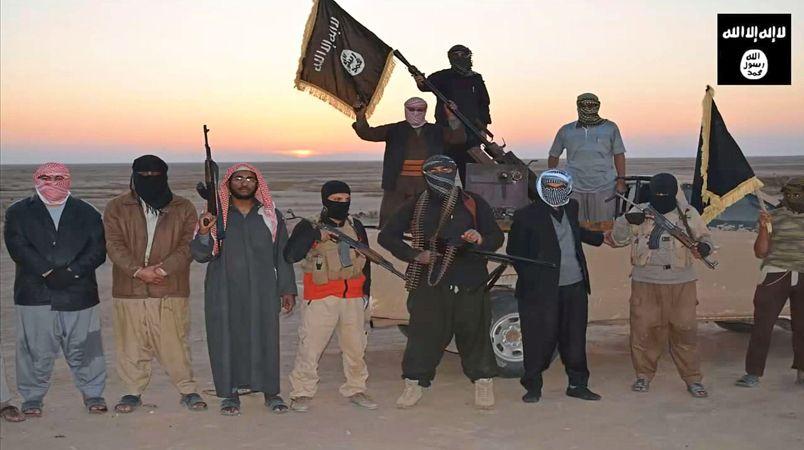

The terrorist group, ISIS, seems to have come from nowhere, storming across northern Iraq to capture the towns of Mosul, Tikrit and most recently Tal Afar. We discuss their rise with Interpol, the US-based Brookings think tank and the UN Assistance Mission for Iraq.
Who are they?
The Islamic State of Iraq and Syria (ISIS) was spun out of an Al-Qaeda cell formed in Iraq after the 2003 invasion, though its tactics vary considerably from that group. Where Al-Qaeda hits and runs, ISIS hits and holds, with the intention of creating a new Islamist state. In areas of Syria it’s snatched, the group has established courts and schools peddling its own brand of brutality.
Are they still linked to Al-Qaeda?
No. In fact, Al-Qaeda distanced itself from ISIS, claiming to be “in no way connected to it”. This could be due to ISIS’s burgeoning reputation for extreme violence, including beheadings and crucifixions. Little wonder, it’s become the jihadists group of choice, reportedly attracting between 7,000 -10,000 members.
Who’s in charge?
ISIS is controlled by a man called Abu Bakr al-Baghdadi, though little’s known of his history beyond the propaganda reports put out by the group. These claim he’s 43 and earned a doctorate at Baghdad University before becoming a jihadist fighter under the reign of Saddam Hussein. Competing reports suggest he was a firebrand preacher radicalised by four years in the US’s Bucca Camp in 2005, rising through the ranks to assume command of ISIS in 2010. Either way, he’s earned a reputation for his tactical acumen and paranoia – rarely appearing in public and only ever addressing prisoners in a mask.
“It is not a coincidence that the Sunni militants made rapid advances across primarily Sunni lands. That’s because it is not surprising that the Iraqi Security Forces would crumble in those areas. As Baghdad has (rightly) observed, several of the divisions in the north were disproportionately composed of Kurds and Sunni Arabs, many of them frustrated and alienated by Prime Minister Maliki’s harsh consolidation of power and marginalisation of their communities. They were never going to fight to the death for Maliki and against Sunni militants looking to stop him.”
Kenneth M. Pollack, senior fellow on Middle Eastern affairs at the Brookings think tank.
Where do they get their money?
Data captured by the Iraq military revealed ISIS had assets worth $875 million before the fall of Iraq’s second-biggest city, Mosul. Some of this came from donations from Gulf nations looking to fund opposition to Syria’s regime, though the majority of ISIS’s wealth flowed from the oilfields of eastern Syria, which it captured in 2012 – some of which it sold back to the Syrian government. After taking Mosul, ISIS raided banks and military bases adding $2 billion to the pot.
So what’s being done?
ISIS has managed to provide common ground for the West and Iran, which discussed the matter during their nuclear regulation talks. According to Brookings, Iran has dispatched General Qasim Suleimani to Iraq along with an unspecified number of troops, who are there to train and assist, rather than fight. Similarly, the US dispatched the USS George HW Bush aircraft carrier to the Gulf and is considering using drone strikes to halt the advance. Both countries have dismissed the idea of putting troops on the ground, preferring to support the Iraq army which the US spent ten years and $1 trillion training.
Will Iraq fall?
After the initial rush it seemed a possibility, but Baghdad has reinforced the shrine cities of Samarra, Karbala and Najaf, while huge numbers of troops stand watch around Baghdad. ISIS’s brutal tactics have spurred a host of volunteer fighters to take up the government’s cause, joining 930,000 US-trained security personnel, including 270,000 soldiers. Unfortunately, morale is low among the troops, who’ve endured daily bombings since 2010 and have been unnerved by ISIS’s tactics. The Iraqi president, Jalal Talabani, has since declared a 30-day state of emergency, with the army beginning air strikes on ISIS targets. Time will tell if the force can be pushed back.