

June 22nd, 1986
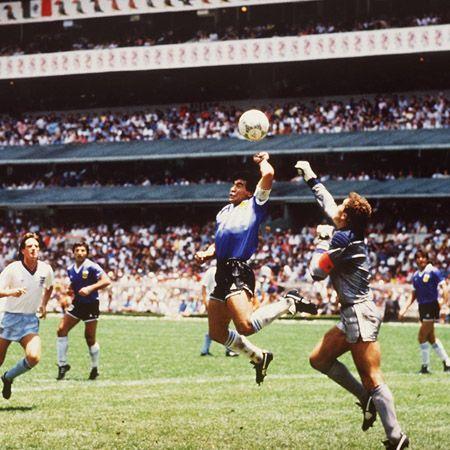
It’s the 51st minute of the World Cup quarter final between England and Argentina, and Diego Maradona is slaloming through a sea of English players, laying the ball off to team mate Jorge Valdano, who’s lingering on the edge of the penalty area. England midfielder Steve Hodge intercepts it, but miscues his clearance – the ball looping back into the penalty area where Maradona leaps into the air, using his hand to nudge it past the onrushing goalkeeper Peter Shilton.
If it had been any other match, any other team, the controversy would have been short lived. Up until that point, Argentina had dominated the game, creating more chances and doing most of the running. Three minutes later, Maradona scored the greatest goal in World Cup history, dribbling the ball 60-metres in 10-seconds, past four English players and finally the goalkeeper. The goal sparked an England fight back, but the final 2-1 score was fair and most neutral commentators knew it.
Unfortunately, this wasn’t any other match, and these certainly weren’t any other teams. Only four years previously, England and Argentina had fought a war over the Falkland Islands – a British protectorate just off the Argentine coast. Around 258 Britons and 655 Argentines died in the conflict, which ended with the British retaking the islands. Even before that, the two nations had struggled to get along. During the 1966 World Cup held in England, the Argentine captain Antonio Rattin had been sent off in a game infamous for its dirty tackles. Rattin subsequently wiped his feet on the Royal Carpet in disgust, prompting England manager of the time Alf Ramsay to describe the Argentines as “animals”.
Politically, emotionally and psychologically, the game had grown beyond sport, becoming a crucible for the ill feeling built up between the two nations over the last 20 years. Though everybody denied the sentiment in the press conference beforehand, Maradona later admitted that “although we had said before the game that football had nothing to do with the Malvinas war, we knew they had killed a lot of Argentine boys there, killed them like little birds. And this was revenge.”
He wasn’t the only one looking for a little payback. British tabloids ran riot with headlines describing Maradona as a cheat, with some even demanding the match be replayed. Throwing fuel on the fire was the player himself, who seemed to revel in his role as a pantomime villain. He described the goal as “a little with the head of Maradona and a little with the hand of God” – referring to divine intervention rather than ascribing himself any biblical powers. He also admitted telling his teammates to celebrate with him after the goal for fear the referee wasn’t going to give it.
But time soothes all wounds, especially when the wound is caused by one of the greatest players who ever lived. The 1986 World Cup belonged to Diego Maradona. He carried his team all the way to the final, setting up chances and creating goals that made everybody else in the tournament look as though they were playing a different sport. It’s arguable whether any player since has had such a singular impact on his team or history in general. The “Hand of God” affair didn’t just knock a ball into the goal, it lifted the entire sport. That’s its real legacy, no matter what legions of grumpy Englishmen might say.