

Despite America’s falling cigarette intake and anti-smoking campaigns more prevalent than ever, Zippo is about to celebrate its most successful year to date, 82 years after its founding. Esquire went stateside to find out more about the brand whose flame refuses to die.
****
The year is 1932 and America is still trying to haul itself out of the greatest economic depression in its history. Industry behemoths stretching from coast to coast have been brought to their knees. World output has plummeted to depths not seen in decades.
And yet, like a man who hadn’t received the memo, George G. Blaisdell, from a sleepy, Pennsylvanian town named Bradford, quietly begins a business out of an auto shop that will eventually become one of the most recognised American brands in the world: Zippo lighters.
In the unlikely event that you haven’t heard the name, you’ve almost definitely seen one in action. Indeed, for all you smokers reading this, it’s almost an impossibility that your cigarette hasn’t been, at one time or another, lit by one. The familiar one-handed flick of the lid, metallic ‘clang’ and spurt of flame that you’ve seen on TV? That’s a Zippo.
Like many success stories of a similar ilk, the beginning is typically humble. One night, having seen a friend using a cumbersome Austrian-made lighter that clicked open and stayed alight, the seed of an idea was placed in George Blaisdell’s mind: a durable lighter that never blew out. Blaisdell and his two daughters set to work in a box room above the an auto repair shop, making lighters by hand and selling them door to door. Eight decades later, Zippo produces 70,000 lighters a day, and has manufactured over half a billion in total.
“To say that he started out and thought, ‘I’m going to make this incredible American product’ would be a lie,” admits George B. Duke, the owner of Zippo Manufacturing and grandson of the company’s founding father. “He just wanted to build a good lighter that would last for a long time.”

Blaisdell was really serious about making them last, promising that if a lighter for some reason stopped working, they could return it and he would repair it and send it back. Cynics would say there is little room in a successful business for ideals. And it arguably doesn’t get more idealistic than offering a lifetime guarantee on a consumer product. But that’s exactly what Blaisdell would predicate his company on. He wanted a product that would not only stand the test of time, but one that inspired loyalty also.
“Many people in Bradford said he was out of his mind doing it, and a lot of his friends tried to talk him out of it,” continues Duke. “But he was so focused on building his lighters with durability that he stuck with it and refused to change. I think it was one of the greatest things he did for his company.” Somewhat incredibly, Zippo still offers that lifetime guarantee today to every single lighter purchased.
Success didn’t happen overnight, however. Like so many start-ups that pop-up in times of severe austerity, Zippo was seriously threatened with relegation to the entrepreneurial trashcan during the 1930s. But then salvation arrived in the unlikeliest of forms. With World War II breaking out, all available brass – the principal material used for making Zippo lighters at the time – was commandeered for army ammunition. Rather than let it cripple the business, Zippo switched to steel, resulting in a product that was weather resistant and wouldn’t deteriorate.
This led to a military request to Blaisdell for his product. As a result, Zippo immediately stopped distributing to the public and sold its entire production to the American Services personnel. The move ensured Zippo’s survival, and by proxy, made the lighters synonymous with the American war effort.
“A portable flame, standing in any weather was a unique and modern concept back then, so as a military accessory it was ideal,” says Duke. “We had hundreds of thousands of servicemen travelling the world, and wherever they went they took their Zippo lighter. Every time somebody saw it they wanted to know where they got one.”
Lieutenants would reward their troops with them, the men in the trenches would read letters from loved ones using them. There are even stories of soldiers’ lives being saved by a bullet hitting a lighter instead of flesh. Zippo soon began to garner recognition around the world, a process that all began on the battlefield, and undoubtedly remains the single greatest catalyst for the success the brand enjoys today.

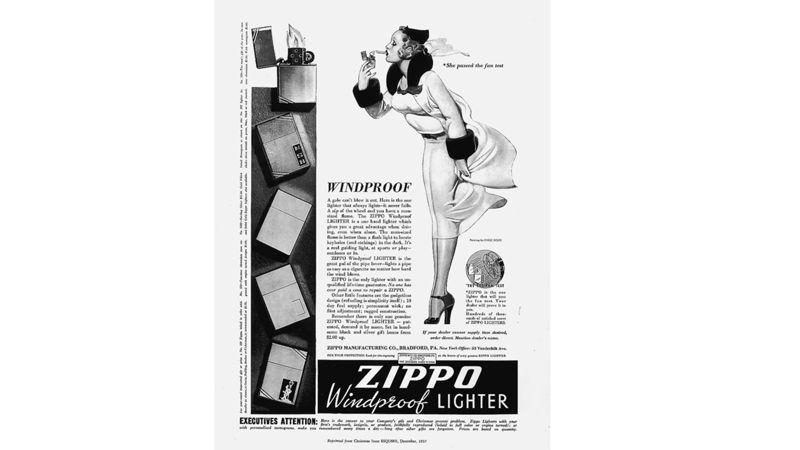
The very first Esquire Ad appeared in Esquire US in 1932
New Markets
Esquire talks to company President Greg Booth about the scale of Zippo’s expansion, the moves that haven’t paid off yet, and the brand’s plans for the Middle East.
On growth
“North America is our largest market and measures about 40 percent of our total business. The international market takes up 60 percent but as time goes on that ratio is changing in favour of the latter. China is now the largest market outside of the US, taking over from Japan. It’s home to 1.4 billion people and is growing exponentially. 400 million of those are in the middle class and they consume a third of the world’s smoking tobacco. India has exploded too. I was whining a couple of years ago that we were selling $100,000 dollars’ worth of lighters a year, which is nothing. They sell more bubble gum. So I went there myself, we looked at the market, the distributors and – after some arm wrestling and fighting – we found out who we wanted to work with. And from $100, 000 a year a couple of years ago, this year we’ll make $12 million. That’s just because someone just wasn’t paying attention.”
On room for improvement
“We’ll always have areas that we’d like to do better in. But sometimes it’s out of your control. Latin America for example is a market that is a concern. You hate to throw rocks on the people that are there, but it seems like every country has some sort of political and/or economic problem. All we can do is get the best importer and distributor stationed there, keep them healthy, and when things turn around politically or economically, we’re in a position to win.”
On the Middle East
“It was more of a suitcase trade in Dubai a few years ago. Somehow our product would find its way into the Middle East and we had some really nice distributors in places like Saudi Arabia. We called our first business meeting with Middle East representatives in Hawaii about four years ago, and I think they were aghast at the prospect, because no-one had done that before. But, for a while, as people in most countries do, you get caught up in the culture that says: “Oh my, that part of the world is dangerous.” Sometimes those perceptions are accurate, sometimes they’re not. In the areas we can go, places like the UAE, where we can help and have partners that are willing work with us, I want to get together. And we started that proactively a few years ago and it’s worked fabulously. I know we could sell more stuff there, no doubt about it. You can’t do ten things at once. But in time, we’ll be there.”