

It’s 2:30 am in the outskirts of Ta’if in the Makkah region of Saudi Arabia. While most of the residents enjoy their slumber, the Jockey Club of Saudi Arabia (JCSA) racecourse is a hive of activity. Beneath floodlights, dozens of lithe purebred Arabian and Thoroughbred horses are led through their morning exercises, getting them into optimum condition for the succession of races ahead.
Situated at an altitude of almost two thousand metres, high above the surrounding desert, Ta’if’s cool and balmy climate is a summer magnet for equine professionals and enthusiasts—horse owners, jockeys, trainers, an array of support professionals and of course, spectators—from across the Kingdom, the Gulf and the wider world.
Take Alexis Moreno, one of Saudi Arabia’s leading jockeys. Born in rural Panama and riding horses almost as soon as he could walk, Moreno cut his teeth as a jockey in his native country before being approached in 2012 to ride for Prince Sultan Al Kabeer’s stable.
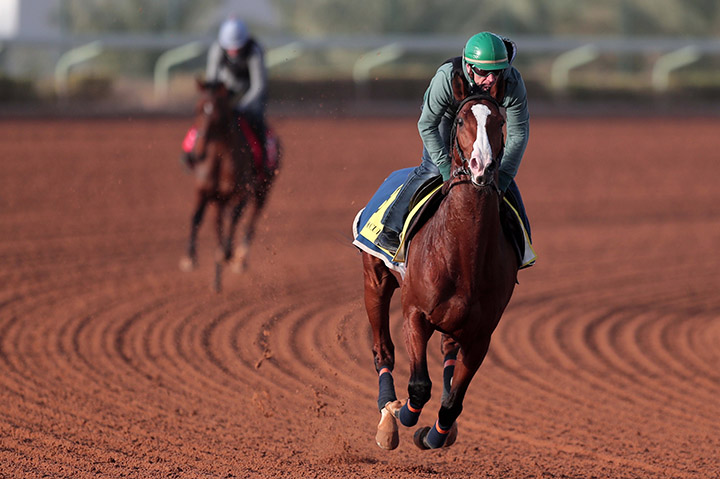
Moreno describes his rather gruelling schedule. “I wake up at 1:30am, because we train the horses from 2:00am to 5:00am—before sunrise, because some horses get distracted by the sun and it can get too hot for them, even in Ta’if. Then I’ll go home, have some breakfast and sleep until about 1:30pm. After lunch, I’ll work out at the gym for a couple of hours—especially cardio, because I have to keep my weight down. After that, if there are races, I’ll be back to the track. I’m working seven days a week. But I love horses, so I’m enjoying it every day.”
Like Moreno, trainer Biden Al Subaie is up and running well before the break of dawn—and likewise driven by his passion for all things equine. He’s worked with King Abdullah’s and Prince Faisal Bin Khalid’s stables and now trains his own horses.
“I’ve always loved horses,” he says. “My family owned many horses and I used to go with my father to the stables as a child.” So, how does Al Subaie turn a good horse into a champion? “We take the young horse and develop its breathing and muscles,” he says. “It’s a very gradual process, taking about four to six months.”
“We can’t push the horse—it has to be done by making the horse happy and confident and relaxed. It’s a psychological and emotional relationship,” admits Al Subaie. “I comfort and pet the horse before the race…and sometimes when a horse hears my voice during the race, it will make that extra effort needed to win.”
Patrolling the track on his bay American ‘quarterhorse’ is the JCSA’s Track Marshal and Chief Outrider, David Rodgers. He and his team keep an eagle eye on the proceedings, making sure that everybody is following the rules. “My alarm clock goes off at one o’clock in the morning, almost every day,” Rodgers says, “because I have to be here, on a horse, when the track opens for training at 2:00am.”
“My team and I make sure that it’s all being monitored and that things are safe,” he continues. “If a jockey falls and gets hurt, we have our radios and we will call the ambulance, which is always on duty.” The working day can often continue until the races are finished at 9:00pm.
Rodgers grew up in southern Oregon, where he imbued the local equine culture, breaking in horses on ranches and competing in Native American horse races. He was a fully-fledged horse trainer when he converted to Islam and travelled to Saudi Arabia to learn Arabic, back in the late 1990s.
“I joined an Arabic language program,” he says. “Then a few small stables started hiring me to help with their training, and I worked my way up to the point that I was training with King Abdullah’s stable,” says Rodgers. “And it was King Abdullah who wanted me to start this marshalling program with the JCSA, to safeguard the safety of horses and riders on the track.”
“Sometimes the equipment breaks—the bridle or the reins might snap. Or the jockey might fall off his horse. And to catch a loose horse is quite a hair-raising thing. You have to match its speed—it’s a racehorse after all. That’s why we ride quarterhorses, which are bred to race in very fast quarter-mile competitions.”
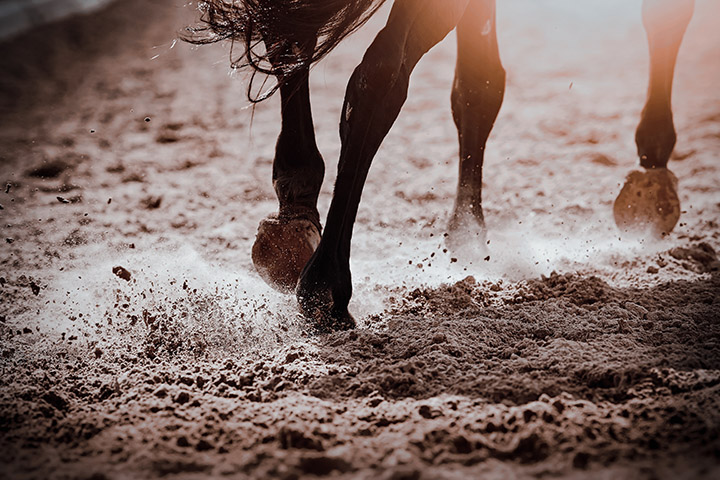
It is not only the jockeys and trainers that are being monitored. The track itself must be highly maintained, and the responsibility lies with Bob Blackburn, a track advisor who came to the JCSA from his native Oklahoma. You might think a horseracing track is composed of just plain old dirt—but you would be wrong. “The dirt is a mixture of three different particle sizes of sand, organic matter which is wood shavings or wood chips, and additives such as silts and clays,” Blackburn says. “I feel that Saudi Arabia is soon going to set the world standards,” he continues. “They just build bigger and better facilities, and the Riyadh racetrack surpasses anything I’ve seen in years. It’s got a great, kind surface for the horses, and it’s well maintained.”
“I feel that Saudi Arabia is soon going to set the world standards. They just build bigger and better facilities, and the Riyadh racetrack surpasses anything I’ve seen in years.
– Bob Blackburn
By late morning, when the trainers and jockeys are taking their rest, the JCSA management is preoccupied with plans for the upcoming Riyadh Season, which starts in mid-October and culminates in the $30.5m Saudi Cup weekend—now the world’s most valuable—held at the racetrack in Thamamah, just north of the capital.
The JCSA’s Director of Racing, Salem Binmahfooz —who came to the club with a degree in equine studies and experience in breeding his own horses—says that he and his colleagues have several priorities. “Our first object is to maintain and continually improve our facilities. And on the strategy side, we’re always helping our breeders and trainers to achieve their dreams by implementing global best practice across the board. When horses come from abroad it adds a new dynamic to racing in Saudi Arabia,” says Binmahfooz. “Domestically we focus on giving our local-bred horses the right nutrition and the right care that is on a par with the international systems of racehorse training. After all, the local- and foreign-bred horses all belong to the same genetic pool of Thoroughbreds.”

Indeed, many if not most of the world’s leading Thoroughbreds are descended from the famous Darley Arabian, brought to the UK from Syria by Britain’s ambassador to Damascus, Thomas Darley, around the year 1700.
“Also,” Binmahfooz continues, “we are talking to neighbouring countries to synchronize horseracing throughout the GCC. “We want to enable owners and trainers to easily move their horses from one country to another, with minimum red tape; we want to streamline programming, so that major cups are not happening on the same day; and we want uniform rules and regulations, so that if, for example, a rule is broken, the penalty applied should be the same in every GCC country—not a one week suspension in one country and a one month suspension in another. The JCSA is leading that conversation.”
“And finally, the JCSA is aiming for Saudi Arabia to be one of the top countries when it comes to racing—along with the UK, Ireland and the US,” says Binmahfooz.
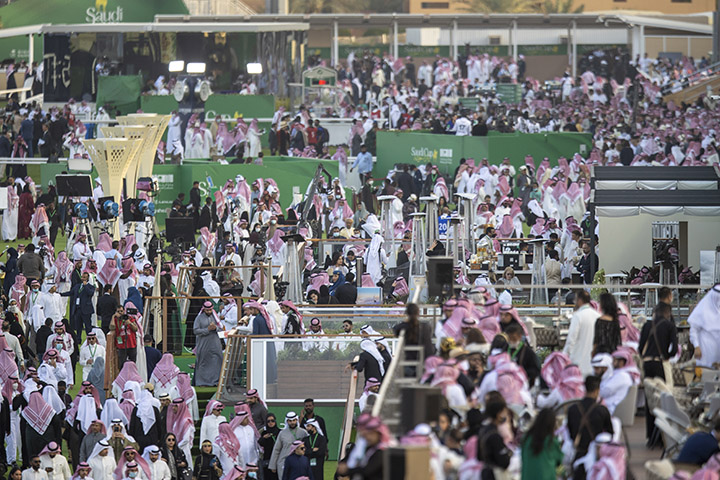
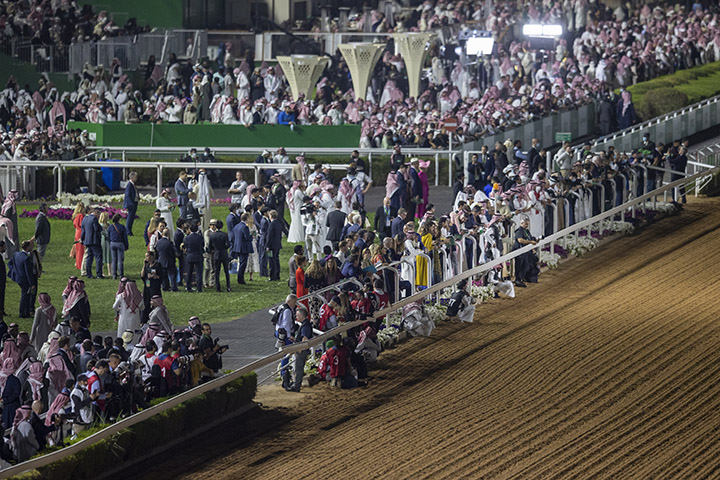
Along with all the technical and regulatory considerations, horseracing would be nothing without its glamorous and cultural aspects. Crown Prince Mohammed Bin Salman saw the potential of the Saudi Cup as a platform to encourage and publicize the Kingdom’s cultural heritage, with support from the Ministry of Culture—at which point JCSA Chairman, HRH Prince Bandar Bin Khalid Al Faisal invited H.H. Princess Nourah bint Mohammed Alfaisal to advise the club, in view of her background as a jewellery designer and her experience as the founder of Adhal, a social enterprise supporting the Saudi design industry.
“We introduced a ‘dress code’,” says the Princess. “Meaning that people from various regions were encouraged to come in their traditional local dress. This highlighted the beautiful textiles and embroidery from different parts of the Kingdom. We’ve also had restaurants with modern variations of traditional Saudi cuisine. And the event is a showcase for all kinds of craftspeople and artists: woodworkers, calligraphers, oud players and painters.”
But ultimately the JCSA’s endeavors come down to the horses themselves. “There has to be an understanding between the jockey and the horse,” says Mareno. “When that understanding and trust is there, the horse will give you more than you expect. It’s something magical—you’re just flying together. You’re sharing that beautiful feeling—I can’t put it into words”.
“And when the horse wins, it understands. Those animals are so smart. They just know,” he says.