


NASA unveiled the first-ever deep space distant universe picture this morning, but it’s only the first of many. Later today, the rest of the images will be released live later today.
Want to watch live? Here’s how.
At 9:45 am EDT, or 3:45 pm GST, NASA will begin its opening remarks with the Webb leadership on NASA TV and the NASA app and the agency’s website. You can watch that part here.
the images themselves will be released live at 10:30 am EDT, or 4:30 pm GST. You can watch taht on NASA TV, the NASA app, or here.
You can also can watch live on Facebook, Twitter, YouTube, Twitch, and Daily Motion.
The Youtube link is embedded above, so bookmark this page and return at 4:30 PM GST to watch!
After the image reveal, there will be a join media briefing at NASA Goddard featuring the following scientists:
- Eric Smith, Webb program scientist and Astrophysics Division chief scientist, NASA Headquarters
- Knicole Colón, Webb deputy project scientist for exoplanet science, NASA Goddard
- René Doyon, principal investigator for the Canadian Near-Infrared Imager and Slitless Spectrograph, University of Montreal
- Christopher Evans, Webb project scientist, ESA
- Klaus Pontoppidan, Webb project scientist, STScI
- Jane Rigby, Webb operations project scientist, NASA Goddard
- Amber Straughn, Webb deputy project scientist for communications, NASA Goddard
We’ll also have all the images up here on esquireme.com, so stay tuned for more!
The first Webb image NASA released
NASA’s James Webb Space Telescope, which features Webb’s Near-Infrared Camera—the most powerful ever—took the ‘deepest and sharpest’ infrared image of the universe in history. They’ve called it Webb’s First Deep Field.
The image shows the galaxy cluster known as SMACS 0723, and it’s astounding, full of colors and shapes that only hint of what may be out there somewhere.
See the full image from NASA here:
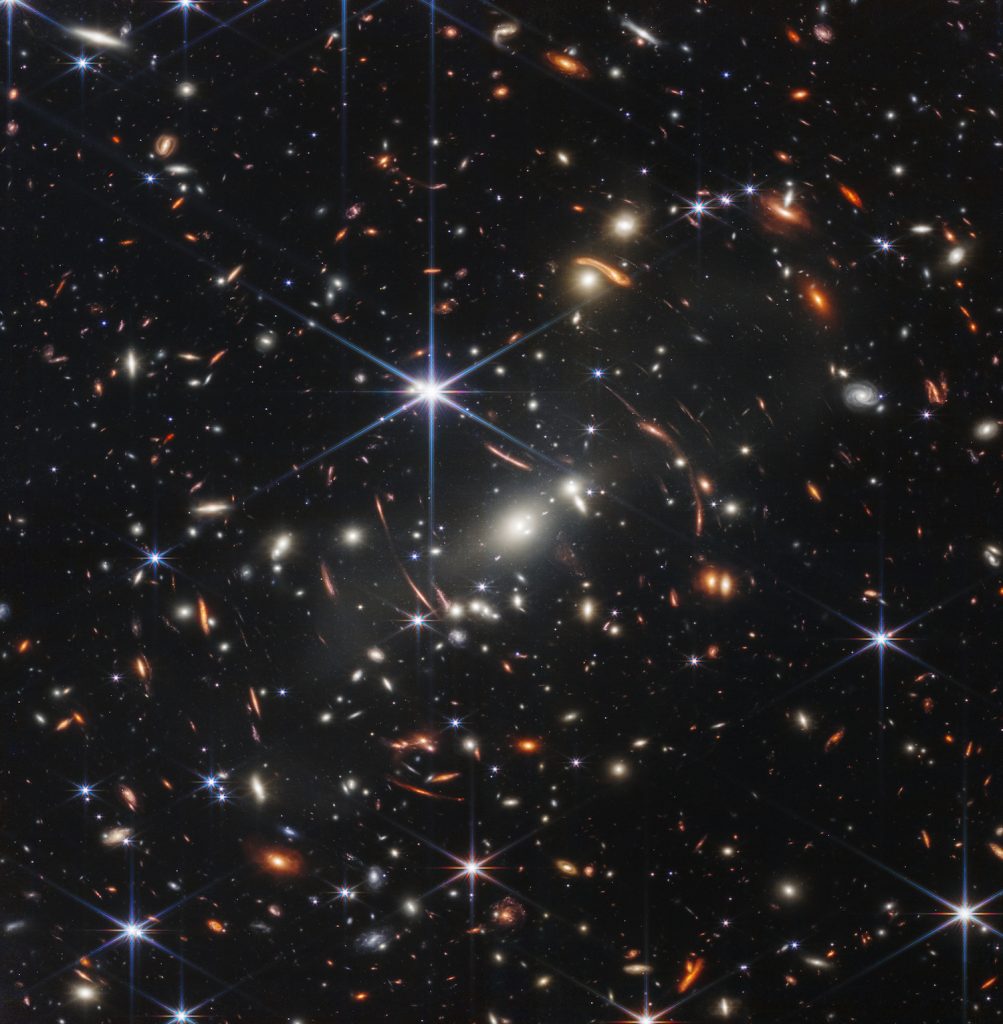
The image shows thousands of galaxies for the first time—even though the picture barely scratches the surface of what is left to be discovered.
Let’s put it this way—the picture only covers a patch of the sky that is the size of a grain of sand held at arm’s length by someone on the ground, according to NASA. And yet that alone revealed thousands of new galaxies. The mind boggles.
Next, NASA’s researchers will study the images to learn the galaxies’ masses, ages, histories, and compositions, ultimately on the path to find the the earliest galaxies in the universe—Webb’s ultimate mission.
To add context, here’s how different it looked with the old telescope:
The deep field image is a composite that is made up of from images at different wavelengths that took 12.5 hours to take—while achieving the depths at infrared wavelengths beyond the Hubble Space Telescope’s deepest fields took weeks of time.
As with any distant image, because of light speed, we’re actually looking at galaxy cluster SMACS 0723 4.6 billion years ago. Only yesterday!
The combined mass of the galaxy cluster also acts as a ‘gravitational lens’ which magnifies the much more distant galaxies behind it, which is what made it so difficult to see them before. With thte NIRCam, those distant galaxies are in sharp focus, with tiny faint structures that have never been seen in history, including star clusters and diffuse features.
“Webb’s First Deep Field is not only the first full-color image from the James Webb Space Telescope, it’s the deepest and sharpest infrared image of the distant universe, so far. This image covers a patch of sky approximately the size of a grain of sand held at arm’s length. It’s just a tiny sliver of the vast universe,” said NASA Administrator Bill Nelson. “This mission was made possible by human ingenuity – the incredible NASA Webb team and our international partners at the European Space Agency and the Canadian Space Agency. Webb is just the start of what we can accomplish in the future when we work together for the benefit of humanity.”
US President Joe Biden was on hand to reveal the images at an event of press and select scientists.
Watch the live stream of that event below:
“These images are going to remind the world that America can do big things, and remind the American people – especially our children – that there’s nothing beyond our capacity,” said Biden in remarks during the event. “We can see possibilities no one has ever seen before. We can go places no one has ever gone before.”