


If you missed last month’s supermoon, you’ve got another chance because tonight, July 13, you’ll be able to see the ‘Full Buck Moon’ in the night sky.
A moon is considered “super” when it reaches 90% of pedigree, its closest approach to Earth.
This is the third supermoon of the year and it is only 357,264km away from the Earth. To put that into perspective, on average, the moon is roughly 384, 472km away from the Earth, meaning that its closer proximity is what makes it look much larger than normal.
How and where to see the supermoon
Astronomy fans can attend a special viewing event hosted at Dubai’s Al Thuraya Astronomy Centre, Mushrif Park from 6pm-8pm tonight. It costs AED 70 for adults, AED 50 for kids and DAG members pay AED 30. Tonight’s session will also include a lecture discussing the supermoon phenomenon, a Q & A session as well as telescopic observations for those wishing to get a closer look at the Buck Moon than the naked eye allows.
“Supermoons are common occurrences. It regularly takes place as part of the Moon’s orbit around the Earth. The moon orbits our planet in an elliptical orbit, once every 27.322 days. Over the course of its orbit, the Moon travels between 363,300 and 405,500 kilometres from Earth.” Says Raj,
“At its perigee, the Moon appears to be 30 per cent brighter and 14 per cent larger than a full Moon at the farthest point of its ellipse (Apogee). When people hear that Supermoons are bigger and brighter, they are frequently perplexed. But the fact is no matter where it appears in the sky, the Moon’s size remains constant. Because there are objects to compare its size, when a supermoon rises and sets on the horizon, it appears bigger rather than in the middle of the sky where no comparisons are possible, it appears smaller.” Says Sarath Raj, Project Director at Amity Dubai Satellite Ground Station and programme Leader at Aerospace Engineering at Amity University Dubai.
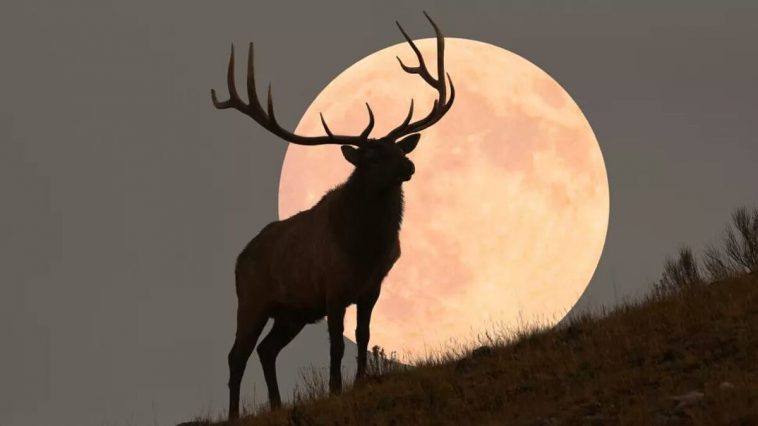
According to The Old Farmer’s Almanac, It is called the Buck Moon because it is believed that the antlers of a male deer (bucks) are in full growth mode at this time. Bucks typically shed and regrow their antlers each year, producing a larger and more impressive set as the years pass by. However, this moon does go by other names such as the Feather Moulting Moon or the Salmon Moon, with the latter indicating that fish have returned to the area and are ready to be harvested.
Non-supermoons appearing in 2022
The final supermoon of 2022 will appear next month on August 11th and is called the Sturgeon Moon. However, The Old Farmer’s Almanac says that each month of the year has its own special moon even if it isn’t “super” which only applies to May’s Blood Moon, June’s Strawberry Moon, this month’s Buck Moon and next month’s Sturgeon Moon.
Check out the rest of the years moons below:
