

You can see most of Abu Dhabi from Rotana Hotel Management Corporation’s new offices, located in a recently completed glass-and-steel tower in the city’s Capital Gate complex, adjacent to the capacious Abu Dhabi National Exhibition Centre. Through its floor-to-ceiling windows, you look across to the Centro by Rotana next door and, on a clear day, the Park Rotana in Khalifa Park. In the distance is the vague outline of Yas Island, where another Centro has been serving the area’s growing attractions since the end of 2009. You can’t quite make out the Beach Rotana, the five-star property down towards the Corniche that, when it opened in 1993, was the group’s very first property, but it seems entirely appropriate that the headquarters looks out over a city where the company made its first steps more than two decades ago.
It is just small sample of the company’s expanding empire of three-, four- and five-star hotels and suites. These come in four distinct brands: the Rotana hotels and resorts, the business-minded Centro, the alcohol-free Rayhaan, and the Arjaan hotel apartments and residences. Currently present in 12 countries in the MENA region and with a portfolio of close to 50 properties, Rotana is now a well-respected fixture on the local hospitality scene. It has ambitious plans to deepen its footprint in the Arab World, with more hotels planned for Dubai, Doha, Bahrain and an astonishing 15 in Saudi Arabia by 2020. But it also plans to extend the brand across the world.
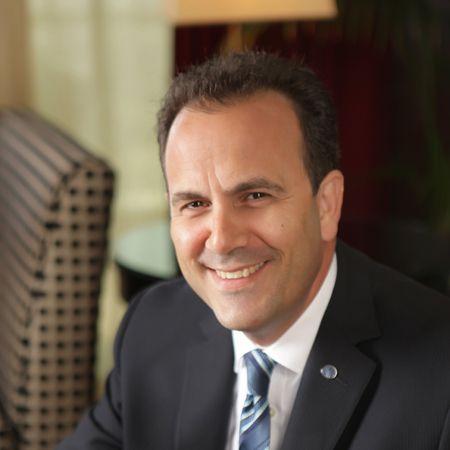
The man now charged with steering all this is Omer Kaddouri, who formally succeeded Selim El Zyr as CEO and President of Rotana on January 1, 2014, after nearly 16 years with the company, the last three of which he served as COO. A little over 10 months into his stint as CEO, he has already presided over the opening of Rotana’s first properties in Oman and Jordan. Deals have been also been signed for the first hotels outside of the company’s traditional Arab World home. In the next couple of years, the Rotana logo will be seen on two hotels in Istanbul, Turkey; two in the northern Iranian city of Meshhad, and one each in Dar es-Salaam, Tanzania, and Kinshasa, Congo. Rotana is now, Kaddouri insists, a truly international hotel chain.
“It’s controlled growth,” he says in an accent that’s more Belgravia than Baghdad. “We are growing outwards from our natural home in the Middle East into neighbouring regions like North Africa, Sub-Saharan Africa, Turkey, Iran and India. They’re regions within easy reach and all have strong connections to us, so it’s organic development.
One look at the political situation in that “natural home” and there is good deal of sense in broadening the horizons. Kaddouri, who blends an easy, affable confidence with a good deal of candour, admits that 2014 has been tough, and that 2015 will likely be the same. The properties in Iraq, Syria and Lebanon were all adversely affected by the deepening civil conflicts. There is still growth in certain markets — Dubai, Doha, Bahrain, Abu Dhabi and Saudi Arabia — but it has slowed in comparison to recent years, both as confidence in the region is reduced by turmoil in the immediate neighbourhoods, and greater competition in the Gulf. The ever-robust Dubai, for instance, saw a slight drop in the three key indices of occupancy rates, average daily rate and revenue per available room (RevPar) in May 2014 (the last of the H1 boom months), compared to the same metrics in 2013.
“Our expansionist strategy has long been designed so it certainly isn’t a reflection of current regional events,” says Kaddouri. “Although it would be fair to say they justify it. As a brand, you can’t stand still. The truth is, we have the ambition to be a global brand, to go from being a small-to-medium chain to being a medium-to-large one. We’re ready for it. We have a very capable team in our HQ which is ready to take on bigger challenges.”
The in-trays of those team members pay testament to those opportunities. They’ve been approached by investors in the likes of London and also in Perth, Australia, which, as Kaddouri notes “potentially opens up Kuala Lumpur and South-East Asia”. But he says Africa, with its myriad opportunities, remains a key territory. “We feel that we can make a difference there by offering something new and good quality.”
From a corporate office in New York or Geneva, a strategy that includes Congo and Tanzania might appear more Indiana Jones than InterContinental. But taking bold choices is very much part of the company’s DNA, and one of the key reasons it has flourished in a competitive industry. “We’ve never been scared to open hotels in places others might not,” says Kaddouri. “We were the first five-star hotel in Erbil, Iraq. We are opening in Baghdad and Kabul. We dare to say yes where others brands might say no. Many of the management team come from Lebanon, and I grew up there as well, and I think that probably explains a lot of it. We all have an understanding that life goes on. Whatever a political situation, shops still open, people still work, people still travel and meet.
There is a line between being brave and reckless, though, and Kaddouri stresses that the company places the safety of his team as paramount. For instance, plans to open a hotel in South Sudan were put on hold when civil war broke out. “Ultimately, the business case will dictate every decision. A property has to make money at the end of the day.”
As CEO, Kaddouri is now fully responsible for all of these decisions, and his reputation in five and 10 years’ time will be shaped by the success of this vision. The move from COO the top position may involve many of the same tasks — his day-to-day work is, in his words, “business as usual” — but the buck now stops his desk alone. And with 14 hotels due to open by the time his second anniversary comes around, there are plenty of benchmarks with which to judge his custodianship of the brand.
“I deal with people and the teams in the same way I did last year,” he says. “The approach to the business is certainly the same, and we haven’t forgotten that it’s not about the hotels we want to open but those we continue to operate.
He describes the responsibility of delivering on these ambitious plans as “character building”, which, given the scale of the task in hand, is understandable. But ultimately this is made easier by having a solid base to work from. “Rotana has built a reputation for delivering good service, good food and good value in good locations,” he says, concluding the interview on a bullish note. “We can take on and even beat some of the best international chains.”